Swing Groove Continuous Melody Exercise 16-7-5
[features_box_yellow width=”75%” + border=”2px”]Level: Advanced
After you have mastered the Swing Groove Chord Inversions and Bass Lines, start learning the Swing Groove Continuous Melody Exercise.[/features_box_yellow]
Developing the Continuous Melody Exercise playing through the “Jazz Swing Tune”:
Play through the tune very slowly with Quarter Notes, Eighth Notes, Quarter-note Triplets and Eighth-note Triplets. Always think forward to the first beat of the next measure. Put the metronome on 2 & 4.
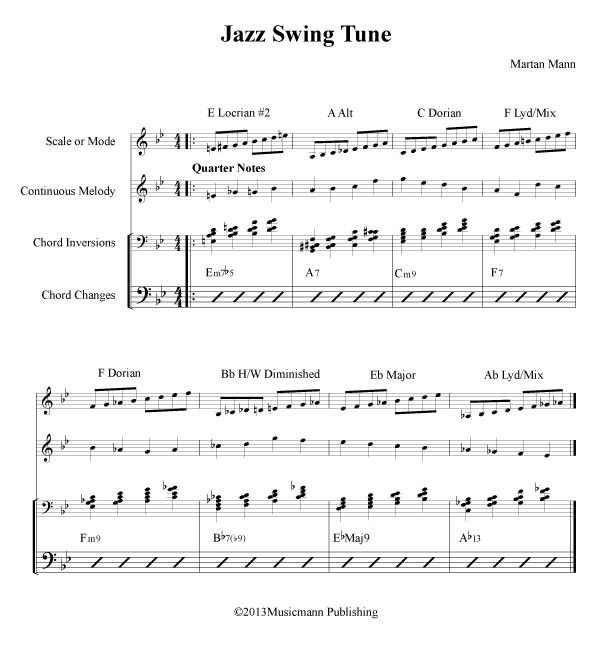
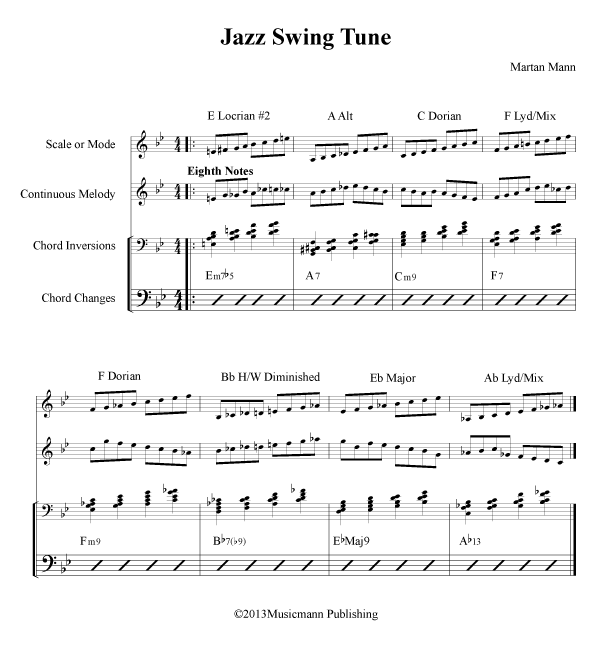
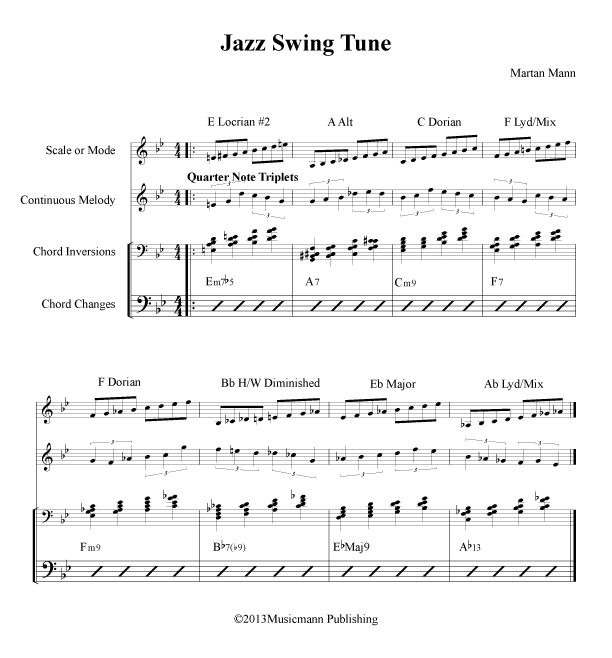
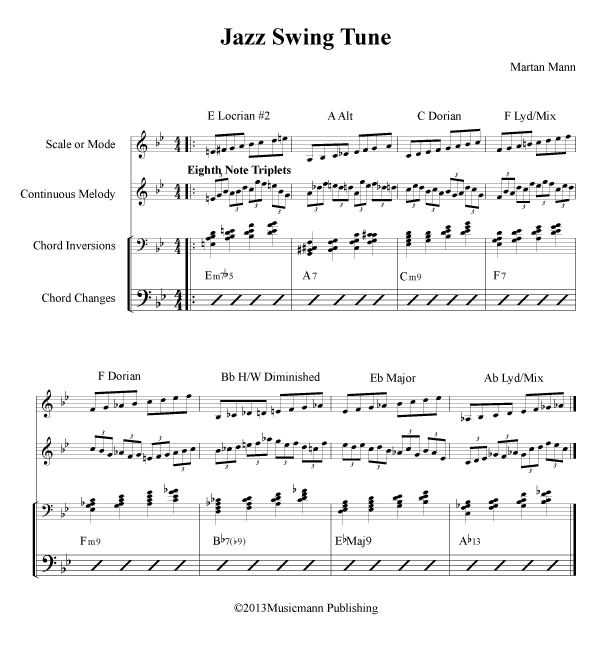 [membership_download_item_pdf link=”http://jsfp.s3.amazonaws.com/JazzSwingTunew-CMEQN.pdf” + target=”_self”]Continuous Melody Exercise – Quarter Notes[/membership_download_item_pdf]
[membership_download_item_pdf link=”http://jsfp.s3.amazonaws.com/JazzSwingTunew-CMEQT.pdf” + target=”_self”]Continuous Melody Exercise – Quarter Note Triplets[/membership_download_item_pdf]
[membership_download_item_pdf link=”http://jsfp.s3.amazonaws.com/JazzSwingTunew-CMEEN.pdf” + target=”_self”]Continuous Melody Exercise – Eighth Notes[/membership_download_item_pdf]
[membership_download_item_pdf link=”http://jsfp.s3.amazonaws.com/JazzSwingTunew-CMEET.pdf” + target=”_self”]Continuous Melody Exercise – Eighth Note Triplets[/membership_download_item_pdf]
[features_box_blue width=”75%” + border=”2px”]Personal Evaluation
[green_tick_2_list width=”100%”]
- I can play through the tune very slowly with Quarter Notes, Eighth Notes, Quarter-note Triplets and Eighth-note Triplets. I always think forward to the first beat of the next measure.
[/green_tick_2_list]
[/features_box_blue]
Stride Groove Bass w/Continuous Melody 17-8-3
[features_box_yellow width=”75%” + border=”2px”]Level: Advanced
After you have mastered the Stride Groove Bass and Chords, start learning the Stride Groove Bass w/Continuous Melody.[/features_box_yellow]
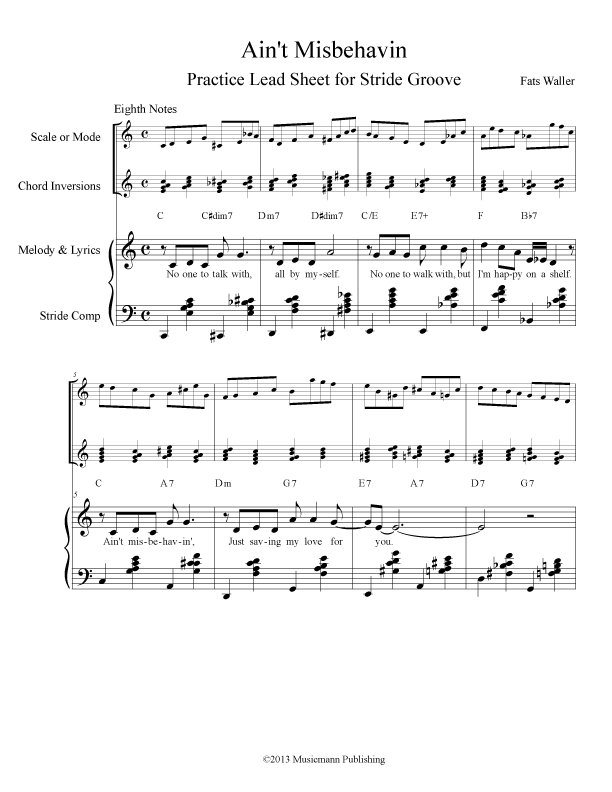
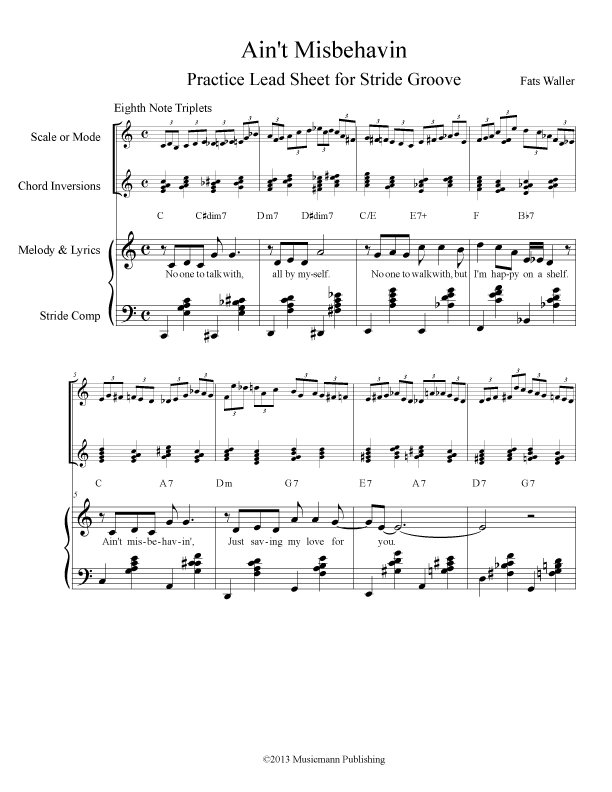
Learning “Ain’t Misbehavin'” with the Continuous Melody Exercise:
- Play the Stride Groove through the tune with the right hand playing Quarter Notes, Eighth Notes, Quarter-note Triplets and Eighth-note Triplets. Start slowly! Start the melody on the second note. Play through the tune.
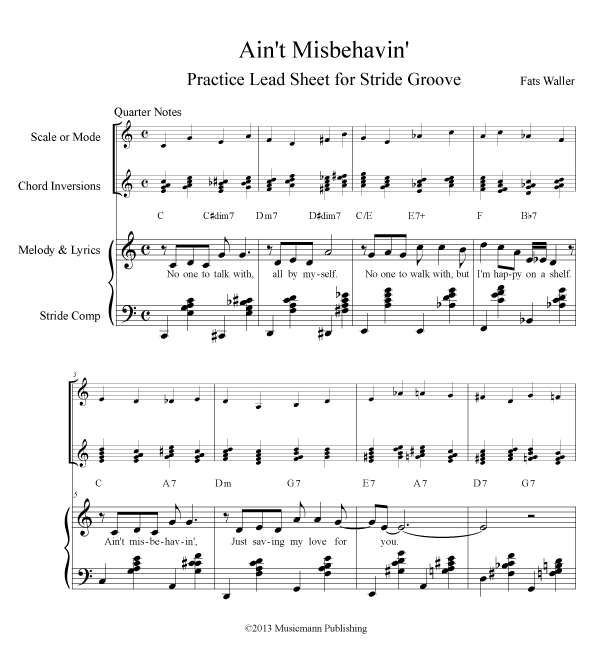
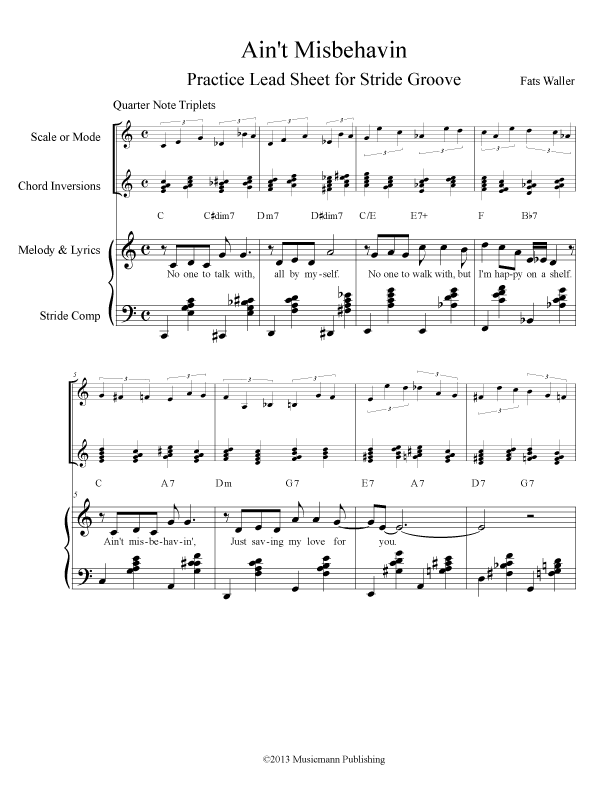
[membership_download_item_pdf link=”http://jsfp.s3.amazonaws.com/Ain’tMisbehavinContMel.pdf” + target=”_self”]Ain’t Misbehavin’ Continuous Melody[/membership_download_item_pdf]
[features_box_blue width=”75%” + border=”2px”]Personal Evaluation
[green_tick_2_list width=”100%”]
I can play the Stride Groove through the tune with the right hand playing the Continuous Melody Exercise using Quarter Notes, Eighth Notes, Quarter-note Triplets and Eighth-note Triplets.
[/green_tick_2_list]
[/features_box_blue]
Jazz Waltz Groove w/Continuous Melody 15-6-4
[features_box_yellow width=”75%” + border=”2px”]Level: Advanced
After you have mastered the Jazz Waltz Groove w/Bass Lines, start learning the Jazz Waltz Groove w/Continuous Melody.[/features_box_yellow]
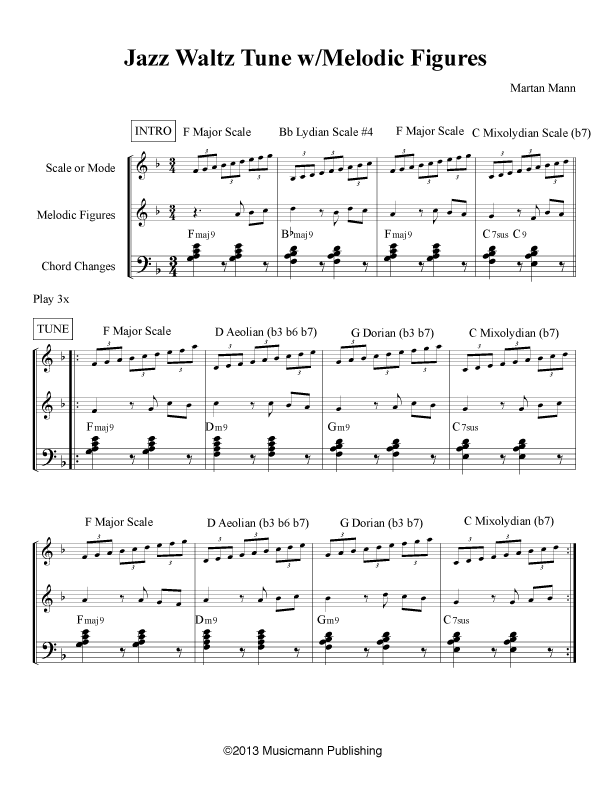
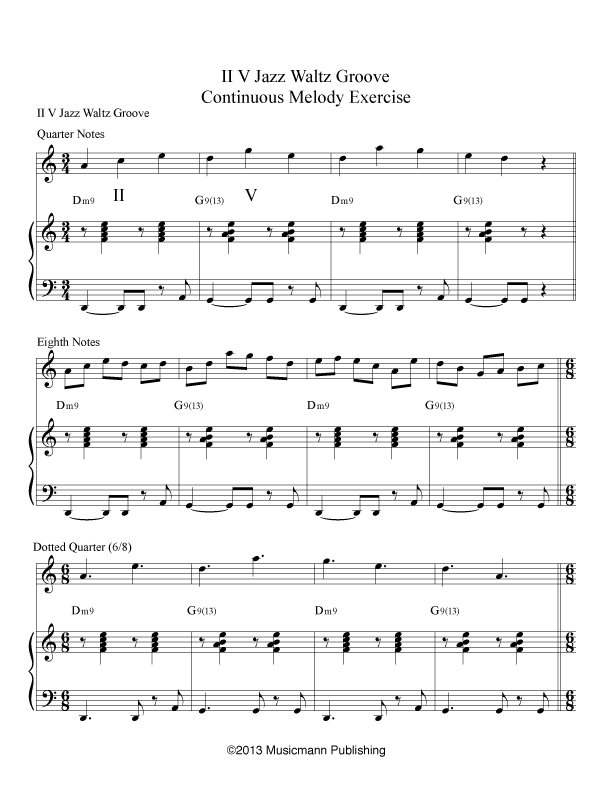
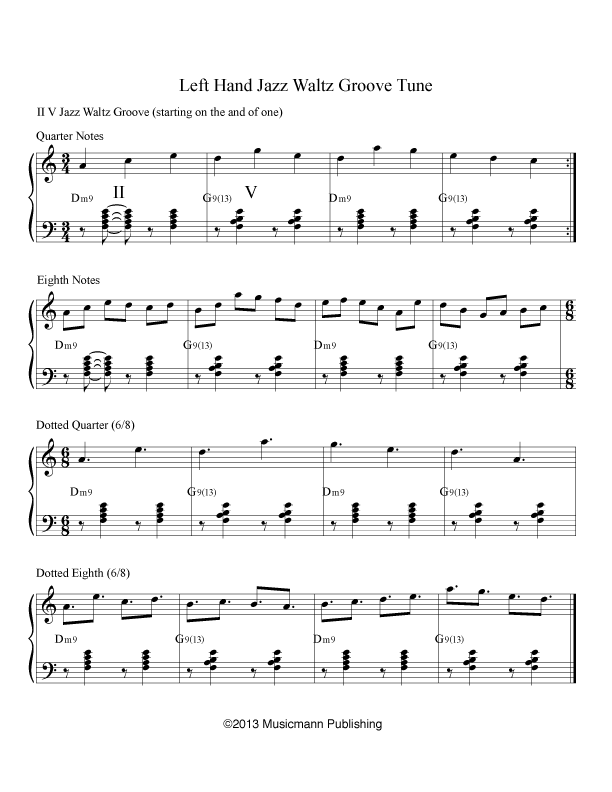
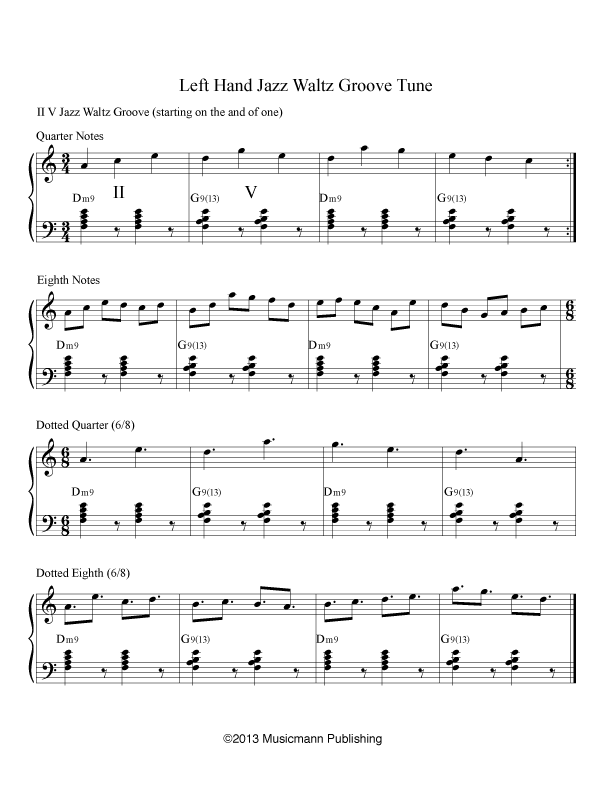
Developing the Jazz Waltz Groove with the Continuous Melody Exercise:
- The purpose of the Continuous Melody Exercise is to create melodic independence from the groove.
- Play or Sing all the time values (Quarter Notes, Eighth Notes, Quarter-note Triplets and Eighth-note Triplets.
- Think in 6/8 time. (3 against 2)
- Put the metronome on 80 and count the time values out loud while playing the Jazz Waltz Groove.
- Play the JW Groove in the left hand and play all the time values using melody in the right hand.
[membership_download_item_pdf link=”http://jsfp.s3.amazonaws.com/JazzWaltzCMEA.pdf” + target=”_self”]Jazz Waltz Groove w/Continuous Melody Page 1[/membership_download_item_pdf]
[membership_download_item_pdf link=”http://jsfp.s3.amazonaws.com/JazzWaltzCMEB.pdf” + target=”_self”]Jazz Waltz Groove w/Continuous Melody Page 2[/membership_download_item_pdf]
[membership_download_item_pdf link=”http://jsfp.s3.amazonaws.com/LHJazzWaltzCMEA.pdf” + target=”_self”]Jazz Waltz Groove w/Left Hand Continuous Melody Page 1[/membership_download_item_pdf]
[membership_download_item_pdf link=”http://jsfp.s3.amazonaws.com/LHJazzWaltzCMEbB.pdf” + target=”_self”]Jazz Waltz Groove w/Left Hand Continuous Melody Page 2[/membership_download_item_pdf]
[features_box_blue width=”75%” + border=”2px”]Personal Evaluation
[green_tick_2_list width=”100%”]
- I understand that the purpose of the Continuous Melody Exercise is to create melodic independence from the groove.
- I can play or sing all the time values (Quarter Notes, Eighth Notes, Quarter-note Triplets and Eighth-note Triplets.
- I can put the metronome on 80 and count the time values out loud while playing the Jazz Waltz Groove.
- I can play the JW Groove in the left hand and play all the time values using melody in the right hand.
[/green_tick_2_list]
[/features_box_blue]
Bossa Nova w/Turnaround – Continuous Melody 14-2-3
[features_box_yellow width=”75%” + border=”2px”]Level: Advanced
After you have studied the Bossa Nova w/Turnaround Counting, start studying Bossa Nova w/Turnaround – Continuous Melody. [/features_box_yellow]
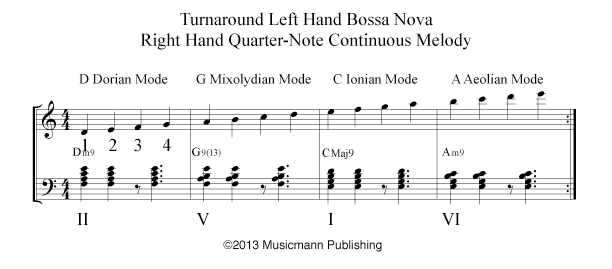
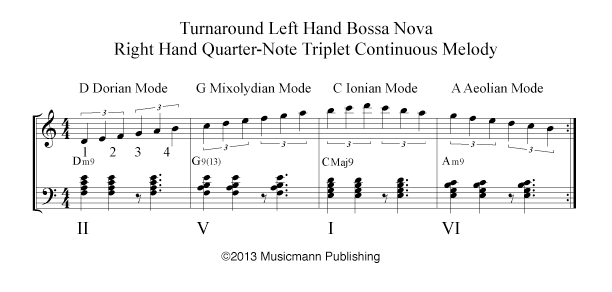
Practicing the Continuous Melody Exercise with the BN Groove Turnaround:
- Start by playing the BN Groove Turnaround(s) with the left hand only.
- When you feel comfortable, start playing continuous melodies using only quarter notes . . . then use quarter-note triplets . . . then, eighth notes . . . then, eighth note triplets.
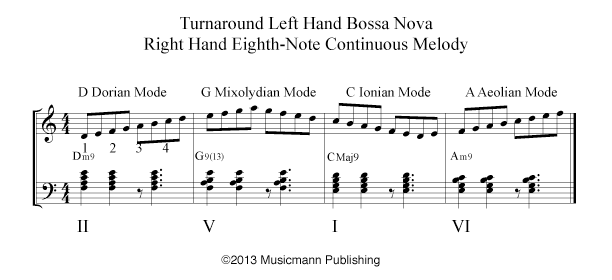
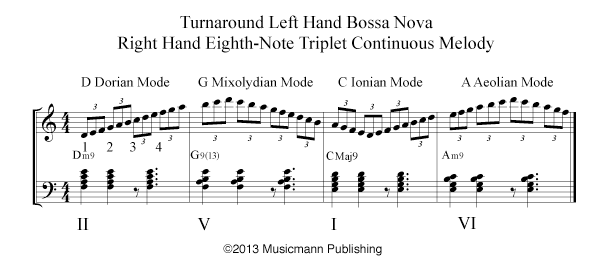
[membership_download_item_pdf link=”http://jsfp.s3.amazonaws.com/LHBossaQuarterTurn.pdf” + target=”_self”]Bossa Turnaround Continuous Melody Quarter Notes[/membership_download_item_pdf]
[membership_download_item_pdf link=”http://jsfp.s3.amazonaws.com/LHBossaQuarterTripTurn.pdf” + target=”_self”]Bossa Turnaround Continuous Melody Quarter Note Triplets[/membership_download_item_pdf]
[membership_download_item_pdf link=”http://jsfp.s3.amazonaws.com/LHBossaEighthTurn.pdf” + target=”_self”]Bossa Turnaround Continuous Melody Eighth Notes[/membership_download_item_pdf]
[membership_download_item_pdf link=”http://jsfp.s3.amazonaws.com/LHBossaEighthTripTurn.pdf” + target=”_self”]Bossa Turnaround Continuous Melody Eighth Note Triplets[/membership_download_item_pdf]
[features_box_blue width=”75%” + border=”2px”]Personal Evaluation
[green_tick_2_list width=”100%”]
- I can comfortably start by playing the BN Groove Turnaround(s) with the left hand only.
- Then, I can comfortably play continuous melodies using only quarter notes . . . then use quarter-note triplets . . . then, eighth notes . . . then, eighth note triplets.
[/green_tick_2_list]
[/features_box_blue]
Bossa Nova Continuous Melody 14-1-4
[features_box_yellow width=”75%” + border=”2px”]Level: Advanced
After you have studied the Bossa Nova Melodic Counting, start studying Bossa Nova Continuous Melody. [/features_box_yellow]
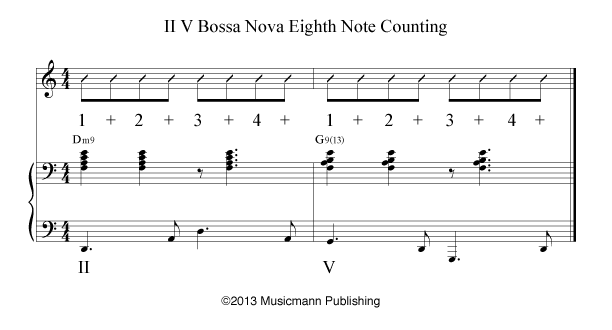
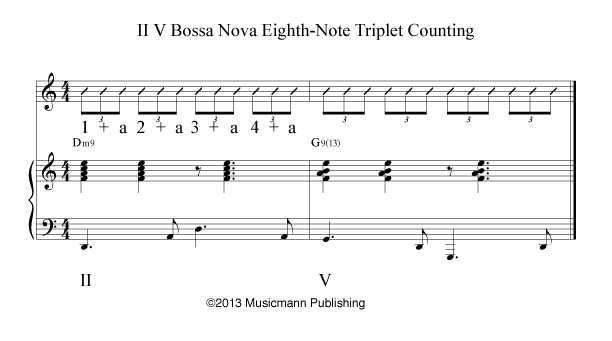
This is a beginning exercise in creating independent right melodies over the BN Groove.
Start by playing the left hand with BN Groove using the II V. Play for awhile . . . feel the groove.
Then start playing a continuous melody over the BN Groove. Play first with Quarter Notes . . . then, Eighth Notes . . . then, Quarter-note Triplets . . . and then, Eighth-note Triplets.
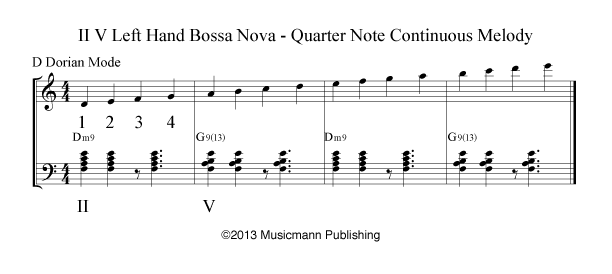
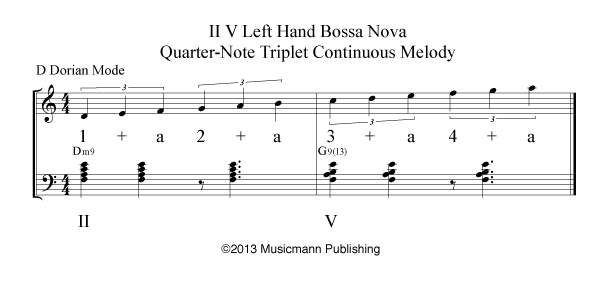
[membership_download_item_pdf link=”http://jsfp.s3.amazonaws.com/LHBossaQuarter.pdf” + target=”_self”]Continuous Melody Quarter Notes w/Left Hand Bossa Nova[/membership_download_item_pdf]
[membership_download_item_pdf link=”http://jsfp.s3.amazonaws.com/LHBossaQuarTrip.pdf” + target=”_self”]Continuous Melody Quarter Note Triplets w/Left Hand Bossa Nova[/membership_download_item_pdf]
[membership_download_item_pdf link=”http://jsfp.s3.amazonaws.com/LHBossaEighth.pdf” + target=”_self”]Continuous Melody Eighth Notes w/Left Hand Bossa Nova[/membership_download_item_pdf]
[membership_download_item_pdf link=”http://jsfp.s3.amazonaws.com/LHBossaEighthTrip.pdf” + target=”_self”]Continuous Melody Eighth Note Triplets w/Left Hand Bossa Nova[/membership_download_item_pdf]
[features_box_blue width=”75%” + border=”2px”]Personal Evaluation
[green_tick_2_list width=”100%”]
- I can quickly and easily play the Bossa Nova in the left hand and the Continuous Melody Exercise in the right hand.
- I can play this in all keys.
[/green_tick_2_list]
[/features_box_blue]
Question and Answer Minor 7-8
[features_box_yellow width=”75%” + border=”2px”]Level: Intermediate
Study Question and Answer Minor after studying the Question & Answer I IV V I Chord Changes.[/features_box_yellow]
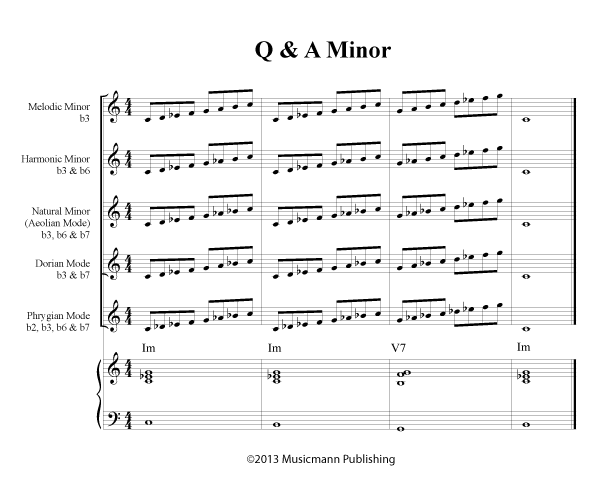
To play the Im IVm V7 Im Q & A – first, study various minor scales and minor-type modes. For instance: Melodic (b3), Natural b3, b6 & b7), & Harmonic Minor (b3 & b6). Also use the Dorian (b3 & b7) and Phrygian (b2 b3 b6 b7) Modes. Practice and familiarize yourself with these scales first.
Then, make melodies using your ear. If you play the Bb . . . then avoid the B natural. If you play the Ab . . . then avoid the A natural. Always use the flatted third. You often use the harmonic minor scale from the I chord when playing melodies over the V7 chord.
[membership_download_item_pdf link=”http://jsfp.s3.amazonaws.com/Q-AMinor.pdf” + target=”_self”]Question and Answer Minor[/membership_download_item_pdf]
[features_box_blue width=”75%” + border=”2px”]Personal Evaluation
[green_tick_2_list width=”100%”]
- I have familiarized myself with the minor modes and scales.
- I have created minor melodies over the Im IVm V7 Im chord progression (in all keys).
[/green_tick_2_list]
[/features_box_blue]
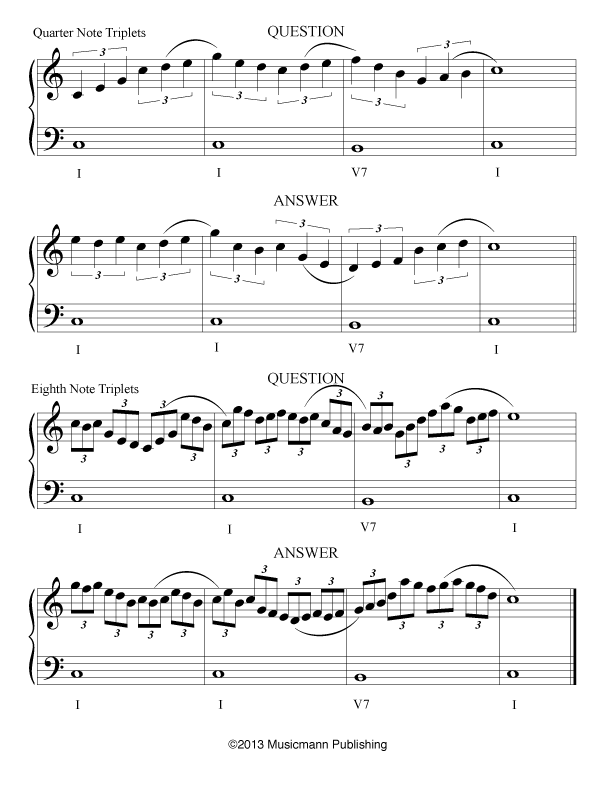
Question and Answer Continuous Melody 7-1
[features_box_yellow width=”75%” + border=”2px”]Level: Intermediate
Study Question and Answer Continuous Melody after studying the V7 to I Introduction.[/features_box_yellow]
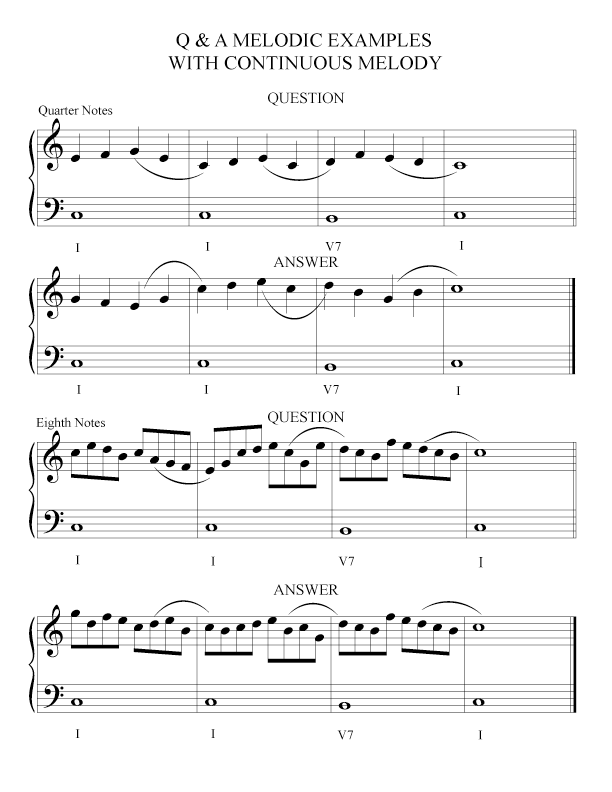
I like to use the Continuous Melody Exercise to develop a flow of ideas. The main intent is to play continuously, thinking forward to new destination notes. In addition, the Continuous Melody Exercise is valuable to learn to think in “melodic rhythms”. In other words, when you think of a melodic idea . . . you are first aware of the rhythm of the lick. After that, you can add the notes. To do this, you have to be totally conversant with all the basic rhythmic values: quarter notes, quarter-note triplets, eighth notes and eighth-note triplets (and sixteenths, if you can).
I use the Continuous Melody Exercise to practice melodies over many grooves . . . and to learn tunes.
[membership_download_item_pdf link=”http://jsfp.s3.amazonaws.com/Q-AContMelA.pdf” + target=”_self”]Question and Answer Continuous Melody Page 1[/membership_download_item_pdf]
[membership_download_item_pdf link=”http://jsfp.s3.amazonaws.com/Q-AContMelBx.pdf” + target=”_self”]Question and Answer Continuous Melody Page 2[/membership_download_item_pdf]
[features_box_blue width=”75%” + border=”2px”]Personal Evaluation
[green_tick_2_list width=”100%”]
- I can play quarter note, eighth note, quarter-note triplets and eighth-note triplets using Question and Answer Patterns in all keys.
- I can easily vary the Continuous Melody rhythms.
[/green_tick_2_list]
[/features_box_blue]