Question and Answer Minor 7-8

Question and Answer Minor 7-8

[features_box_yellow width=”75%” + border=”2px”]Level:  Intermediate

Study Question and Answer Minor after studying the Question & Answer I IV V I Chord Changes.[/features_box_yellow]
video
play-sharp-fill

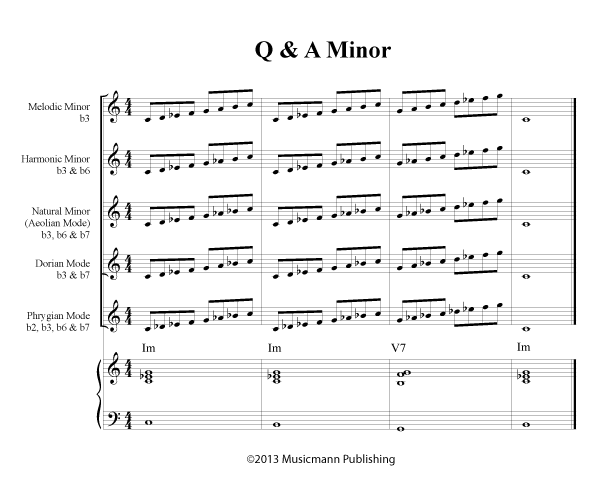
To play the Im IVm V7 Im Q & A – first, study various minor scales and minor-type modes.  For instance:  Melodic (b3), Natural b3, b6 & b7), & Harmonic Minor (b3 & b6).  Also use the Dorian (b3 & b7) and Phrygian (b2 b3 b6 b7) Modes.  Practice and familiarize yourself with these scales first.

Then, make melodies using your ear.  If you play the Bb . . . then avoid the B natural.  If you play the Ab . . . then avoid the A natural.  Always use the flatted third.  You often use the harmonic minor scale from the I chord when playing melodies over the V7 chord.
Q-AMinor

[membership_download_item_pdf link=”http://jsfp.s3.amazonaws.com/Q-AMinor.pdf” + target=”_self”]Question and Answer Minor[/membership_download_item_pdf]

[features_box_blue width=”75%” + border=”2px”]Personal Evaluation

[green_tick_2_list width=”100%”]

  • I have familiarized myself with the minor modes and scales.
  • I have created minor melodies over the Im IVm V7 Im chord progression (in all keys).
[/green_tick_2_list]

[/features_box_blue]

Question and Answer I IV V I Chord Changes 7-7

Question and Answer I IV V I Chord Changes 7-7

[features_box_yellow width=”75%” + border=”2px”]Level:  Intermediate

Study Question and Answer I IV V I after studying the Question & Answer Chord Changes.[/features_box_yellow]

video
play-sharp-fill

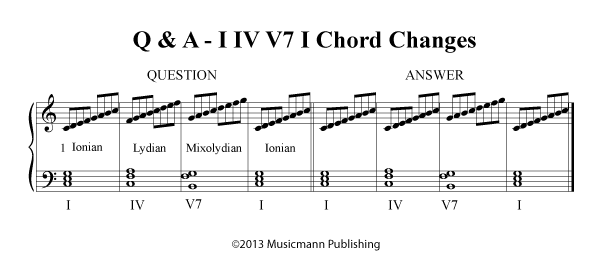
Now, practice Q & A with the I IV V7 I progression.  Start by practicing the Ionian Mode (Major Scale), Lydian Mode (#4) (for the IV chord and Mixolydian Mode (b7) (for the V chord).   Then, play a single note for the bass and single note for the melody.  Then, add in tones.  Then, play modally.  Take this step-by-step.

Q-ACh1451

[membership_download_item_pdf link=”http://jsfp.s3.amazonaws.com/Q-ACh1451.pdf” + target=”_self”]Question and Answer I IV V I Chord Changes[/membership_download_item_pdf]

[features_box_blue width=”75%” + border=”2px”]Personal Evaluation

[green_tick_2_list width=”100%”]

  • I have practiced the Ionian, Lydian and Mixolydian Modes.
  • I have played Q & A with a single note in the bass and single note in the melody.
  • I have then created Added Tones.
  • I can now play I IV V7 I modally.
[/green_tick_2_list]

[/features_box_blue]

Question and Answer Chord Changes 7-6

Question and Answer Chord Changes 7-6

[features_box_yellow width=”75%” + border=”2px”]Level:  Intermediate

Study Question and Answer Chord Changes after studying the Modal Exercise.[/features_box_yellow]

video
play-sharp-fill

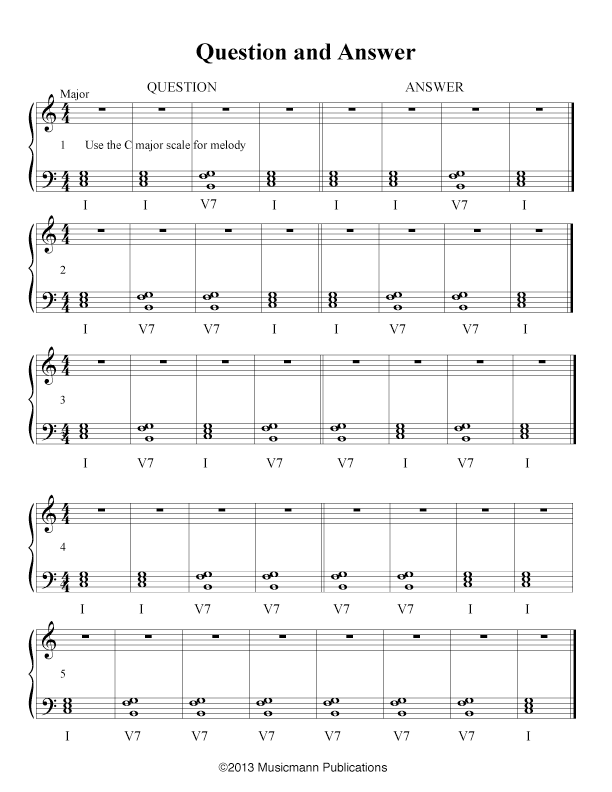
When you change the chord patterns – you are “forced” to change your melodies accordingly.  Use different chord patterns in your practice.  Once you have practiced the sample chord patterns . . . make up your own.  You can also take the chord pattern from any “Question” and mix it with the chord pattern from any “Answer”.  Of course . . . don’t change the chord pattern once you have chosen it.Q-AChPatterns

[membership_download_item_pdf link=”http://jsfp.s3.amazonaws.com/Q-AChPatterns.pdf” + target=”_self”]Question & Answer Chord Changes[/membership_download_item_pdf]

[features_box_blue width=”75%” + border=”2px”]Personal Evaluation

[green_tick_2_list width=”100%”]

  • I practice playing Question and Answer Sample Chord Patterns in all keys.
  • I have mixed the “Question” chord patterns with the “Answer” chord patterns.
[/green_tick_2_list]

[/features_box_blue]


Question and Answer Added Tones 7-4

Question and Answer Added Tones 7-4

[features_box_yellow width=”75%” + border=”2px”]Level:  Intermediate

Study Question and Answer Added tones after studying the V7 to I Accompaniments.[/features_box_yellow]

video
play-sharp-fill

We started Q & A by playing simply a single bass note and single melody note.  Now, use your “ears” to add in additional tones.  They can be chord tones, suspended tones, thirds, sixths, etc.  You can also move the bass line to another chord tone, such as the third.  After you have practiced adding in a single extra note (that would give you three notes) . . . then, use “open voicings” and add in additional tones.  (Open Voicings will be discussed in another lesson.)

Q-AChPatterns

[membership_download_item_pdf link=”http://jsfp.s3.amazonaws.com/Q-AChPatterns.pdf” + target=”_self”]Question and Answer Chord Changes[/membership_download_item_pdf]

[features_box_blue width=”75%” + border=”2px”]Personal Evaluation

[green_tick_2_list width=”100%”]

  • I have practiced using Added Tones in Question and Answer in all keys.
  • I have added in extra tones – ie:  suspended tones, four tones, five tones, etc.
  • Of course, all melodies move forward.
[/green_tick_2_list]

[/features_box_blue]

Question and Answer Accompaniments 7-3

Question and Answer Accompaniments 7-3

[features_box_yellow width=”75%” + border=”2px”]Level:  Intermediate

Study Question and Answer Accompaniments after studying the V7 to I Syncopated Melody.[/features_box_yellow]

video
play-sharp-fill

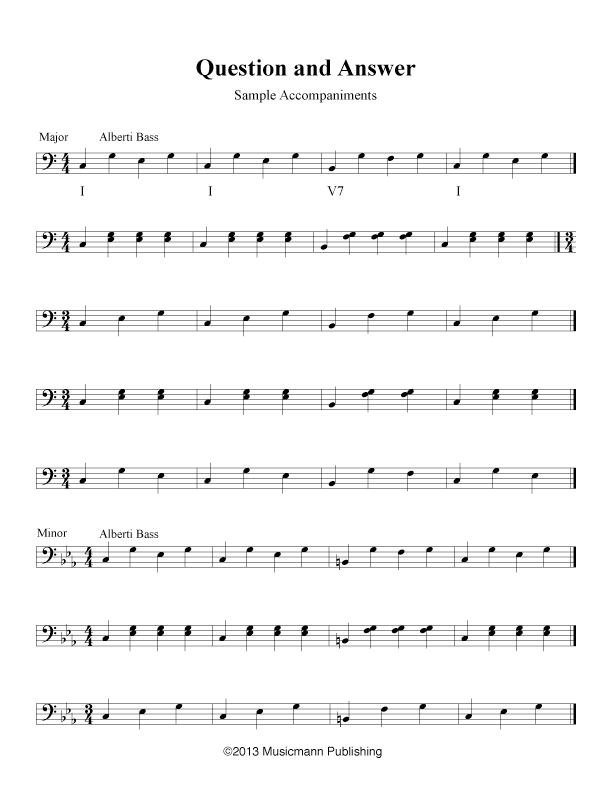
The purpose of these accompaniment patterns is to keep the music moving forward.  Practice all the sample accompaniments and make up your own.  Keep them simple and easy.  Then, have fun making up simple melodic phrases over the accompaniment patterns.   The accompaniment patterns can be in different rhythms, ie:  2/4, 3/4, 4/4, 5/4, etc.  Play in all tempos and in different keys.

Below are some possible accompaniments.  Experiment with your own accompaniment patterns.

Q-Aaccomp

[membership_download_item_pdf link=”http://jsfp.s3.amazonaws.com/Q-Aaccomp.pdf” + target=”_self”]Question and Answer Accompaniments[/membership_download_item_pdf]

[features_box_blue width=”75%” + border=”2px”]Personal Evaluation

[green_tick_2_list width=”100%”]

  • I can play all the different Accompaniment Patterns using Question and Answer Patterns in all keys.
[/green_tick_2_list]

[/features_box_blue]