Five Finger Exercise Part 2 2-3

Five Finger Exercise Part 2  2-3

[features_box_yellow width=”75%” + border=”2px”]Level:  Beginning

This extends the Five Finger Exercise to minor, diminished and augmented.  Practice this after learning the major five finger exercise.  Learn this completely.[/features_box_yellow]

video
play-sharp-fill

Now play the five finger position in minor (b3), augmented (#5) and diminished (b3 & b5).  Then play the triad inversions in each.  FYI: we usually we don’t play inversions in diminished triads.  Later – you will  play the inversions in diminished sevenths.

[membership_download_item_pdf link=”http://jsfp.s3.amazonaws.com/5 Finger Position1.pdf” + target=”_self”]Five Finger Positions[/membership_download_item_pdf]

[features_box_blue width=”75%” + border=”2px”]Personal Evaluation

[green_tick_2_list width=”100%”]

  • I can easily find the Minor, Diminished and Augmented Five Fingers intervals in all keys (starting on any note).
  • I am practicing playing the Five Finger Position using weight transfer and striving for a good tone.
  • I am able to increase speed playing up and down without increasing tension.
  • I am analyzing the structures of the Minor, Diminished and Augmented Triad inversions.
  • I am practicing playing the Minor and Augmented Triad inversions using the “Think Before Moving Exercise”
[/green_tick_2_list]

[/features_box_blue]


Playing Random Scales and Arpeggios 1-7

Playing Random Scales and Arpeggios 1-7

[features_box_yellow width=”75%” + border=”2px”]Level:  Intermediate and Advanced

This exercise should be practiced after you have mastered the Major Scales.  This is a fun way to experience scales and arpeggios in unexpected musical ways.  The fingerings are fresh and new . . . as are the sounds you will be hearing.  This is a great preliminary way to develop creative soloing skills.  I suggest that you play to a metronome.  Start slowly and increase speed as your competency improves. [/features_box_yellow]

video
play-sharp-fill

Here is an interesting exercise using scales and arpeggios.  Play any scales up and down, changing direction at any time.  Start with one hand and later progress to playing with both hands in octaves.  You can also play random arpeggios.

One of the benefits of this practice is that it helps to develop the ability to develop fingering “on-the-fly”.  It is important to develop an effective and easy approach to creating fingering which works.  Fingering is an important element in improvisation and sight reading.

Try to put your thumbs always on a white key.  Play to a metronome, first slowly . . . then at a quicker pace.

Have fun with this.

[features_box_blue width=”75%” + border=”2px”]Personal Evaluation[green_tick_2_list width=”100%”]

  • I have mastered the basic scales before applying parameters.
  • I can apply different parameters to the right and left hand.
  • I can “mix and match” parameters.
  • I am always discovering new parameters to keep scale practice fresh.

[/green_tick_2_list][/features_box_blue]

Playing Scales and Arpeggios with Musical Parameters 1-6

Playing Scales and Arpeggios with Musical Parameters 1-6

[features_box_yellow width=”75%” + border=”2px”]Level:  Intermediate

This is a way to add musicality to your scales and arpeggios . . . and all your playing.  I suggest that you thoroughly learn the fingerings for the major scales and arpeggios before using parameters.  [/features_box_yellow]

video
play-sharp-fill

Once you have learned to play a scale with both hands . . . you can increase your musical ability by playing the scales using musical parameters.  Below are some parameters.  You can easily create more.  This adds variety, musicality and . . . fun to your scale and arpeggio practice.

Musical parameters for scale and arpeggio practice:

  • Dynamics
  • Phrasing
  • Tempo, Rhythm & Meter
  • Rhythm Independence
  • Direction
  • Independence

Add these (and other) parameters to your daily practice.  Enjoy!

[features_box_blue width=”75%” + border=”2px”]Personal Evaluation[green_tick_2_list width=”100%”]

  • I have mastered the basic scales before applying parameters.
  • I can apply different parameters to the right and left hand.
  • I can “mix and match” parameters.
  • I am always discovering new parameters to keep scale practice fresh.

[/green_tick_2_list][/features_box_blue]
Minor Scales 1-5

The Minor Scales 1-5

[features_box_yellow width=”75%” + border=”2px”]Level:  Intermediate

I suggest that you do not start studying the minor scales until the major scales have been completely learned.  Once the major scales are learned, the minor scales will be much easier to master.  All the fingerings for the minor scales are the same as for the major scales . . . except in the left hand for Bb and Eb (those minor scales start with the second finger).[/features_box_yellow]

video
play-sharp-fill

When analyzing the minor scales . . . all the minor scales flat the third.  The difference between the minor scales all exist in the top four notes of the scale (called a tetrachord).

Here are the minor scales:

  • Melodic Minor (b3).  The top tetrachord is major.  It should be noted that classical theory states that the melodic minor scale consists of a melodic minor going up and natural minor (b3, b6 & b7) on the way down.  In jazz theory, most jazz players use the melodic minor scale up and down.
  • Harmonic Minor (b3 & b6)
  • Natural Minor (b3, b6 & b7).  This is also known as the Aeolian Mode (6-6) and Relative Minor.
  • Dorian Mode (b3 & b7) (2-2)  This is not technically a minor scale . . . however it does use the flatted 3rd and sounds minor.  I use it in practice because it helps to hear the subtle difference between all the minor scales.  Remember . . . the difference all exists in the upper tetrachord.  I’ll be discussing all the modes in future lessons.

[membership_download_item_pdf link=”http://jsfp.s3.amazonaws.com/Scales Exercise  – Two Octaves.pdf” + target=”_self”]Minor Scales Exercise[/membership_download_item_pdf]

[features_box_blue width=”75%” + border=”2px”]Personal Evaluation[green_tick_2_list width=”100%”]

  • I have mastered the Major Scales before mastering the Minor Scales.
  • I can play the Minor Scales with rhythmic evenness.
  • I can play the Minor Scales with a beautiful legato touch.
  • My fingerings are automatic.
  • Practicing Minor Scales is part of my daily practice.

[/green_tick_2_list][/features_box_blue]
Practicing Major Triad Arpeggios 1-4

Practicing Major Triad Arpeggios 1-4

[features_box_yellow width=”75%” + border=”2px”]Level:  Beginning

Start practicing arpeggios once you have begun studying “The Five Finger Exercise” and playing inversions of triads.  The practice is the same as for learning scales.  Play in duple meter (two octaves), triple meter (three octaves) and 16th notes (four octaves).  Then – practice with a metronome. The goal is to play comfortably, evenly and legato, with a beautiful tone.

Once you have perfected playing the triad arpeggios,  practice using musical parameters.

Once you can play arpeggios as triads (under Basic Theory) . . . then, begin practicing seventh chords (upcoming lesson).[/features_box_yellow]

video
play-sharp-fill
Practicing Major Triad Arpeggios

Practice all the “white-key” arpeggios.  The bottom note is on a white key. For instance, place your right hand thumb on C.  Play up and down the white-key major triad arpeggio using the fingering 1-2-3-1-2-3-5 (two octaves).   Then play the arpeggio with the left hand using the fingering 5-3-2-1-3-2-1.   Then, play the hands together.  (See Video )

Then, practice all the “black-key” arpeggios (except Gb, which uses the white-key fingering).  The starting note is a black key.  The fingering in the right hand is 2124 124.  Fingering for the left hand is 2142 142.

Once you can easily . . . and evenly play arpeggios, practice with a metronome.  Start slowly.  Play two octaves in eighth-note duple meter, with the accent on every other beat.  Then play three octaves with eighth-note triplets.  Then play four octaves in sixteenth notes.

Once you play arpeggios in major triads, then practice in minor triads and augmented triads.  (It is not recommended to play diminished triads in arpeggios.  Rather, play arpeggios as a diminished seventh.)

A couple of things to remember when practicing arpeggios:

  • The spaces between the keys are farther then when playing scales.  Gently push the arms in the direction that you are moving.  This places the balanced weight of each finger directly over each key.  Try not to touch the sides of the white keys and place your finger securely on the center of the black keys.
  • You have to pivot your wrist to allow the thumb to move under the hand to the next note.  This would be up in the case of the right hand and down in the case of the left hand.  When coming down in the right hand and up in the left hand, you collapse the thumb.

[membership_download_item_pdf link=”http://jsfp.s3.amazonaws.com/Arps.pdf”]Practicing Arpeggios[/membership_download_item_pdf]

[features_box_blue width=”75%” + border=”2px”]Personal Evaluation[green_tick_2_list width=”100%”]

  • I can play all the Arpeggios comfortably to a metronome (continually increase the tempo).
  • I can play all the Major, Minor and Augmented Arpeggios two octaves in duple meter, three octaves in triple meter and four octaves in sixteenth notes.
  • My Arpeggios are automatic, even and played with a beautiful, legato tone.

[/green_tick_2_list][/features_box_blue]
Minor Scale Structures 3-3

Minor Scale Structures 3-3

[features_box_yellow width=”75%” + border=”2px”]Level:  Intermediate/Advanced

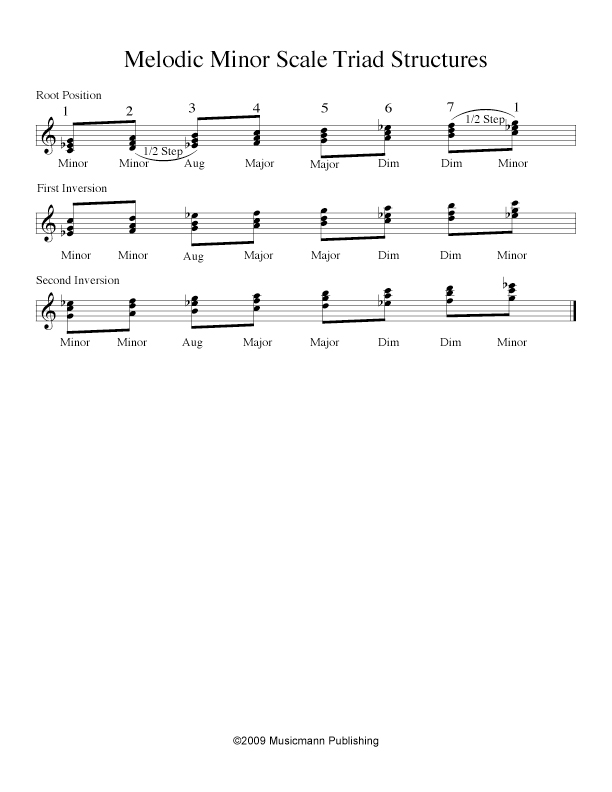
This is an excellent way to deeply learn the melodic and harmonic minor scales, it’s triads and the triad inversions.  A melodic minor scale (major scale with a b3) has seven notes (with half steps at 2&3 and 7&8).   If you number the notes in order, the triad types are as follows:  minor, diminished, augmented, minor, major, major, diminished.  Learn the melodic minor triads in all keys.  Then play the inversions up the melodic minor scale in all keys.

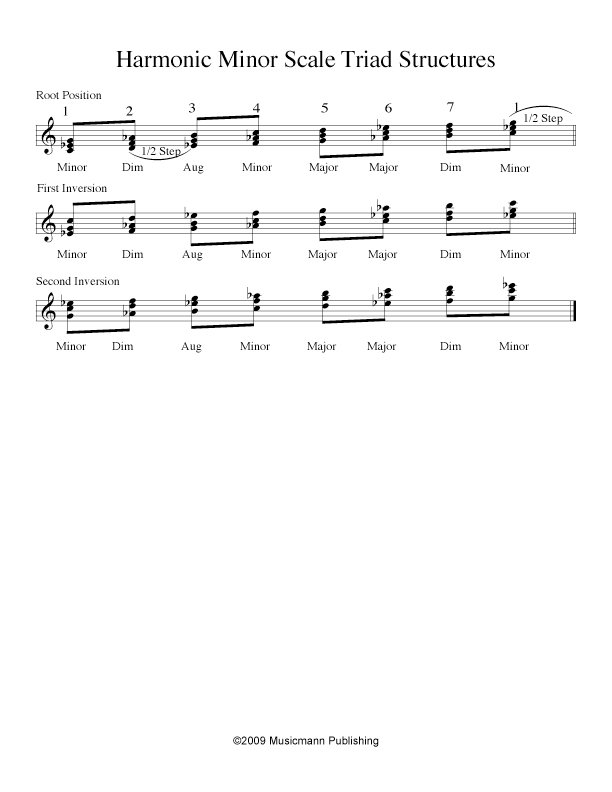
A harmonic minor scale (major scale with a b3 & b6) has seven notes (with half steps at 2&3, 5&6 and 7&8).   If you number the notes in order, the triad types are as follows:  minor, minor, augmented, major, major, diminished, diminished.  Learn the harmonic minor triads in all keys.  Then play the inversions up the melodic minor scale in all keys.

Learn the major chord structures first . . . followed by the melodic minor chord structures . . . and then the harmonic minor structures.  This is a long-term study.  Keep at it.

[/features_box_yellow]

video
play-sharp-fill

Scalew-melminortriads

Scalew-harmminortriads

[membership_download_item_pdf link=”http://jsfp.s3.amazonaws.com/Scalew-melminortriads.pdf” + target=”_self”]Melodic Minor Scale Structures[/membership_download_item_pdf]

[membership_download_item_pdf link=”http://jsfp.s3.amazonaws.com/Scalew-harmminortriads.pdf” + target=”_self”]Harmonic Minor Scale Structures[/membership_download_item_pdf]


[features_box_blue width=”75%” + border=”2px”]Personal Evaluation

[green_tick_2_list width=”100%”]

  • I can quickly and easily play all the Triads up the Melodic Minor Scale.
  • I can quickly and easily play all the Triads up the Harmonic Minor Scale.
[/green_tick_2_list]

[/features_box_blue]

Spelling Scales 1-1

Spelling Scales 1-1

[features_box_yellow width=”75%” + border=”2px”]Beginning Level.

Study this lesson before you start practicing scales.  This is also important knowledge to know before you begin studying music theory.[/features_box_yellow]

It is recommended that you are able to quickly spell the major scales (major for now, minor scales, later). This helps in giving you a basis of harmonic analysis. The following is a method that I learned from my piano teacher, Frederic Saatman years ago. lt is easy and logical. To understand this method of spelling scales you should first understand that all major scales have a half step between steps 3 & 4 and 7 & 8.  Every major scale has seven notes.

It is important to note that this formula or template allows you to start on any note and alphabetically spell up a major scale. You must, however, follow the exact relation of half steps to whole steps (half step between steps 3 & 4 and 7 & 8). Now you are learning to think in numbers (half steps and whole steps) instead of letters, which is an essential aspect of improvisation.

Here is how it works:

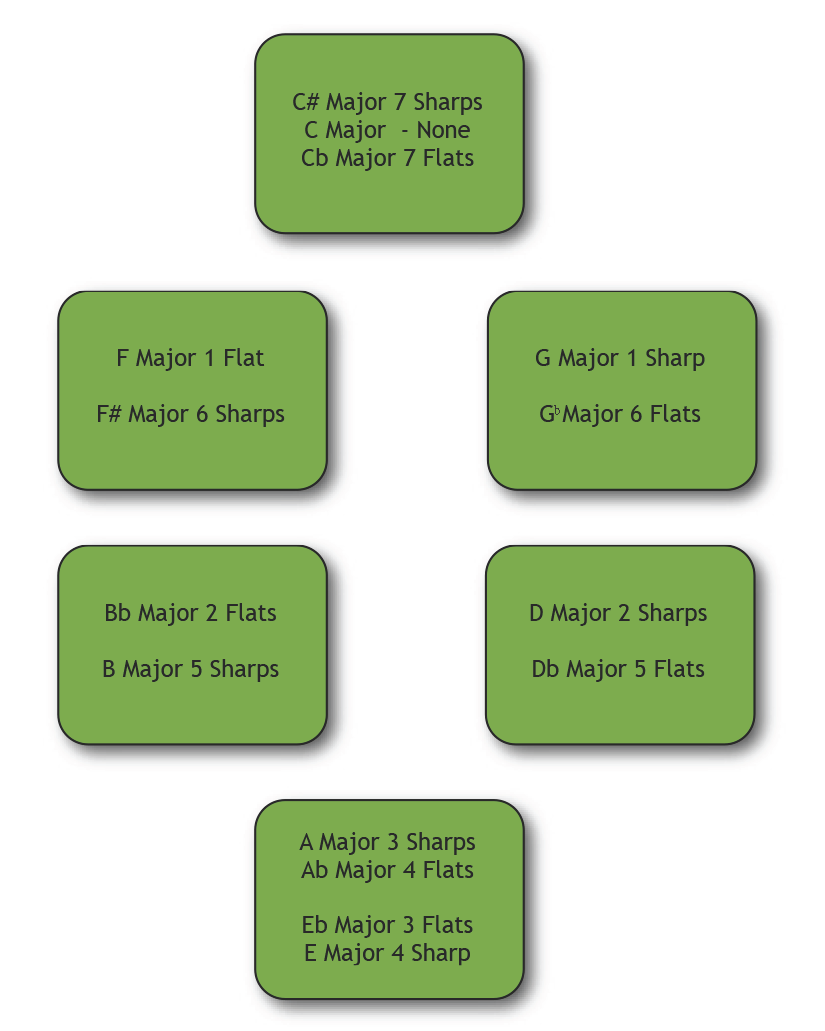
The major scale of C has seven notes (with half steps between 3 & 4 and 7 & 8).  There are no sharps or flats.  So . . . spell up the scale  (up the alphabet) CDEFGABC.  If you want to spell the scale of C# . . . simply add a sharp after each letter:  C#, D#, E# etc.  For C flat major, simply add a flat after each letter.  So, you have either 0 or 7 (C has 0 flats or sharps and C# has seven sharps).

[membership_download_item_pdf link=”http://jsfp.s3.amazonaws.com/Scale-Spelling1.pdf” + target=”_self”]C/C#/Cb Major Scales[/membership_download_item_pdf]

Now – this can be applied to other scales.  For instance:  the scale of G major has one sharp, G (F#).  The scale of G flat, has six flats (adds up to seven) – every note is flatted – except F.  The scale of F has one flat (Bb) . . . the scale of F# has 6 sharps – every note is sharped – except B.  You can apply this to all scales.

[membership_download_item_pdf link=”http://jsfp.s3.amazonaws.com/Scale-SingleMajorGGb1.pdf” + target=”_self”]G & Gb Major Scale[/membership_download_item_pdf][membership_download_item_pdf link=”http://jsfp.s3.amazonaws.com/Scale-SingleMajorFFsharp1.pdf” + target=”_self”]F & F# Major Scale[/membership_download_item_pdf]

[headline_cufon_font_centered color=”#000000″]Spelling Scales Chart[/headline_cufon_font_centered]SpScChart1


[features_box_blue width=”75%” + border=”2px”]Personal Evaluation[green_tick_2_list width=”100%”]

  • I have studied Spelling Scales and can now quickly and easily spell any Major Scale.

[/green_tick_2_list][/features_box_blue]
Practicing Scales 1-2

Practicing Scales 1-2

[features_box_yellow width=”75%” + border=”2px”]Level:  Beginning

Before studying scales, make sure you have studied the “Five Finger Exercise” (in Beginning Theory).  Studying scales is a long-term study.  Start now . . . if you don’t already thoroughly know your scales.  I suggest that you first learn C G D A & E (they have the same fingering for all).  Then, learn Bb Eb Ab & Db (the left hand is a group of 3 & 4).  Then Study Cb (B)  Gb (F#)  & F (the final three scales).

Definitely keep at this until ALL the scales are fluid, effortless and even . . . in all meters.  The fingerings should be automatic.

[/features_box_yellow]

video
play-sharp-fill

It is universally accepted that practicing scales (and arpeggios) is the bedrock of learning an instrument.  Strive to develop rhythmic evenness and a beautiful, fluid, legato touch.  The fingerings must be totally subconscious.  Work on playing scales to a metronome (see video).  As you master scales . . . your playing in general will improve.

In studying jazz improvisation, it is also the foundation of music theory.  It is essential that you continually assimilate new harmonic sounds in your subconscious to expand your creative improvisation.  This is done by mastering new scales.

It is suggested that you start with learning the fingering of a scale in all twelve keys.  Once the scale is learned, you can start the process of developing chord structures within that harmony (explained later).  Then, begin the process of learning all the modes of the scale (explained later).

Of course, this is a long process.  It takes constant practice to develop these “tonalities”.  However, as you progress, your “ears” will develop.  The language of music will available to you.

The most important scales to master are the Major Scales and the Major Scale Modes.  Then work on the Diminished Scales.  Once that is accomplished, work on the Melodic Minor Scale and Harmonic Minor Scale and their modes.

Actually, this process can be extended into many many other scales.  A wonderful source of scales is the Slonimsky Book of Scales.  In addition, there are many jazz books which discuss jazz oriented scales.

I really believe that this is a life-long process.  As an improviser, you are always seeking to place new tonalities into your subconscious.  Enjoy the process.

[membership_download_item_pdf link=”http://jsfp.s3.amazonaws.com/Scales-Major1-TwoOctaves.pdf” + target=”_blank”]Major Scales – Two Octaves C C# Db D[/membership_download_item_pdf]

[membership_download_item_pdf link=”http://jsfp.s3.amazonaws.com/Scales-MajorB – Two Octaves.pdf” + target=”_blank”]Major Scales – Two Octaves Eb E F F#[/membership_download_item_pdf]

[membership_download_item_pdf link=”http://jsfp.s3.amazonaws.com/Scales-Major3-Two Octaves.pdf” + target=”_blank”]Major Scales – Two Octaves Gb G Ab A[/membership_download_item_pdf]

[membership_download_item_pdf link=”http://jsfp.s3.amazonaws.com/Scales-MajorD Two Octaves.pdf”]Major Scales – Two Octaves Bb B Cb[/membership_download_item_pdf]

[membership_download_item_pdf link=”http://jsfp.s3.amazonaws.com/Scales-MelMinor1-Two Octaves.pdf” + target=”_blank”]Melodic Minor Scales – Two Octaves C C# Db[/membership_download_item_pdf]

[membership_download_item_pdf link=”http://jsfp.s3.amazonaws.com/Scales-MelMinor2-Two Octaves.pdf” + target=”_blank”]Melodic Minor Scales – Two Octaves Eb E F F#[/membership_download_item_pdf]

[membership_download_item_pdf link=”http://jsfp.s3.amazonaws.com/Scales-MelMinor3-Two Octaves.pdf” + target=”_blank”]Melodic Minor Scales – Two Octaves Gb G Ab A[/membership_download_item_pdf]

[membership_download_item_pdf link=”http://jsfp.s3.amazonaws.com/Scales-MelMinor4-Two Octaves.pdf” + target=”_blank”]Melodic Minor Scales – Two Octaves Bb B Cb[/membership_download_item_pdf]

[membership_download_item_pdf link=”http://jsfp.s3.amazonaws.com/Scales-HarMinor1a-Two Octaves.pdf” + target=”_blank”]Harmonic Minor Scales – Two Octaves C C# Db D[/membership_download_item_pdf]

[membership_download_item_pdf link=”http://jsfp.s3.amazonaws.com/Scales-HarMinor2a-Two Octaves.pdf” + target=”_blank”]Harmonic Minor Scales – Two Octaves Eb E F F#[/membership_download_item_pdf]

[membership_download_item_pdf link=”http://jsfp.s3.amazonaws.com/Scales-HarMinor3a-Two Octaves.pdf” + target=”_blank”]Harmonic Minor Scales – Two Octaves Gb G Ab A[/membership_download_item_pdf]

[membership_download_item_pdf link=”http://jsfp.s3.amazonaws.com/Scales-HarMinor4a-Two Octaves.pdf” + target=”_blank”]Harmonic Minor Scales – Two Octaves Bb B Cb[/membership_download_item_pdf]

[features_box_blue width=”75%” + border=”2px”]Personal Evaluation[green_tick_2_list width=”100%”]

  • I can play the scales with rhythmic evenness.
  • I can play the scales with a beautiful legato touch.
  • My fingerings are automatic.
  • Practicing scales is part of my daily practice.

[/green_tick_2_list][/features_box_blue]

 

Section 1: Piano Technique

Explanation of Piano Technique

[features_box_yellow width=”75%” + border=”2px”]Beginning Level.

Use this section on technique according to your needs.  It’s always advisable to have a daily regime of piano technique practice.[/features_box_yellow]

I am presenting a very basic set of principles and exercises to develop your jazz piano technique.  At the outset I say that these are my ideas – a collection of thoughts from classical piano teachers and a great deal of my own analysis.

The single most important element of piano technique is to become comfortable with the “key bed” – that it is the bottom of the key.  In development of any instrument – it is most important that you define where the initial sound is created.  In the case of the piano, that is the instant the hammer touches the harp or strings in the piano.  In the case of the piano – you have to project your mind to the hammer and strings, since it is not usually convenient to see the event.

It is most important that you don’t think that the sound of the piano is created by pushing down the keys in front of you.  if you do, you will probably develop a “struck tone” – instead of a “singing tone”.  This is important because . . . literally, the piano can’t sing.  It doesn’t have vocal cords.  The piano can’t ‘bow it’, or ‘blow’ across a reed or vocal cord.  Since the piano can’t literally sing . . . we have to approximate the “singing tone” so that the listener feels that the piano is singing.

Why is this important – especially for jazz?  It’s important because all music is an emotional event.  We want to create that emotional event in the mind and heart of the listener.  Striking the piano is too jarring and distorted to do this.  I believe that one of  the main reasons that we like one pianist over another is largely due to his ability to connect to the listener’s heart, soul and emotion by using the “singing” tone.

In my mind – no one explains this process better than Kenny Werner.  For instance – in his wonderful book, “Effortless Mastery”, Kenny talks about the initial experience of just sitting in front of the piano.  Sitting and breathing and becoming very quiet and centered (feeling the “space”) you “allow” the arm and finger to raise and gently and automatically fall onto the key bed.  You allow the sound of the piano to “wash” over you.  Kenny suggests that you say:  “That is the most beautiful sound I have ever heard”.  Then, while gravity is holding the finger to the key bed – you transfer the weight to another finger.


Technique Exercises:

  • My favorite essential exercise is practicing all the major and minor scales played with a metronome in duple meter for two octaves; in triple meter for three octaves; and four octaves in sixteenth notes.
  • Secondly – I like playing arpeggios.  They can be first played in triads, then seventh chords.  You can also play them in the inversion of triads and sevenths.  As with the scales you play them in duple meter for two octaves – in triple meter for three octaves and then in sixteenth notes for four octaves.
  • Finally – my basic group of exercises uses the famous Hanon Exercises.  When playing Hanon it is most important that you don’t bang on the keys.  Start by playing the exercises slowly, with sensitivity, legato and good tone.  Then slowly pick up the tempo, but keep the good tone and sensitivity.  Lastly – once you play the Hanon Exercises in C major – then start playing them in all keys.  You can also play Hanon in minor keys.