Question and Answer Continuous Melody 7-1

Question and Answer Continuous Melody 7-1

[features_box_yellow width=”75%” + border=”2px”]Level:  Intermediate

Study Question and Answer Continuous Melody after studying the V7 to I Introduction.[/features_box_yellow]

video
play-sharp-fill

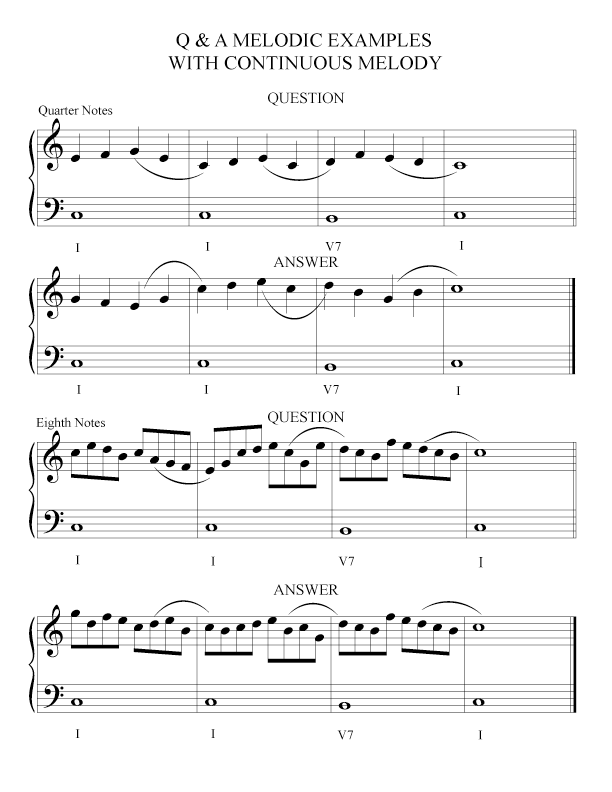
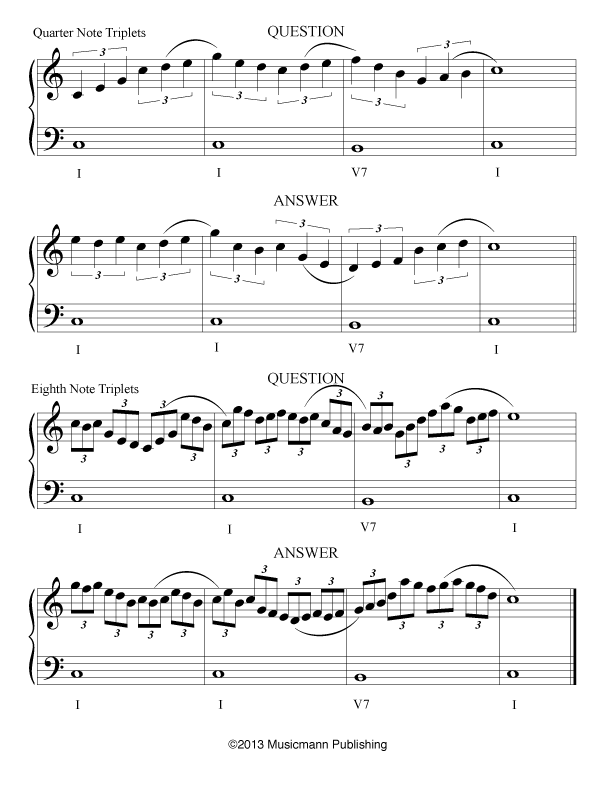
I like to use the Continuous Melody Exercise to develop a flow of ideas.  The main intent is to play continuously, thinking forward to new destination notes.   In addition, the Continuous Melody Exercise is valuable to learn to think in “melodic rhythms”.  In other words, when you think of a melodic idea . . . you are first aware of the rhythm of the lick.  After that, you can add the notes.  To do this, you have to be totally conversant with all the basic rhythmic values:  quarter notes, quarter-note triplets, eighth notes and eighth-note triplets (and sixteenths, if you can).

I use the Continuous Melody Exercise to practice melodies over many grooves . . . and to learn tunes.

Q-AContMelAQ-AContMelBx

[membership_download_item_pdf link=”http://jsfp.s3.amazonaws.com/Q-AContMelA.pdf” + target=”_self”]Question and Answer Continuous Melody Page 1[/membership_download_item_pdf]

[membership_download_item_pdf link=”http://jsfp.s3.amazonaws.com/Q-AContMelBx.pdf” + target=”_self”]Question and Answer Continuous Melody Page 2[/membership_download_item_pdf]

[features_box_blue width=”75%” + border=”2px”]Personal Evaluation

[green_tick_2_list width=”100%”]

  • I can play quarter note, eighth note, quarter-note triplets and eighth-note triplets using Question and Answer Patterns in all keys.
  • I can easily vary the Continuous Melody rhythms.
[/green_tick_2_list]

[/features_box_blue]

V7 to I Added Tones 6-5

V7 to I Added Tones 6-5

[features_box_yellow width=”75%” + border=”2px”]Level:  Intermediate

Study Added Tones after you have practiced the other V7 – I Exercises.[/features_box_yellow]

video
play-sharp-fill

This is an way to develop continuity to your soloing.  Instead of always ending your phrases on a chord tone . . . add a couple (or more) tones.  This causes your phrases to be “unexpected”.  That is a great way to develop a creative solo.

[features_box_blue width=”75%” + border=”2px”]Personal Evaluation

[green_tick_2_list width=”100%”]

  • I can play the V to I Added Tones Exercise in all keys.
[/green_tick_2_list]

[/features_box_blue]


V7 to I Pickups and Resolutions 6-4

V7 to I Pickups and Resolutions 6-4

[features_box_yellow width=”75%” + border=”2px”]Level:  Intermediate

Study Pickups and Resolutions after you have practiced the other V7 – I Exercises.[/features_box_yellow]

video
play-sharp-fill

Here are two ideas to add interest and continuity to your soloing.

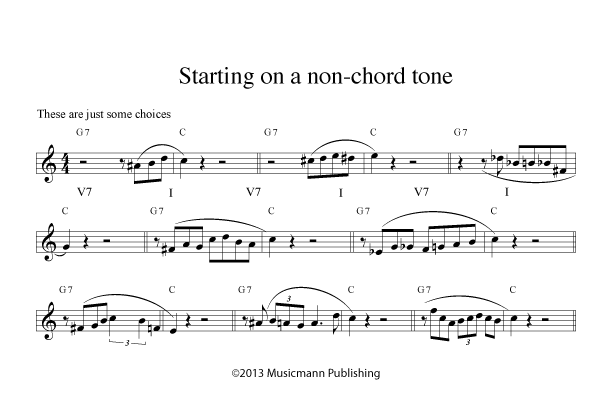
  • First – think of deliberately starting on a non-chord tone.  This means a note which is different from the usual scale tones.  The purpose is to “force” you to deliberately think of creative ways to resolve the non-chord tone into the “normal” tones.  This adds creativity and excitement to your solos.
  • Second – use suspensions to delay the resolution of your destination note.  For instance, instead of landing on a chord tone, you can play the note a diatonic above or below.  Then resolve it to the chord tone.

V7-IOddChTone

[membership_download_item_pdf link=”http://jsfp.s3.amazonaws.com/V7-IOddChTone.pdf” + target=”_self”]Starting from a non-chord tone[/membership_download_item_pdf]

[features_box_blue width=”75%” + border=”2px”]

[green_tick_2_list width=”100%”]

  • I can play the V7 to I Pickups and Resolutions in all keys.
[/green_tick_2_list]

[/features_box_blue]

V7 to I Melodic Exercise 6-1

V7 to I Melodic Exercise 6-1

[features_box_yellow width=”75%” + border=”2px”]Level:  Intermediate

Learn this lesson after having mastered the Chordal Melodic Exercise.[/features_box_yellow]

video
play-sharp-fill

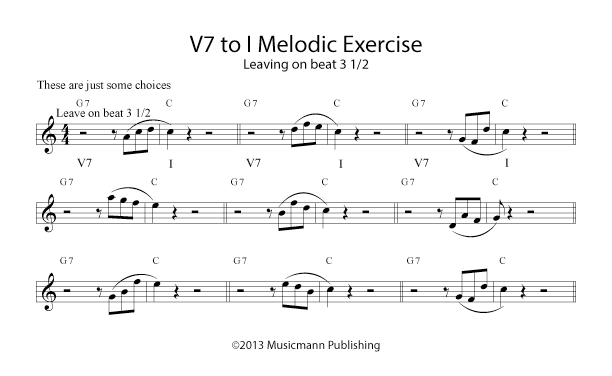
This exercise is in several parts.  Melodically, resolve the “unstable” V7 chord to the “very stable” I Chord.  The V7 is “restless” because the third and seventh in the chord are leading tones.  The leading tones literally want to be resolved to the stable I chord.  The third of the V7 (G7) chord is a B, which “wants” to resolve to the I (C) of the C major triad.  And, the F, the seventh of the G7 chord wants to resolve to the third (or possibly the fifth) the the C major triad.

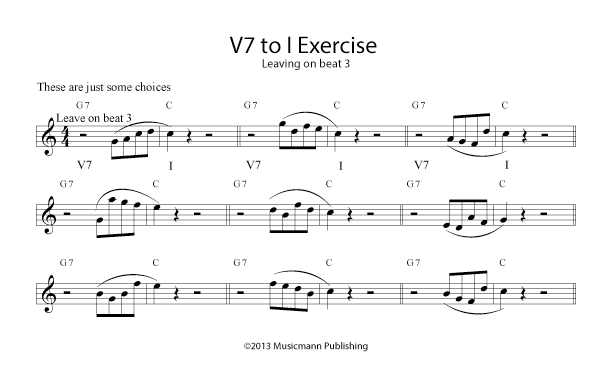
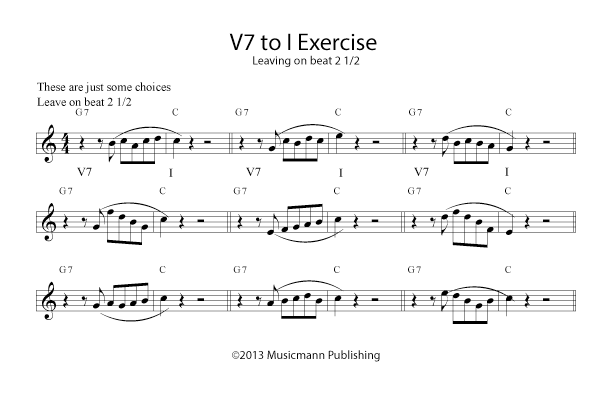
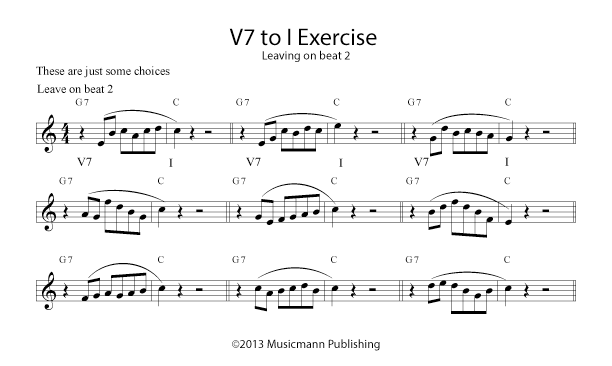
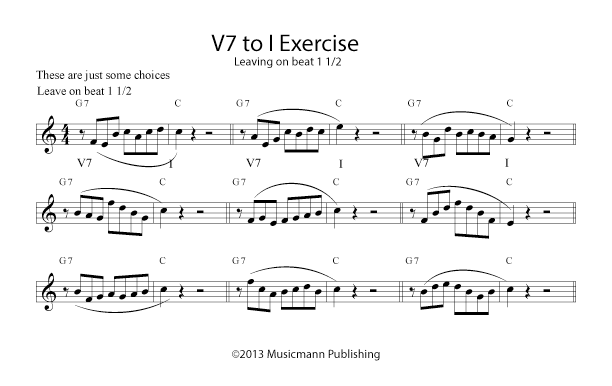
Begin by using two measures.  One measure is the territory of the V7 and the second measure is for the I chord.  Put on a metronome at a comfortable tempo.  Then start counting at an eighth-note level (For instance, 1+2+3+4+).    Decide which of the beats to begin your lick or phrase.  For now, keep all of the notes as eighth notes.  Therefore – if you begin the phrase on the and of 3, you will have four notes before you end the phrase at beat one of the next measure (count +4+1).  Incidentally, in this case, we are deliberately ending the phrase, in an obvious place, the first beat (for syncopation, sometimes we end the phrase on the and of four).  It is important that we keep the rules of this exercise to a minimum.  We want to “feel” our way through this.  My suggestion is that you always end on a chord tone of the I chord. Your “intelligent” problem is finding a way to resolve (the operative word) successfully to the I chord.  In other words – use your ear.  Feel the result.  Try an idea of “grading” each lick.  Do this according to your taste.  Perhaps, a “10” is a killer lick and a “1” is worth forgetting.  (See Examples  )
When you have exhausted all the possibilities (in every key) of leaving on the “and of 3”, then explore leaving on 3.  You will notice that now it takes 5 notes to resolve to the I chord (count 3+4+1).  Every time you leave from a different beat – you have to re-organize the notes to the resolution.

After you have accomplished “leaving” from all the possible eighth-note beats, then start playing syncopations and using triplet figures.  This is much more difficult.

Think about it.  When a jazz soloist stands on the stage and performs a solo – he MUST know all of the notes of a lick that he intends to play right through to it’s destination.  If not – the audience will know that he is not in control.  It will also be difficult for him to maintain continuity from lick to lick.
V7-IMelEx


V7-IMelExBV7-IMelExCV7-IMelExDV7-IMelExE

[membership_download_item_pdf link=”http://jsfp.s3.amazonaws.com/V7-IMelEx.pdf” + target=”_self”]V7 to I Melodic Exercise – Leaving on 3 1/2[/membership_download_item_pdf]

[membership_download_item_pdf link=”http://jsfp.s3.amazonaws.com/V7-IMelExB.pdf” + target=”_self”]V7 to I Melodic Exercise – Leaving on 3[/membership_download_item_pdf]

[membership_download_item_pdf link=”http://jsfp.s3.amazonaws.com/V7-IMelExC.pdf” + target=”_self”]V7 to I Melodic Exercise – Leaving on 2 1/2[/membership_download_item_pdf]

[membership_download_item_pdf link=”http://jsfp.s3.amazonaws.com/V7-IMelExD.pdf” + target=”_self”]V7 to I Melodic Exercise – Leaving on 2[/membership_download_item_pdf]

[membership_download_item_pdf link=”http://jsfp.s3.amazonaws.com/V7-IMelExE.pdf” + target=”_self”]V7 to I Melodic Exercise – Leaving on 1 1/2[/membership_download_item_pdf]

[features_box_blue width=”75%” + border=”2px”]Personal Evaluation

[green_tick_2_list width=”100%”]

  • I can play the V to I Melodic Exercise in all keys.
  • I can start melodies on each beat.
[/green_tick_2_list]

[/features_box_blue]