Five Finger Exercise Part 2 2-3

Five Finger Exercise Part 2  2-3

[features_box_yellow width=”75%” + border=”2px”]Level:  Beginning

This extends the Five Finger Exercise to minor, diminished and augmented.  Practice this after learning the major five finger exercise.  Learn this completely.[/features_box_yellow]

video
play-sharp-fill

Now play the five finger position in minor (b3), augmented (#5) and diminished (b3 & b5).  Then play the triad inversions in each.  FYI: we usually we don’t play inversions in diminished triads.  Later – you will  play the inversions in diminished sevenths.

[membership_download_item_pdf link=”http://jsfp.s3.amazonaws.com/5 Finger Position1.pdf” + target=”_self”]Five Finger Positions[/membership_download_item_pdf]

[features_box_blue width=”75%” + border=”2px”]Personal Evaluation

[green_tick_2_list width=”100%”]

  • I can easily find the Minor, Diminished and Augmented Five Fingers intervals in all keys (starting on any note).
  • I am practicing playing the Five Finger Position using weight transfer and striving for a good tone.
  • I am able to increase speed playing up and down without increasing tension.
  • I am analyzing the structures of the Minor, Diminished and Augmented Triad inversions.
  • I am practicing playing the Minor and Augmented Triad inversions using the “Think Before Moving Exercise”
[/green_tick_2_list]

[/features_box_blue]


Swing Groove Swing Groove Chord Inversions 16-7-3

Swing Groove Swing Groove Chord Inversions 16-7-3

[features_box_yellow width=”75%” + border=”2px”]Level:  Advanced

After you have mastered the Swing Groove Bass Lines and Melody, start learning the Swing Groove Swing Groove Chord Inversions.[/features_box_yellow]

video
play-sharp-fill

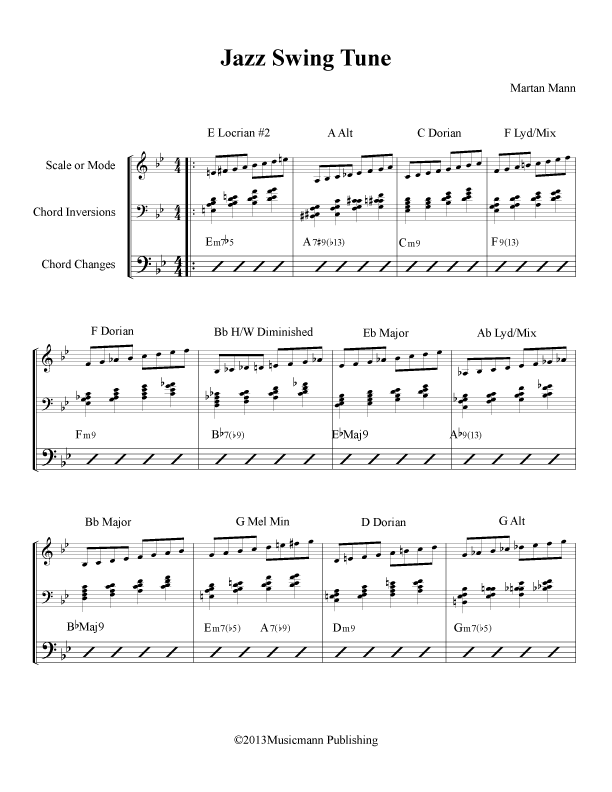
Learning the “Jazz Swing Tune”:

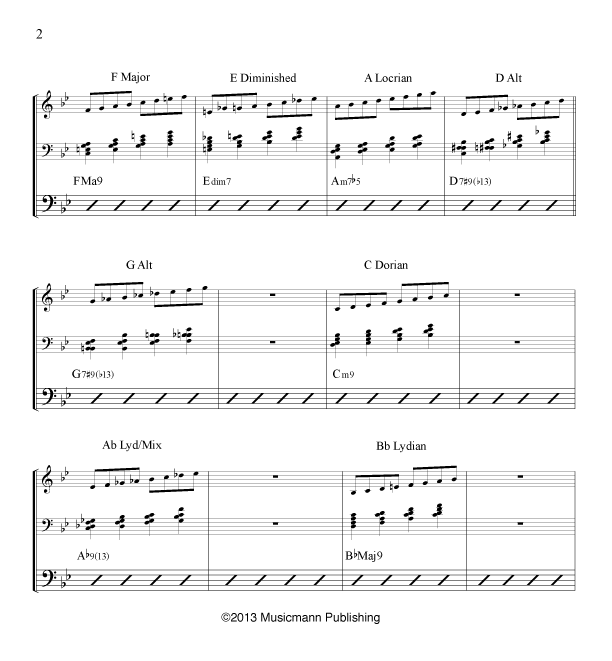
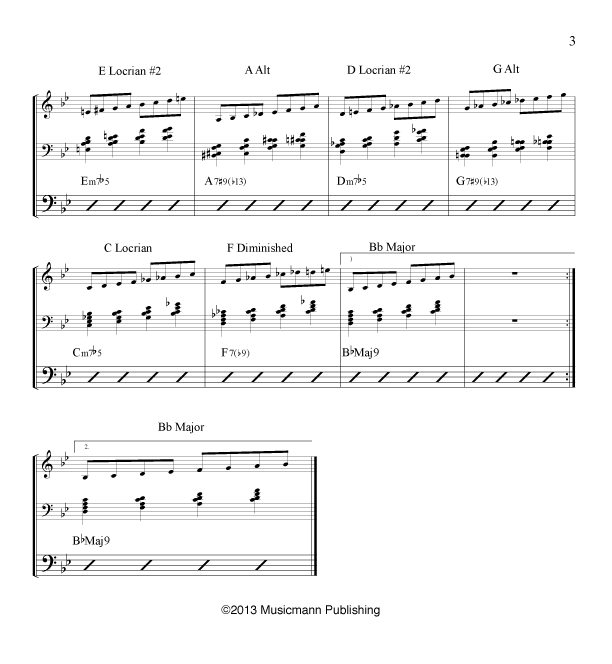
  1. Make a chart.  Include the chord changes, chord inversions and scale choices.
  2. Study each chord and it’s scale (modes).
  3. Play chords in inversions in both the right hand and left hand.  Bounce around.  (See example and video)


JazzSwingTune1a JazzSwingTune1b JazzSwingTune1c

[membership_download_item_pdf link=”http://jsfp.s3.amazonaws.com/JazzSwingTune1a.pdf” + target=”_self”]Swing Jazz Tune Page 1[/membership_download_item_pdf]

[membership_download_item_pdf link=”http://jsfp.s3.amazonaws.com/JazzSwingTune1b.pdf” + target=”_self”]Swing Jazz Tune Page 2[/membership_download_item_pdf]

[membership_download_item_pdf link=”http://jsfp.s3.amazonaws.com/JazzSwingTune1c.pdf” + target=”_self”]Swing Jazz Tune Page 3[/membership_download_item_pdf]

[features_box_blue width=”75%” + border=”2px”]Personal Evaluation

[green_tick_2_list width=”100%”]

  • I have made a chart – including the chord changes, chord inversions and scale choices.
  • I have studied each chord and it’s scale (modes).
  • I can play chords in inversions in both the right hand and left hand while bouncing around.
[/green_tick_2_list]

[/features_box_blue]

Bossa Nova Left Hand Inversions 14-1-2

Bossa Nova Left Hand Inversions 14-1-2

[features_box_yellow width=”75%” + border=”2px”]Level:  Advanced

After you have studied the Bossa Nova Inversions, start studying Bossa Nova Left Hand Inversions. [/features_box_yellow]

video
play-sharp-fill

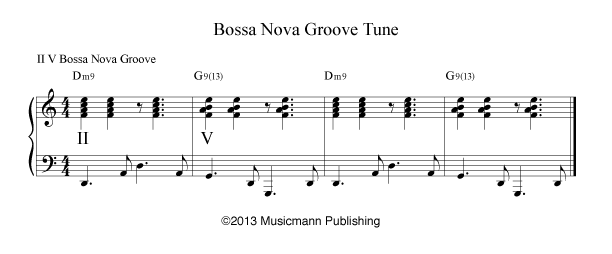
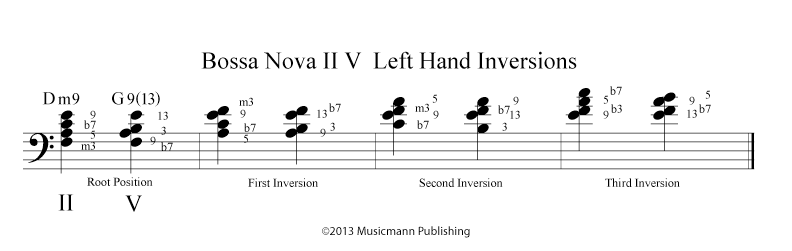
Left Hand Inversions:

  1. Once you have mastered the BN Inversions . . . then switch the chords to the left hand.
  2. Play the BN Groove with the left hand “bouncing” around the inversions.
  3. Think melodically.
  4. Play in all keys.

GrooveT-Bossa ProgLH25inv

[membership_download_item_pdf link=”http://jsfp.s3.amazonaws.com/GrooveT Bossa.pdf” + target=”_self”]Bossa Nova Groove Tune[/membership_download_item_pdf]

[features_box_blue width=”75%” + border=”2px”]Personal Evaluation

[green_tick_2_list width=”100%”]

  • I can quickly and easily play the Bossa Nova Left Hand Inversions while “bouncing”.
[/green_tick_2_list]

[/features_box_blue]

II V I Progression Alterations 10-5

II V I Progression Alterations 10-5

[features_box_yellow width=”75%” + border=”2px”]Level:  Advanced

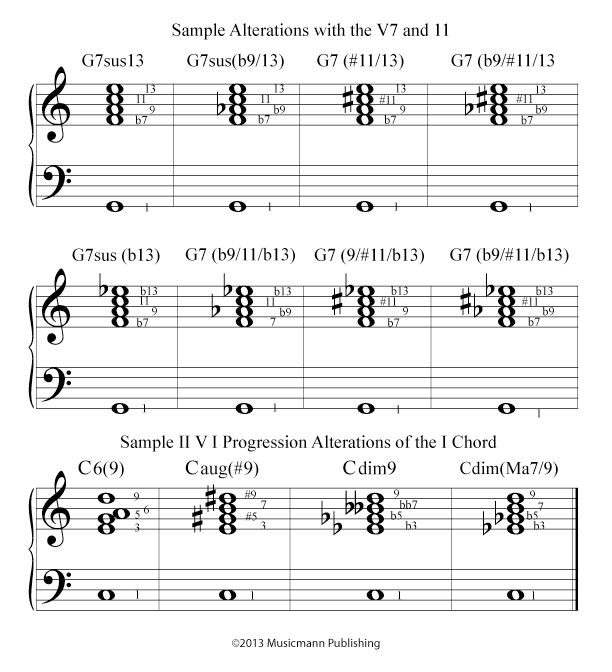
Now, after studying the full II V I begin the difficult study of all of the alterations.   Study the II V I alterations diligently around the Cycle of Fourths and Fifths and up and down chromatically.  This is definitely a long-term study.[/features_box_yellow]

video
play-sharp-fill

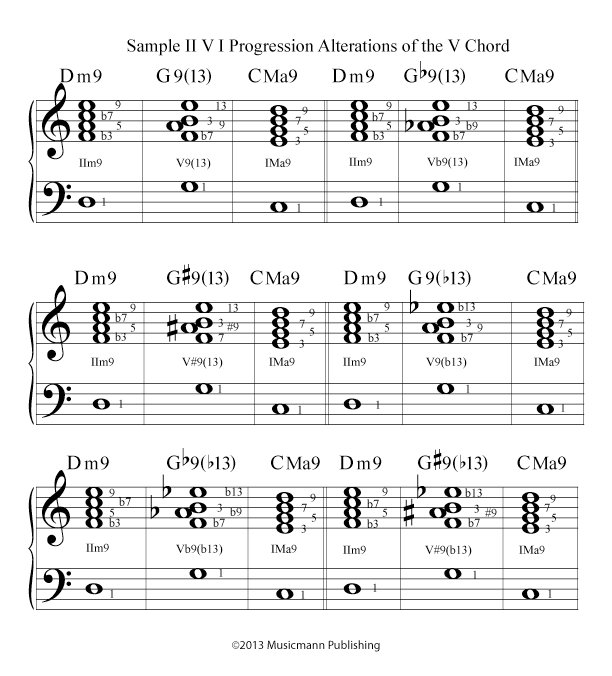
This is where the II V I Progression study gets a lot more complicated.  We can alter the II chord, V chord and I chord.  Most of the alterations take place in the V chord.  So start your study there.  Play all of the alterations until you know each completely.  Use the II V I Progression as a vehicle for learning the alterations.  Of course, play the alterations in ALL inversions.  Play around the Cycle of Fourths, Cycle of Fifths and up and down Chromatically.  This is definitely a long-term exercise.  Keep at it!

251ProgAlt1251ProgAlts251

[membership_download_item_pdf link=”http://jsfp.s3.amazonaws.com/251ProgAlt1.pdf” + target=”_self”]II V I Progressions with Alterations Page 1[/membership_download_item_pdf]

[membership_download_item_pdf link=”http://jsfp.s3.amazonaws.com/251ProgAlts251.pdf” + target=”_self”]II V I Progressions with Alterations Page 2[/membership_download_item_pdf]

[features_box_blue width=”75%” + border=”2px”]Personal Evaluation

[green_tick_2_list width=”100%”]

  • I can quickly and easily play the II V I Progression with Alts around the Cycle of Fourths, Cycle of Fifths and up and down chromatically in all keys.
  • I can quickly and easily play the II V I Progression Inversions with Alts around the Cycle of Fourths, Cycle of Fifths and up and down chromatically in all keys.
  • I can do the above using the left hand playing the chord and singing the root note.
[/green_tick_2_list]

[/features_box_blue]

Seventh Chords Around Cycle of Keys 4-1

Seventh Chords Around the Cycle of Keys 4-1

[features_box_yellow width=”75%” + border=”2px”]Level:  Intermediate

Before practicing playing the seventh chords around the cycle . . . make sure that you have thoroughly mastered the Cycle of Keys Exercise.[/features_box_yellow]

video
play-sharp-fill

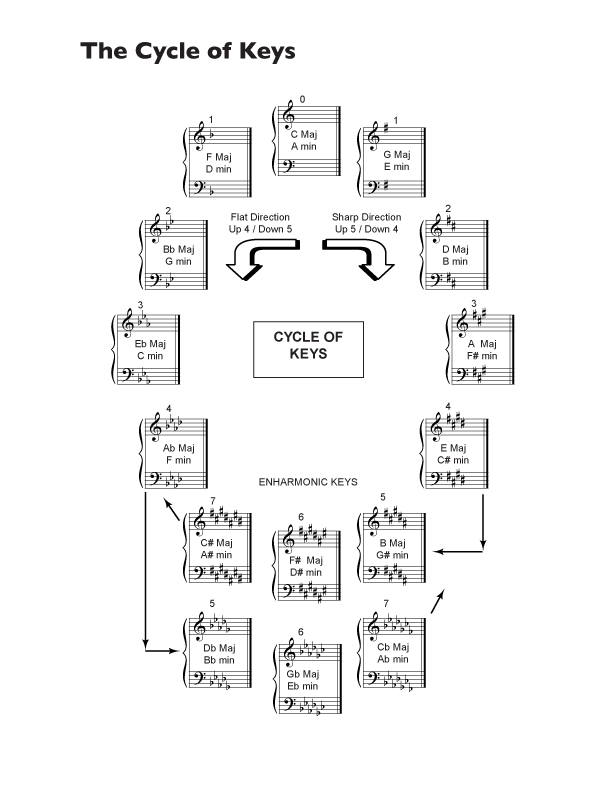
Play each seventh chord around the Cycle of Keys, both in fourths and fifths directions.  Also, play the sevenths up and down chromatically.  Do this also in each inversion of the sevenths.

Sevenths-cycle

CycleChart

[membership_download_item_pdf link=”http://jsfp.s3.amazonaws.com/Sevenths-cycle.pdf” + target=”_self”]Seventh Chords Around Flat Cycle of Keys[/membership_download_item_pdf]

[membership_download_item_pdf link=”http://jsfp.s3.amazonaws.com/CycleChartCnt.pdf” + target=”_self”]Cycle of Keys[/membership_download_item_pdf]

[features_box_blue width=”75%” + border=”2px”]Personal Evaluation

[green_tick_2_list width=”100%”]

  • I can play all the Sevenths (and sixths) around the Cycle of Fourths and Fifths.
  • I can play the Sevenths in all inversions around the Cycle of Fourths and Fifths.
[/green_tick_2_list]

[/features_box_blue]


Major Triad Open Voicings Part 1 3-7

Major Triad Open Voicings Part 1  3-7

[features_box_yellow width=”75%” + border=”2px”]Level:  Intermediate

Study the Major Triad Open Voicings Exercise after you have mastered playing all the triad inversions.  It would also be a good idea to know how to spell all the major scales.

[/features_box_yellow]

video
play-sharp-fill

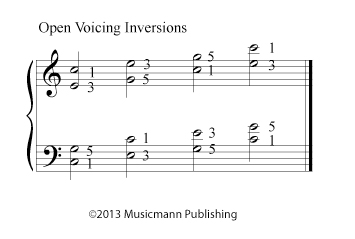
Up to this point, we have been playing chords in their “closed” position.  That is when the notes are most compact.  However, to develop an orchestrated sound on the piano, it is necessary to “open up” the notes.  There are many ways to do this.  For instance, we can play the chord inversions in their “open” position.

Notice that in the root position, the closed position 1-3-5 is now 1-5-3-1 in the open position.  Move the third up an octave and then double the root.  One way to practice this exercise is to first play the open voicings inversions in each hand separately.  Then put the hands together.  Of course, play in all keys.
OVInvOV-Series-Exercise

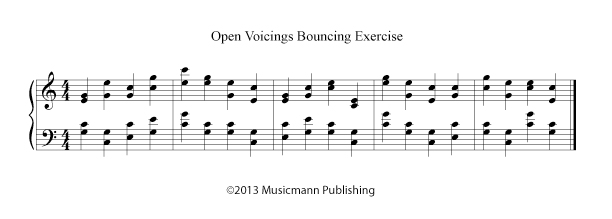
Open Voicings Bouncing Exercise

Here is an excellent method to develop your ability to play open voicings.  One of the main issues is to not double the third.  Because of the overtone series, the third sounds “heavy”.  The other voicings sound smooth.

Start by playing two notes in the right hand.  The right hand is used because it allows you to listen to the melody note (the top note).  The right hand will play either a third, sixth, fourth or fifth.  Once you have committed to those intervals in the right hand, you can determine your two notes in the left hand.

For instance, if the right hand plays an interval with a third in it, then do not play a third in the left hand.  Vice versa, if the right hand plays an interval without a third, then you can add in one third in the left hand.

This is called the Open Voicings Bouncing Exercise because you are randomly “bouncing” open voicings triads around the keyboard.  (See Example  )  Eventually, you should be able to do this quickly and effortlessly in all keys, major and minor.
OVexercise[membership_download_item_pdf link=”http://jsfp.s3.amazonaws.com/OVInv.pdf” + target=”_self”]Open Voicings Inversions[/membership_download_item_pdf]

[membership_download_item_pdf link=”http://jsfp.s3.amazonaws.com/OV Series Exercise.pdf” + target=”_self”]Open Voicings Series Exercise[/membership_download_item_pdf]

[membership_download_item_pdf link=”http://jsfp.s3.amazonaws.com/OVexercise.pdf” + target=”_self”]Open Voicings Bouncing Exercise[/membership_download_item_pdf]

[features_box_blue width=”75%” + border=”2px”]Personal Evaluation

[green_tick_2_list width=”100%”]

  • I can quickly and easily play the Open Voicings Inversion Exercise in all keys.
  • I can quickly and easily play the Open Voicings Bouncing Exercise in all keys.
[/green_tick_2_list]

[/features_box_blue]

 

Major Scale Structures 3-2

Major Scale Structures 3-2

[features_box_yellow width=”75%” + border=”2px”]Level:  Beginning/Intermediate

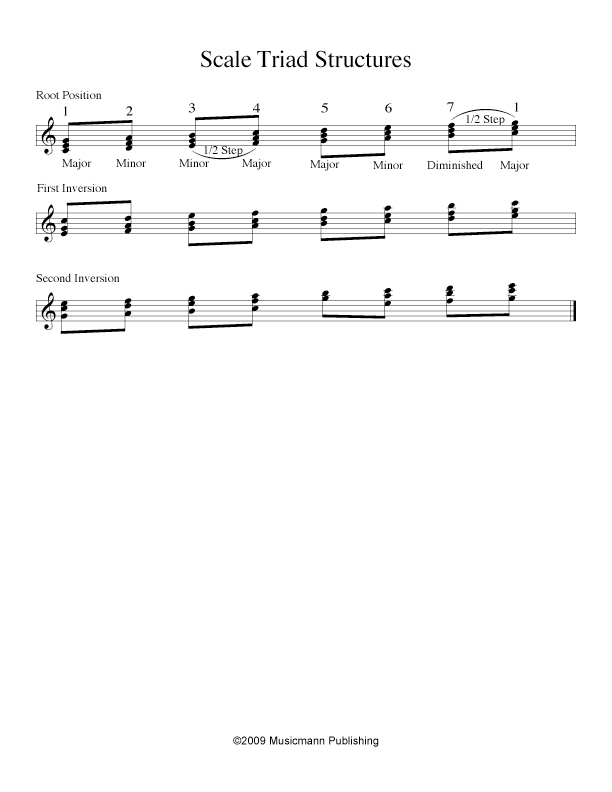
This is an excellent way to deeply learn the major scales, it’s diatonic triads and the triad inversions.  A major scale has seven notes (with half steps at 3&4 and 7&8).   If you number the notes in order, the triad types are as follows:  major, minor, minor, major, major, minor, diminished.  Learn the triads in all major keys.  Then play the inversions up the major scale in all keys.

Take your time.  Learn the major scale chords well before studying the melodic minor and harmonic minor structures.

[/features_box_yellow]

video
play-sharp-fill

Scalew_triads

[membership_download_item_pdf link=”http://jsfp.s3.amazonaws.com/Scalew_triads.pdf” + target=”_self”]Major Scale Structures[/membership_download_item_pdf]

[features_box_blue width=”75%” + border=”2px”]Personal Evaluation

[green_tick_2_list width=”100%”]

  • I can quickly and easily play all the Triads up the Major Scale.
  • I can state the order of triad chord types going up the Major Scale.
[/green_tick_2_list]

[/features_box_blue]
Five Finger Exercise Part 1 2-2

Five Finger Exercise Part 1  2-2

[features_box_yellow width=”75%” + border=”2px”]Level:  Beginning

Practice the Five Finger Exercise before beginning studying scales and arpeggios.  This lesson introduces you to the concept of thinking in numbers and intervals.  You should be able to play the Five Finger Exercise easily starting on any note.  Then, play the triad and it’s inversions.  Practice this until the Five Finger Exercise is totally subconscious.  Then, begin studying scales and arpeggios.

[/features_box_yellow]

video
play-sharp-fill

Here is a good beginning exercise to eventually understand advanced jazz theory.  It starts with counting the keys.  You can start on any key.  Count in half steps (two adjacent notes) and whole-steps (two adjacent notes with a note in between).  When you count up (to the right on the keyboard),  count five notes:  between 1 & 2 is a whole step;  between 2 & 3 is a whole step; between 3 & 4 is a half step; and between 4 & 5 is a whole step (See the video and PDFs).

We number the notes 1-2-3-4-5.  Then, we chose notes 1-3-5.  That will form a Major Triad.  In that position, the triad is in the root position.  To find and name the “inversions” of the chord,  take the bottom note (#1) and place it on top.  That creates the first inversion (3-5-1).  Then move the bottom note (3) to the top and play the second inversion (5-1-3).

  • First, find the major five-finger template as described above.  You can start on any note.   Then, find the same five finger position an octave below with the left hand.  Now, play “up-and-down” the notes with both hands at the same time.  The object is to play relaxed and evenly.  Don’t forget to curve your fingers.  Slowly speed up your playing to the point where you start to tense up.  At that point, slow down to a relaxed tempo.  Keep moving the tempo up to the point where you begin to tense up – then slow back down again and again.
  • After doing this for a short time, play the major triad (1-3-5).  Then, play the inversions of the major triad (root position, first inversion and second inversion) (See the video and PDFs).

[membership_download_item_pdf link=”http://jsfp.s3.amazonaws.com/5 Finger Position.pdf” + target=”_blank”]Five Finger Exercise Part 1[/membership_download_item_pdf]

[features_box_blue width=”75%” + border=”2px”]Personal Evaluation

[green_tick_2_list width=”100%”]

  • I can easily find the Major Five Fingers intervals in all keys (starting on any note).
  • I am practicing playing the Five Finger Position using weight transfer and striving for a good tone.
  • I am able to increase speed playing up and down without increasing tension.
  • I am analyzing the structures of the Major Triad inversions.
  • I am practicing playing the Major Triad inversions using the “Think Before Moving Exercise”
[/green_tick_2_list]

[/features_box_blue]