Martan explains how to develop four-part harmony and open voicings by playing the Pachelbel Canon with a Groove. This utilizes Band-in-a-box. It’s fun. Try it.
Related files:
Section 8: Pachelbel Canon Project
Pachelbel Exercise Melody and Single Bass Note 8-1
Pachelbel Exercise Continuous Melody and Single Bass Note 8-2
Pachelbel Exercise Random Melody 8-3
Pachelbel Exercise Open Voicings 8-4
Pachelbel Exercise Open Voicings w/Melody 8-5
Pachelbel Exercise Open Voicings w/Melody Continued 8-6
Email Martan with your suggestions, questions and reactions. martan@jazzskillsforpiano.com
[features_box_yellow width=”75%” + border=”2px”]Level: Intermediate
It is recommended that you first study the Theory Exercises, at least through Section Three: Triad Study before you begin the Motion Exercises. These exercise are studied if you have never improvised.[/features_box_yellow]
Motion Exercises
Motion Exercises are designed to help you feel comfortable while improvising. It’s important that you know theory so that you have a basis to improvise. But, then it is important to use that theory as a language. Once you have accomplished this . . . then, I recommend beginning actual Jazz Study. Jazz theory, jazz tunes, and jazz rhythm are much more complicated. You should find your “freedom to improvise”, first here.
Of course, if you are already comfortable with general improvisation, move on to the Jazz Sections in this course.
Swing Groove Comping w/Modes 16-7-7
[features_box_yellow width=”75%” + border=”2px”]Level: Advanced
After you have mastered the Swing Groove Comping and Melody, start learning the Swing Groove Comping w/Modes.[/features_box_yellow]
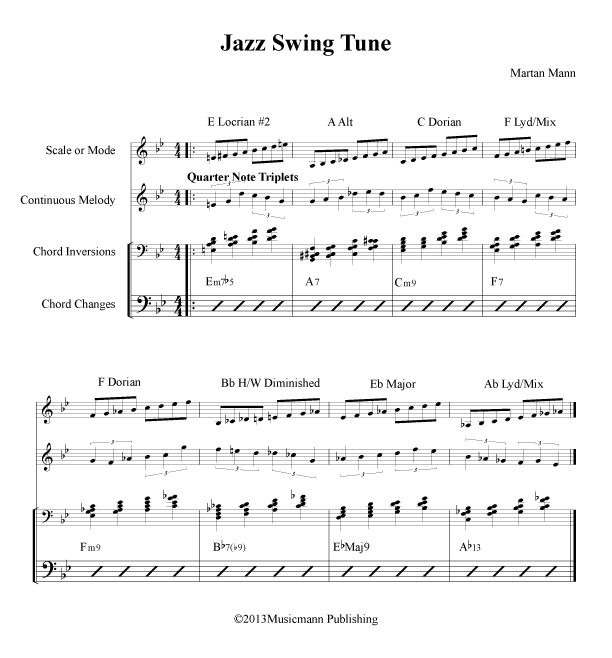
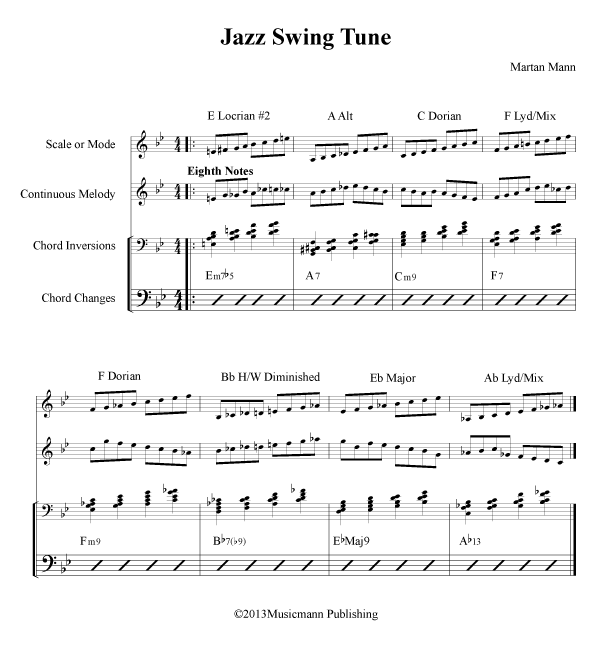
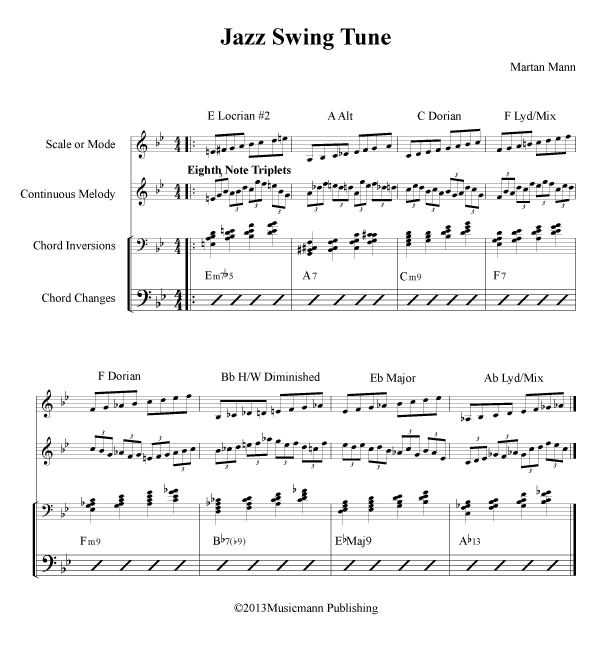
Studying the Modes for each chord in the “Jazz Swing Tune”:
- Take each chord in the “Jazz Swing Tune” and completely learn the scales which work with that chord.
- For instance: the first chord in the tune is an Em7(b5). You can use either the Locrian Mode (7-7) or the Sharp 2 Locrian (6-6 of the Melodic Minor).
- Take the #2 Locrian Mode and play it in Triads up the scale. (See the example and video).
- Take the #2 Locrian Mode and play it in Sevenths up the scale.
- Make up chord structures using the E #2 Locrian Mode. Play in 3-notes, 4-notes, 4-note open structures and 5-note open structures.


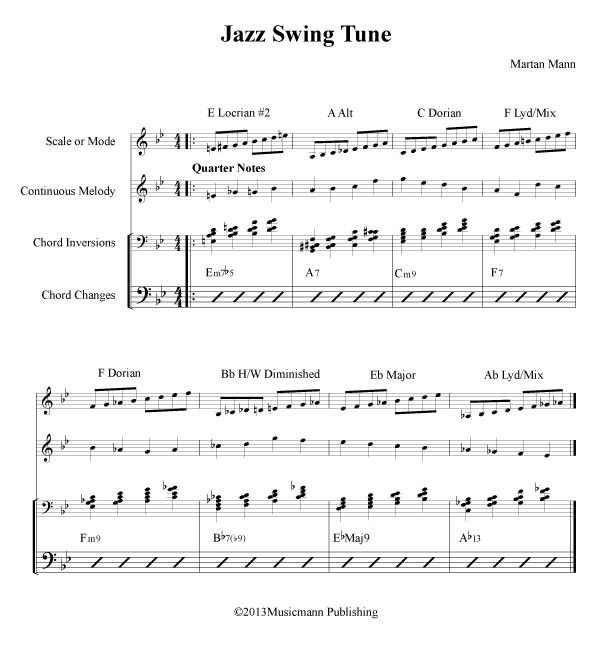
[membership_download_item_pdf link=”http://jsfp.s3.amazonaws.com/JazzSwingTunew-CMEQN.pdf” + target=”_self”]Continuous Melody Exercise – Quarter Notes[/membership_download_item_pdf]
[membership_download_item_pdf link=”http://jsfp.s3.amazonaws.com/JazzSwingTunew-CMEQT.pdf” + target=”_self”]Continuous Melody Exercise – Quarter Note Triplets[/membership_download_item_pdf]
[membership_download_item_pdf link=”http://jsfp.s3.amazonaws.com/JazzSwingTunew-CMEEN.pdf” + target=”_self”]Continuous Melody Exercise – Eighth Notes[/membership_download_item_pdf]
[membership_download_item_pdf link=”http://jsfp.s3.amazonaws.com/JazzSwingTunew-CMEET.pdf” + target=”_self”]Continuous Melody Exercise – Eighth Note Triplets[/membership_download_item_pdf]
[membership_download_item_pdf link=”http://jsfp.s3.amazonaws.com/JSTModeStructEloc2.pdf” + target=”_self”]E Locrian Mode Chord Structures Page 1[/membership_download_item_pdf]
[membership_download_item_pdf link=”http://jsfp.s3.amazonaws.com/JSTModeStructEloc2b.pdf” + target=”_self”]E Locrian Mode Chord Structures Page 2[/membership_download_item_pdf]
[membership_download_item_pdf link=”http://jsfp.s3.amazonaws.com/JSTModeStructAalt.pdf + target=”_self”]A Alt Chord Structures[/membership_download_item_pdf]
[features_box_blue width=”75%” + border=”2px”]Personal Evaluation
[green_tick_2_list width=”100%”]
- I have studied the first chord in the tune is an Em7(b5) and used either the Locrian Mode (7-7) or the Sharp 2 Locrian (6-6 of the Melodic Minor).
- I can take the #2 Locrian Mode and play it in Triads up the scale. (See the example and video).
- I can take the #2 Locrian Mode and play it in Sevenths up the scale. (See the example and video).
- I can make up chord structures using the E #2 Locrian Mode. Play in 3-notes, 4-notes, 4-note open structures and 5-note open structures.
- I can take all of the chords of the “Jazz Swing Tune” and play the above.
[/green_tick_2_list]
[/features_box_blue]
Bossa Nova Modal Tune w/Continuous Melody 14-5-4
[features_box_yellow width=”75%” + border=”2px”]Level: Advanced
After you have mastered Bossa Nova Modal Tune Soloing w/Tonalities, start studying Bossa Nova Modal Tune w/Continuous Melody.[/features_box_yellow]
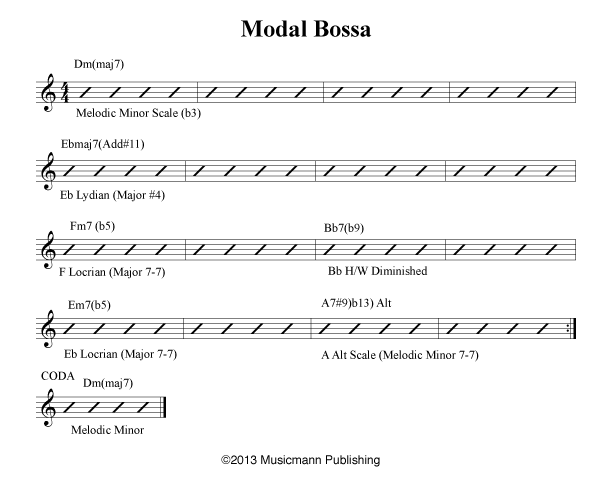
Developing melodies:
- Left hand chords must be totally subconscious. Practice each chord in the tune in all positions (inversions).
- Practice the right hand using the Continuous Melody Exercise. Play Quarter Notes, Eighth Notes, Quarter-note Triplets, Eighth-note Triplets using the scales suggested by the chords. Always think forward (you can leave out the first note of the phrase to move forward).
- Play the Modal Bossa Tune with a metronome with “bouncing” left hand chords and the continuous melody exercise with all of the time values.


[membership_download_item_pdf link=”http://jsfp.s3.amazonaws.com/ModalBossa.pdf” + target=”_self”]Modal Bossa Chord Chart[/membership_download_item_pdf]
[membership_download_item_pdf link=”http://jsfp.s3.amazonaws.com/ModalBossaTunew-ModesA.pdf” + target=”_self”]Modal Bossa Tune with Modes Page 1[/membership_download_item_pdf]
[membership_download_item_pdf link=”http://jsfp.s3.amazonaws.com/ModalBossaTunew-ModesB.pdf” + target=”_self”]Modal Bossa Tune with Modes Page 2[/membership_download_item_pdf]
[features_box_blue width=”75%” + border=”2px”]Personal Evaluation
[green_tick_2_list width=”100%”]
- I have practiced the left hand chords and inversions until they are totally subconscious.
- I have practiced the right hand using the Continuous Melody Exercise.
- I can play the Modal Bossa Tune with a metronome with “bouncing” left hand chords and the continuous melody exercise with all of the time values.
[/green_tick_2_list]
[/features_box_blue]
Bossa Nova Turnaround Chart 14-5-7
[features_box_yellow width=”75%” + border=”2px”]Level: Advanced
After you have mastered Bossa Nova Modal Tune Soloing w/Band-in-a-box, start studying Bossa Nova Turnaround Chart.[/features_box_yellow]
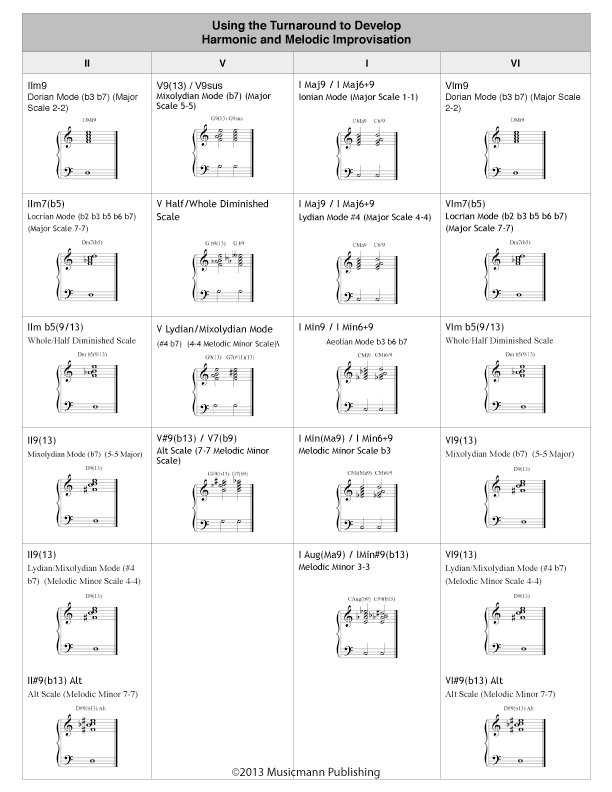
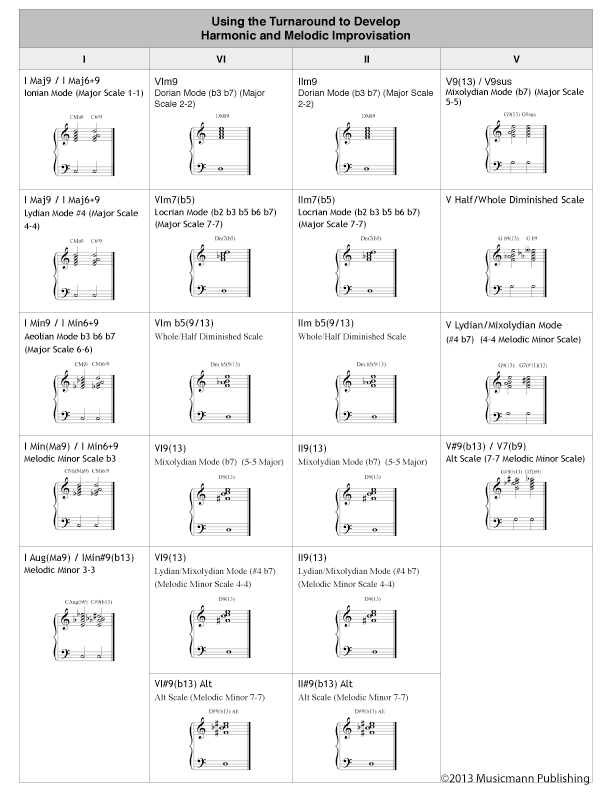
Using the Turnaround Chart:
- Can use either the I VI II V or the II V I VI.
- The first column down is all Diatonic (out of the Major Scale). In C Major . . . it uses just the white keys. However, each chord is a different mode. The I chord is the Ionian Mode (1-1). The VI chord is the Aeolian Mode (6-6). The II chord is the Dorian Mode (2-2) and the V chord is the Mixolydian Mode (5-5). Practice the modes with structures.
- You can also break up the structures and play modally.
- Looking at the Turnaround Chart – you can choose any chord and mode from the I chord, VI chord, II chord and V chord. Learn each mode completely.
- Play your choices over and over . . . until it is totally automatic. Always think forward to the next chord.
[membership_download_item_pdf link=”http://jsfp.s3.amazonaws.com/Turnaround Chart1a.pdf” + target=”_self”]Turnaround Chart II V I VI[/membership_download_item_pdf]
[membership_download_item_pdf link=”http://jsfp.s3.amazonaws.com/Turnaround Chart1b.pdf” + target=”_self”]Turnaround Chart I VI II V[/membership_download_item_pdf]
[features_box_blue width=”75%” + border=”2px”]Personal Evaluation
[green_tick_2_list width=”100%”]
- I have studied the Turnaround Chart and all the chords and modes (in all keys).
- I have chosen a mode for the I, VI, II and V chords and can play them with a metronome or BIAB.[/green_tick_2_list]
[/features_box_blue]
Bossa Nova Modal Tune Soloing w/Band-in-a-box 14-5-6
[features_box_yellow width=”75%” + border=”2px”]Level: Advanced
After you have mastered Bossa Nova Modal Tune Soloing Phrasing, start studying Bossa Nova Modal Tune Soloing w/Band-in-a-box.[/features_box_yellow]
Ideas for soloing:
- Always be aware of the Bossa Groove. You don’t have to play the literal groove. Work off of the drummer and bassist.
- Always play licks forward to a destination point. Practice playing from chord to the next chord.
- Use different note values, including triplets and syncopations.
- Use comping chords in all inversions.
- Think modally. Play across the hands.
- Allow time to think. Play in complete phrases (to the last note). Don’t meander.


[membership_download_item_pdf link=”http://jsfp.s3.amazonaws.com/ModalBossa.pdf” + target=”_self”]Modal Bossa[/membership_download_item_pdf]
[membership_download_item_pdf link=”http://jsfp.s3.amazonaws.com/ModalBossamelA.pdf” + target=”_self”]Modal Bossa Tune with scales Part 1[/membership_download_item_pdf]
[membership_download_item_pdf link=”http://jsfp.s3.amazonaws.com/ModalBossamelB.pdf” + target=”_self”]Modal Bossa Tune with scales Part 2[/membership_download_item_pdf]
[features_box_blue width=”75%” + border=”2px”]Personal Evaluation
[green_tick_2_list width=”100%”]
- I have played the Modal Bossa Tune over and over.
[/green_tick_2_list]
[/features_box_blue]
Bossa Nova Modal Tune Soloing Phrasing 14-5-5
[features_box_yellow width=”75%” + border=”2px”]Level: Advanced
After you have mastered Bossa Nova Modal Tune w/Continuous Melody, start studying Bossa Nova Modal Tune Soloing Phrasing.[/features_box_yellow]
Developing phrasing:
- Practice just one chord (mode) at a time. Count out loud. Start the lick (phrase) at a specific point in the measure. Clap out your rhythm and then place notes “on top” of the rhythm.
- Practice the above where one chord changes to the next chord. “Leave” (start the lick) on different beats of the measure. Use all the different time values (especially triplets). Play syncopated patterns.
- Practice “Adding in a couple of notes”.
- Practice landing on suspensions (and resolve).
- Practice “Starting on an odd note.
- Play, play and play through the Modal Bossa Tune with a metronome using the above.
[membership_download_item_pdf link=”http://jsfp.s3.amazonaws.com/ModalBossa.pdf” + target=”_self”]Modal Bossa Chord Chart[/membership_download_item_pdf]
[membership_download_item_pdf link=”http://jsfp.s3.amazonaws.com/ModalBossaTunew-ModesA.pdf” + target=”_self”]Modal Bossa Tune with Modes Page 1[/membership_download_item_pdf]
[membership_download_item_pdf link=”http://jsfp.s3.amazonaws.com/ModalBossaTunew-ModesB.pdf” + target=”_self”]Modal Bossa Tune with Modes Page 2[/membership_download_item_pdf]
[features_box_blue width=”75%” + border=”2px”]Personal Evaluation
[green_tick_2_list width=”100%”]
- I have practiced just one chord (mode) at a time.
- I have practiced the above where one chord changes to the next chord.
- II have practiced “Adding in a couple of notes”.
- I have practiced landing on suspensions (and resolve).
- I have practiced “Starting on an odd note.
- I have played through the Modal Bossa Tune with a metronome using the above.
[/green_tick_2_list]
[/features_box_blue]
Bossa Nova Modal Tune Soloing w/Tonalities 14-5-3
[features_box_yellow width=”75%” + border=”2px”]Level: Advanced
After you have mastered Bossa Nova Modal Tune Comp w/Band-in-a-box, start studying Bossa Nova Modal Tune Soloing w/Tonalities.[/features_box_yellow]
Studying the Bossa Modal Tune to develop soloing:
- Study all the possible scales and modes for each chord in the Bossa Modal Tune (see below and the video).
[membership_download_item_pdf link=”http://jsfp.s3.amazonaws.com/ModalBossa.pdf” + target=”_self”]Modal Bossa Chord Chart[/membership_download_item_pdf]
[membership_download_item_pdf link=”http://jsfp.s3.amazonaws.com/ModalBossaTunew-ModesA.pdf” + target=”_self”]Modal Bossa Tune with Modes Page 1[/membership_download_item_pdf]
[membership_download_item_pdf link=”http://jsfp.s3.amazonaws.com/ModalBossaTunew-ModesB.pdf” + target=”_self”]Modal Bossa Tune with Modes Page 2[/membership_download_item_pdf]
[features_box_blue width=”75%” + border=”2px”]Personal Evaluation
[green_tick_2_list width=”100%”]
- I have studied all the possible scales and modes for each chord in the Bossa Modal Tune.
[/green_tick_2_list]
[/features_box_blue]
Bossa Nova Modal Tune Comp 14-5-1
[features_box_yellow width=”75%” + border=”2px”]Level: Advanced
After you have mastered Bossa Nova Modal Structures for Melodic Minor Scale, start studying Bossa Nova Modal Tune Comp.[/features_box_yellow]
Studying the Modal Bossa Tune for Comping:
- Every chord suggests different scales (or modes). You can “bounce around” the modes when playing chords.
- Study the chords and modes in the Modal Bossa Tune (see below and in video).
[membership_download_item_pdf link=”http://jsfp.s3.amazonaws.com/ModalBossa.pdf” + target=”_self”]Modal Bossa Chord Chart[/membership_download_item_pdf]
[membership_download_item_pdf link=”http://jsfp.s3.amazonaws.com/ModalBossaTunew-ModesA.pdf” + target=”_self”]Modal Bossa Tune with Modes Page 1[/membership_download_item_pdf]
[membership_download_item_pdf link=”http://jsfp.s3.amazonaws.com/ModalBossaTunew-ModesB.pdf” + target=”_self”]Modal Bossa Tune with Modes Page 2[/membership_download_item_pdf]
[features_box_blue width=”75%” + border=”2px”]Personal Evaluation
[green_tick_2_list width=”100%”]
- I have studied the chords and modes in the Modal Bossa Tune.
- I can “bounce around” playing chords throughout the Modal Bossa Tune.
[/green_tick_2_list]
[/features_box_blue]
Bossa Nova Modal Structures for the Major Chord 14-4-1
[features_box_yellow width=”75%” + border=”2px”]Level: Advanced
After you have mastered Bossa Nova Learning Scales for Turnaround I Chord, start studying Bossa Nova Modal Structures for the Major Chord.[/features_box_yellow]
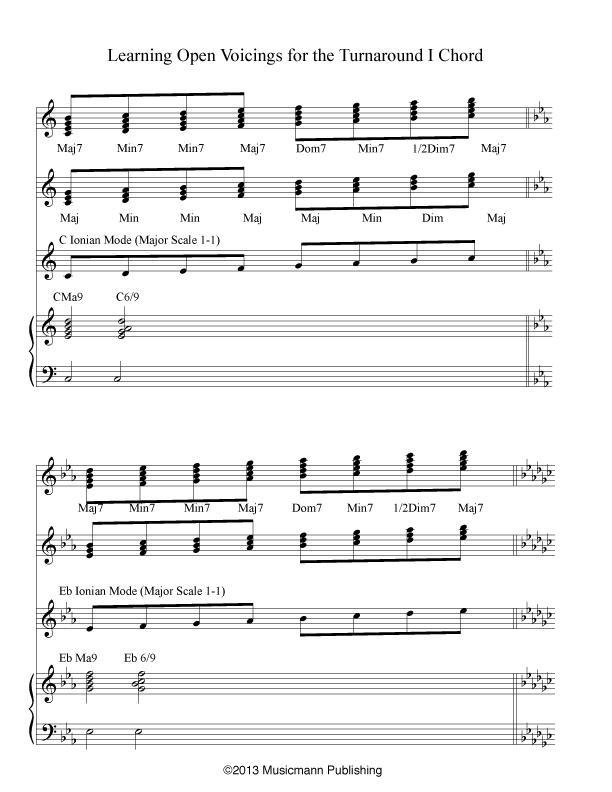
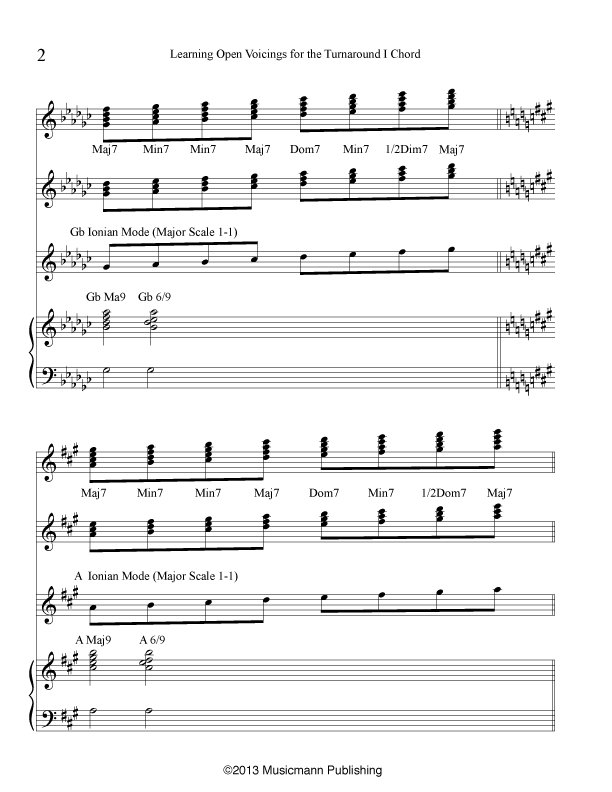
Learning the chord structures for the I chord (Major Scale):
This is for the C9 and C6+9 chords.
Start playing structures in the key of C.
Play a “core” chord (from the Turnaround) in the left hand and add in add in additional notes or tones from the Major Scale in the right hand.
Play 10ths and add in diatonic (notes from the Major Scale) tones in the middle of the 10th.
Put on the metronome at 90 and play structures in the key of C. Let you hands flow over the piano keyboard. Don’t play melody at this point.
Pick three additional keys and learn the Major Scale Structures in each of those keys. Play each with a metronome.
Finally . . . play with a metronome from chord to chord (in your chosen four keys). Always think forward to the next chord.
[membership_download_item_pdf link=”http://jsfp.s3.amazonaws.com/ProgLearningBasicSc1chExA.pdf” + target=”_self”]Chord Structures for the major chord. Page 1[/membership_download_item_pdf]
[membership_download_item_pdf link=”http://jsfp.s3.amazonaws.com/ProgLearningBasicSc1chExB.pdf” + target=”_self”]Chord Structures for the major chord. Page 2[/membership_download_item_pdf]
[features_box_blue width=”75%” + border=”2px”]Personal Evaluation
[green_tick_2_list width=”100%”]
- I understand that the C Major Chord Structures are for the C9 and C6+9 chords.
- I have practiced playing structures in the key of C.
- I can play a “core” chord (from the Turnaround) in the left hand and add in add in additional notes or tones from the Major Scale in the right hand.
- I can play 10ths and add in diatonic (notes from the Major Scale) tones in the middle of the 10th.
- I can put on the metronome at 90 and play structures in the key of C. Pick three additional keys and learn the Major Scale Structures in each of those keys. Play each with a metronome.
- I can play with a metronome from chord to chord (in your chosen four keys). Always think forward to the next chord.
[/green_tick_2_list]
[/features_box_blue]