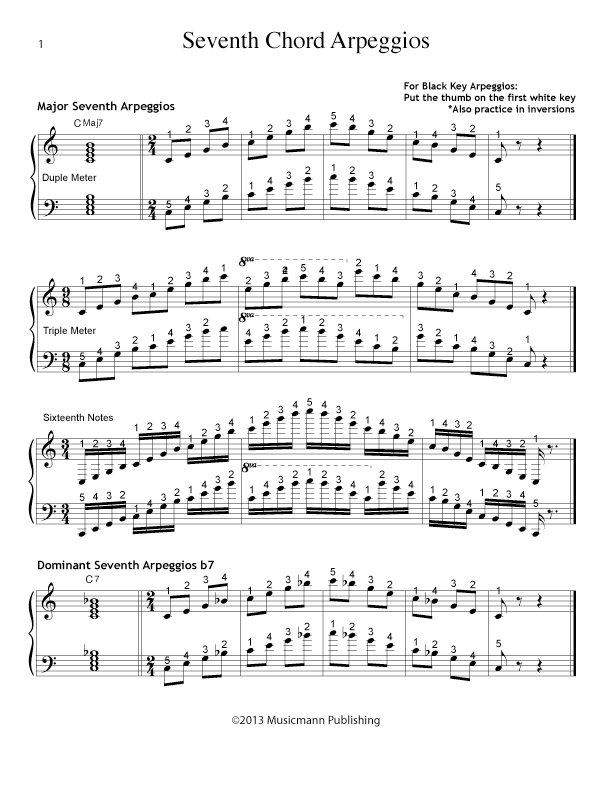
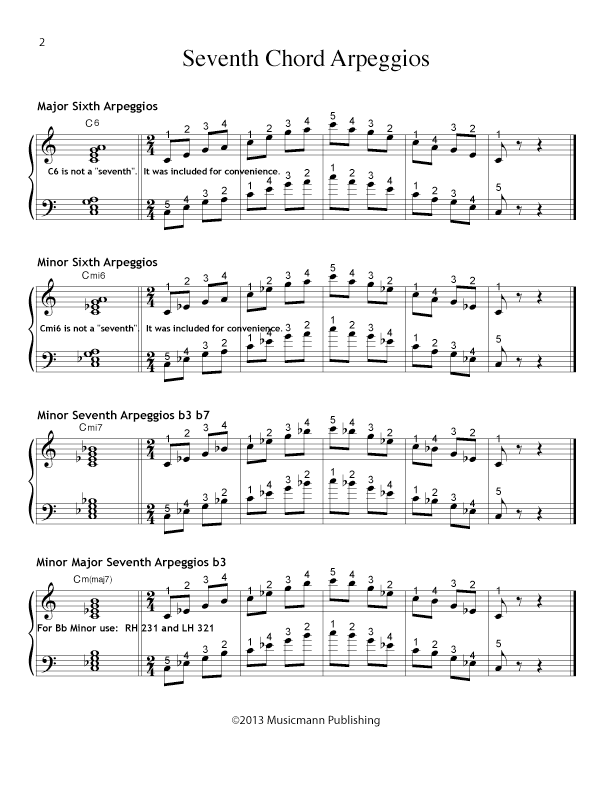
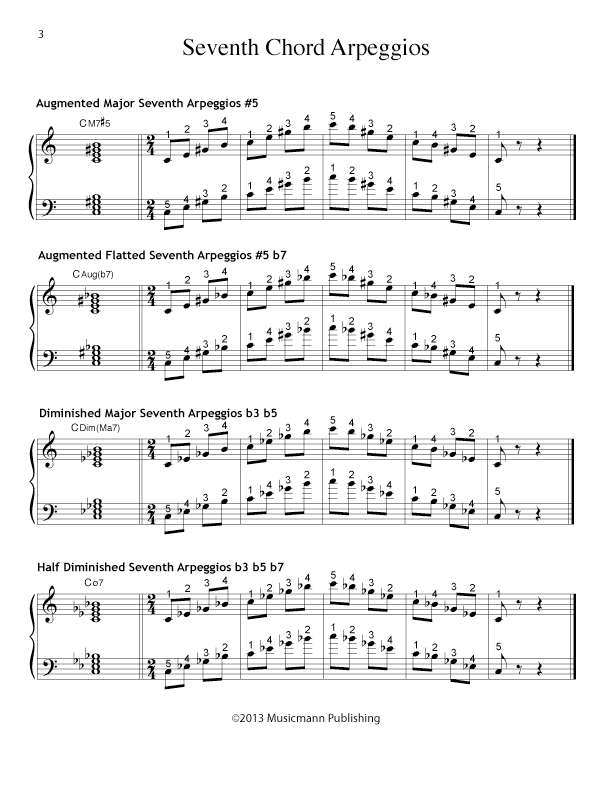
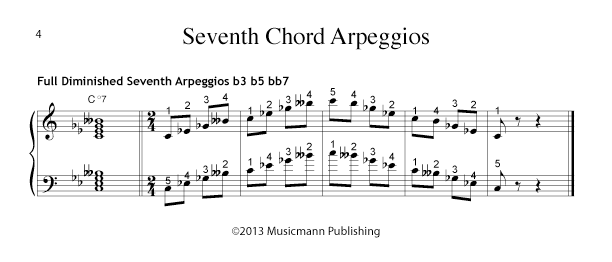
Practicing Major Triad Arpeggios 1-4
[features_box_yellow width=”75%” + border=”2px”]Level: Beginning
Start practicing arpeggios once you have begun studying “The Five Finger Exercise” and playing inversions of triads. The practice is the same as for learning scales. Play in duple meter (two octaves), triple meter (three octaves) and 16th notes (four octaves). Then – practice with a metronome. The goal is to play comfortably, evenly and legato, with a beautiful tone.
Once you have perfected playing the triad arpeggios, practice using musical parameters.
Once you can play arpeggios as triads (under Basic Theory) . . . then, begin practicing seventh chords (upcoming lesson).[/features_box_yellow]
Practicing Major Triad Arpeggios
Practice all the “white-key” arpeggios. The bottom note is on a white key. For instance, place your right hand thumb on C. Play up and down the white-key major triad arpeggio using the fingering 1-2-3-1-2-3-5 (two octaves). Then play the arpeggio with the left hand using the fingering 5-3-2-1-3-2-1. Then, play the hands together. (See Video )
Then, practice all the “black-key” arpeggios (except Gb, which uses the white-key fingering). The starting note is a black key. The fingering in the right hand is 2124 124. Fingering for the left hand is 2142 142.
Once you can easily . . . and evenly play arpeggios, practice with a metronome. Start slowly. Play two octaves in eighth-note duple meter, with the accent on every other beat. Then play three octaves with eighth-note triplets. Then play four octaves in sixteenth notes.
Once you play arpeggios in major triads, then practice in minor triads and augmented triads. (It is not recommended to play diminished triads in arpeggios. Rather, play arpeggios as a diminished seventh.)
A couple of things to remember when practicing arpeggios:
- The spaces between the keys are farther then when playing scales. Gently push the arms in the direction that you are moving. This places the balanced weight of each finger directly over each key. Try not to touch the sides of the white keys and place your finger securely on the center of the black keys.
- You have to pivot your wrist to allow the thumb to move under the hand to the next note. This would be up in the case of the right hand and down in the case of the left hand. When coming down in the right hand and up in the left hand, you collapse the thumb.
[membership_download_item_pdf link=”http://jsfp.s3.amazonaws.com/Arps.pdf”]Practicing Arpeggios[/membership_download_item_pdf]
[features_box_blue width=”75%” + border=”2px”]Personal Evaluation[green_tick_2_list width=”100%”]
- I can play all the Arpeggios comfortably to a metronome (continually increase the tempo).
- I can play all the Major, Minor and Augmented Arpeggios two octaves in duple meter, three octaves in triple meter and four octaves in sixteenth notes.
- My Arpeggios are automatic, even and played with a beautiful, legato tone.
[/green_tick_2_list][/features_box_blue]