

Learning Giant Steps for the Jazz Pianist Introduction
Giant Steps by John Coltrane has always been considered as a difficult tune for jazz pianists to understand, learn and play. Of course, adding to the complexity is that the tune is usually played very fast. I think, what we really need is a simple, step-by-step approach to studying this tune . . . then developing the tune into our subconscious. Once this tune is totally subconscious, we should be able to freely improvise on it.
This lesson on Learning Giant Steps contains four videos, downloadable PDFs, graphics of examples, and text. Scroll down this page for more instructional text. Video #4 contains backup tracks for your practice. You can practice soloing over Giant Steps in different styles and tempos. Have fun learning Giant Steps.
I’d also like to mention that I offer Skype lessons.
I’d love to hear your questions and feedback regarding this lesson. Please contact me at martan@jazzskillsforpiano.com. If you received this lesson as a “stand-alone” lesson . . . check out my online jazz piano course, JazzSkills for Piano (jazzskillsforpiano.com/wp).
Best to you –
–Martan 🙂

Videos
Video 1: Basic Understanding of Giant Steps:
Video 2: Melodic Development:

Video 3: Fast-Tempo Development:

Video 4: Giant Steps Practice Tracks
Step-by-Step
Step #1: Basic Understanding of Giant Steps
Let’s take a look at Giant Steps (Example 1). The tune is 16 bars. All of the principle chord relationships are based on the major third. In the original key, there are only three principle chords: B, G, Eb. Look down the first row and notice the keys: B, G, Eb and B. Also look down from the third measure: Eb, B, G and Eb (See Example 1). This is great for understanding the basic structure Giant Steps, but not helpful in creating a method to play it (See Example #1 below).
Step #2: Make a Practice Chart for Giant Steps.
The Practice Chart should contain the melody, bass note, chord changes, comping chords, and scales for each chord. You can also include any helpful analysis.
I suggest that you use a music notation app. For a free application, go to Finalemusic and download Notepad http://www.finalemusic.com/products/finale-notepad/.
Create a Practice Chart.
- Bassline
- Closed position chords and inversions
- Melody
- Chord names
- Scales for every chord
- Analysis
You can view the Practice Chart below (See Example #2 below).
Step #3: Practice in chord flows.
For “Flow #1”, say: “B, D, G, Bb, Eb” over and over until the chords are completely in the subconscious. Then For “Flow #2”, say: “G, Bb, Eb, F#, B” over and over. Then for “Flow #3”, say: “Eb, G, B, Eb” over and over (When you play this flow, you will play the II V before each chord). Just to mention: notice that flows #1 and #2 are descending major thirds and flow #3 is ascending major thirds. (The return to the top of the tune on measure 16 is descending.) (See Example #2: Chord Flows and Chord Chart)
Step #4: Practice flows with bass and melody.
Just play through GS with a single note in the bass and a single note in the melody. This helps to establish the basic melody and form of the tune in your subconscious.
Step #5: Practice scales for each chord.
Take a look at each of the scales for all the chords in Giant Steps. Make sure you can play the scales fluently (See Example #2 below).
Step #6: Practice flows with closed position left hand chords.
Play each of the flows using the closed position chords in the left hand, in all inversions through the tune. Then, play the closed position chords in all inversions through the entire tune (See Example #2 below).
Step #7: Continuous Melody Exercise
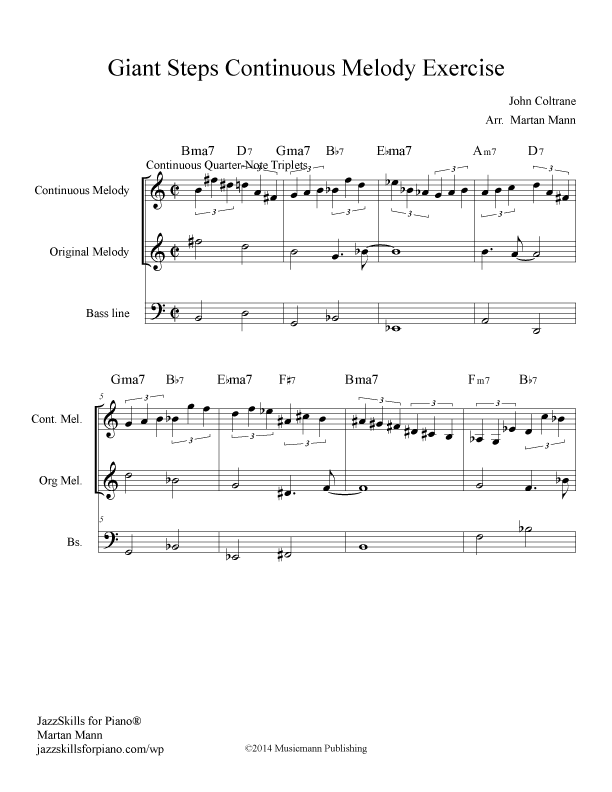
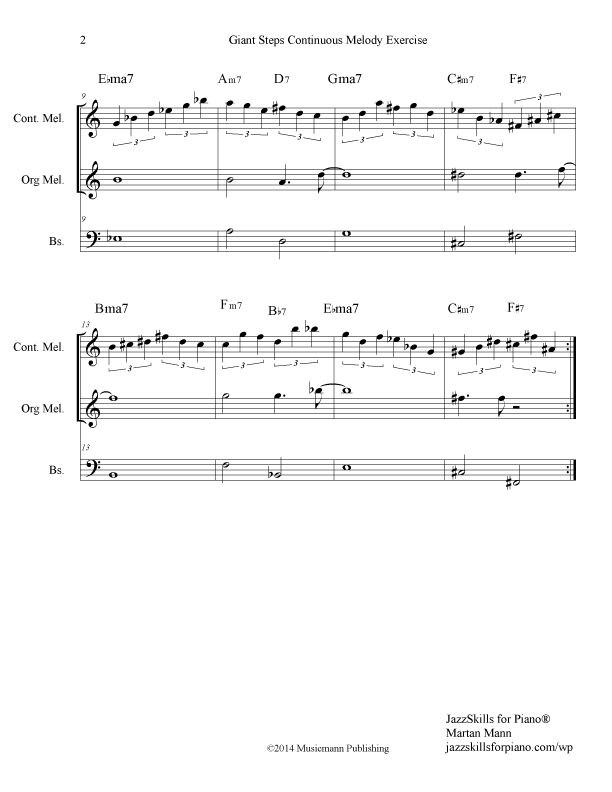
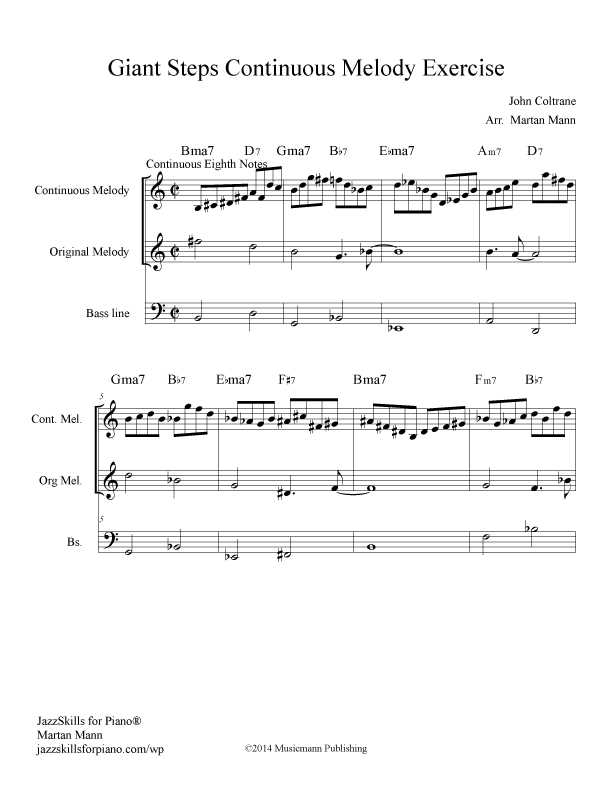
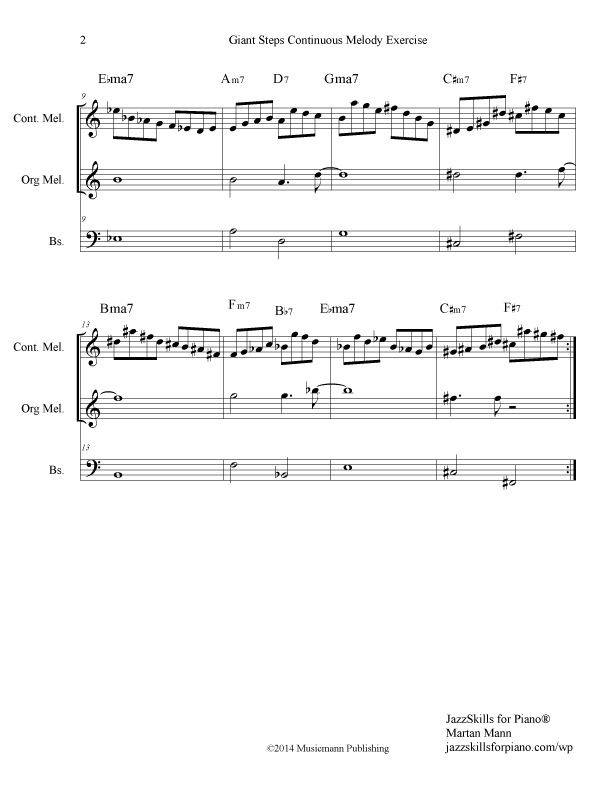
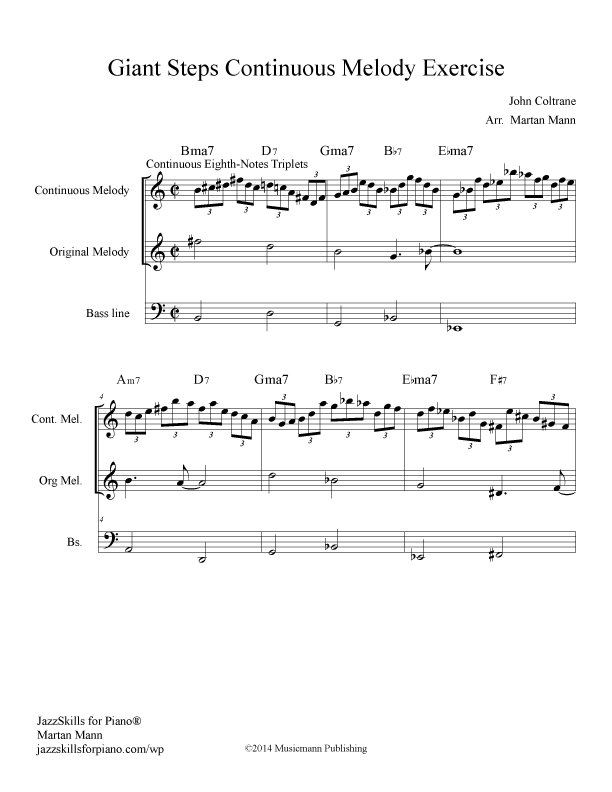
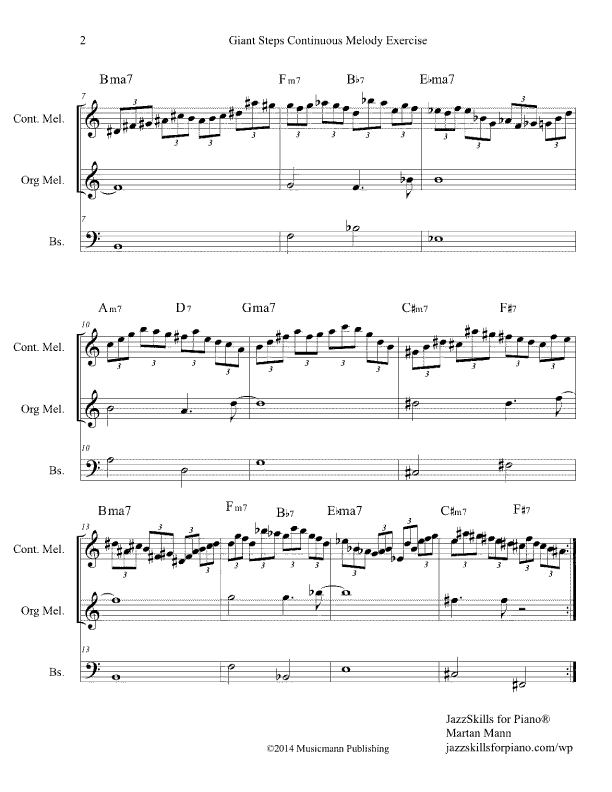
Practice the Continuous Melody Exercise using quarter notes, quarter-note triplets, eighth notes and eighth-note triplets through the tune. The left hand plays a single bass note or chord (See Example #3 below).
Continuously Play.
- Scales
- Triads
- Seventh Chords
- Pentatonics (1,2,3,5,6)
- Then, play melodies which use a combination of scales and chords (arpeggios). Be musical. Think forward.
Step #8: Slowly play each of the flows in the right hand as a complete melodic idea.
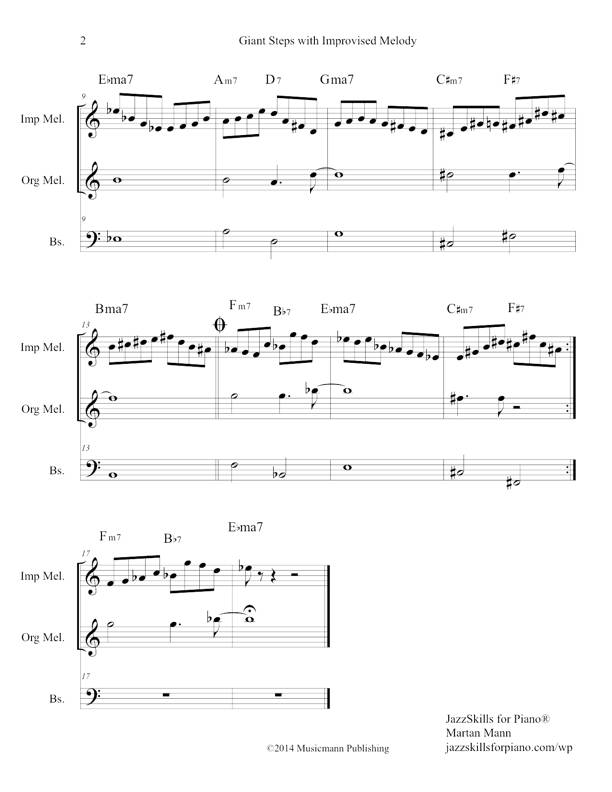
Practice making up melodies from one chord to the next chord. For instance, take the first chord, "B" and play melodic ideas forward to "D7". Always think and resolve ideas forward. Do this until you learn the "flow". Then practice playing slowly over the entire flow. Do this for all three flows.
Step #9: Play Giant Steps as a ballad.
Start playing GS slowly through the tune as a ballad. Take your time. Allow yourself time to think. Try to play the ideas emotionally. Resolve all your melodic ideas (See Example #1 above).
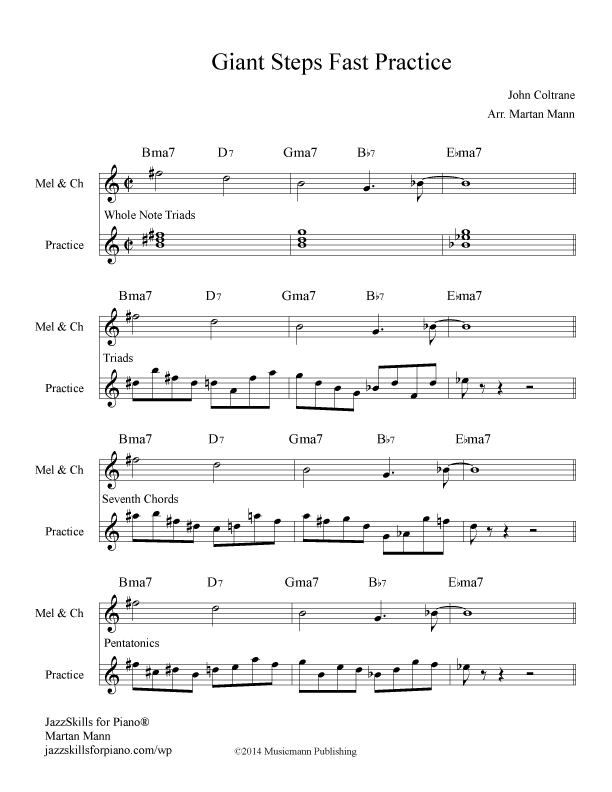
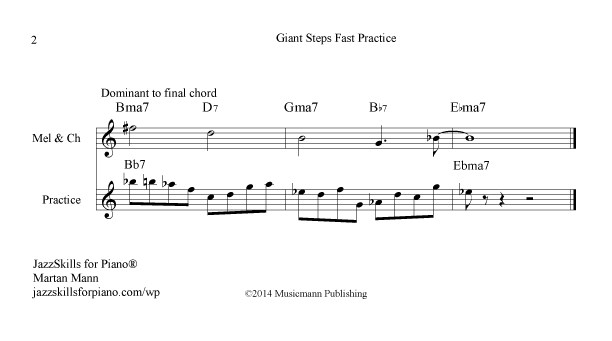
Step #10: Tune development for faster playing.
Tune development for faster playing.
- Practice Hanon, scales and arpeggios.
- Simplify the chord changes
- Practice in chords
- Practice with triads
- Practice with seventh chords
- Practice with Pentatonics
- Think of melodic rhythm
- Breathe in your playing
- Play musically w/phrasing
- Play GS in all keys
- Play GS with others
- Listen to recordings and transcribe solos
Step #11: Video #4 Giant Steps Practice
This video contains Band-in-a-box backup practice tracks. Enjoy practicing your Giant Steps improv.
Video 4: Giant Steps Practice.
- Bossa Nova - Starts at 15 seconds
- Easy Swing - Starts at 2m 40s
- Fast Swing - Starts at 5m 05s
- Very Fast Swing - Starts at 6m 50s
EXAMPLES
EXAMPLE #1: Basic Giant Steps Chart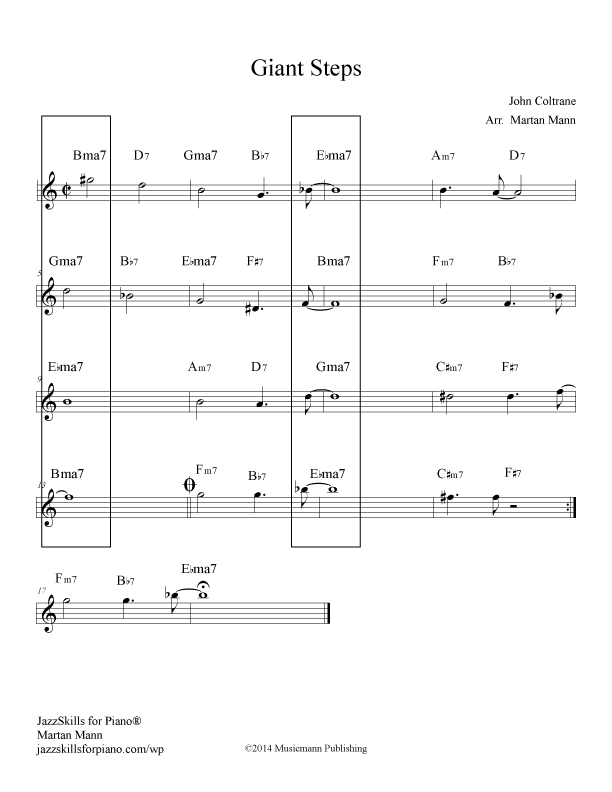
EXAMPLE #2: Chord Flows and Practice Tune Chart
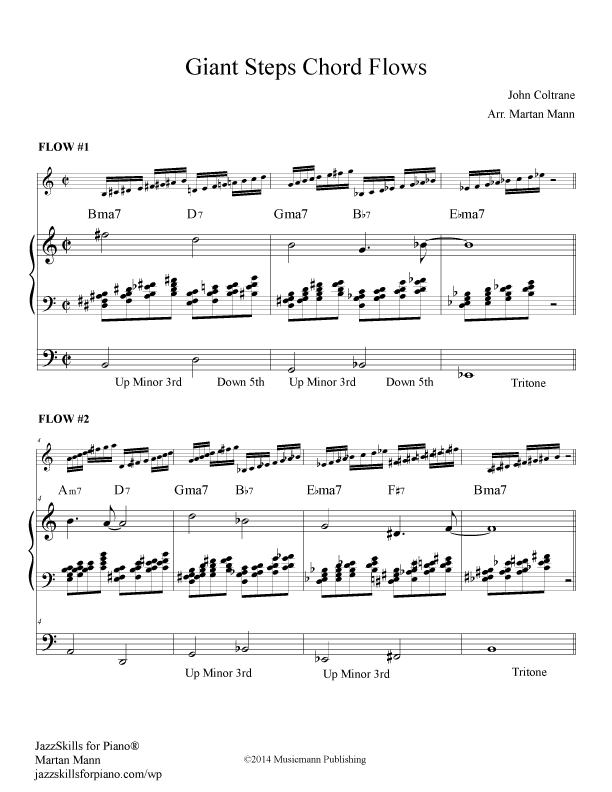
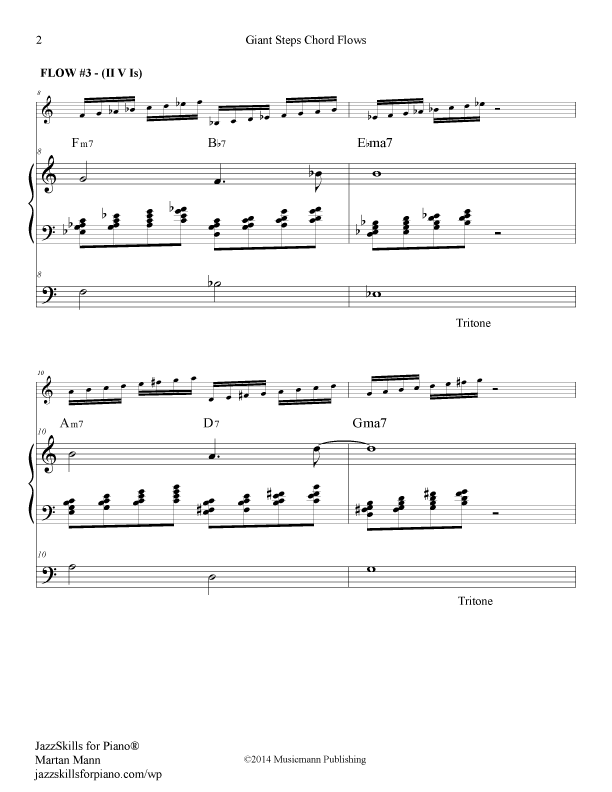
EXAMPLE #3: Giant Steps Continuous Melody Exercise
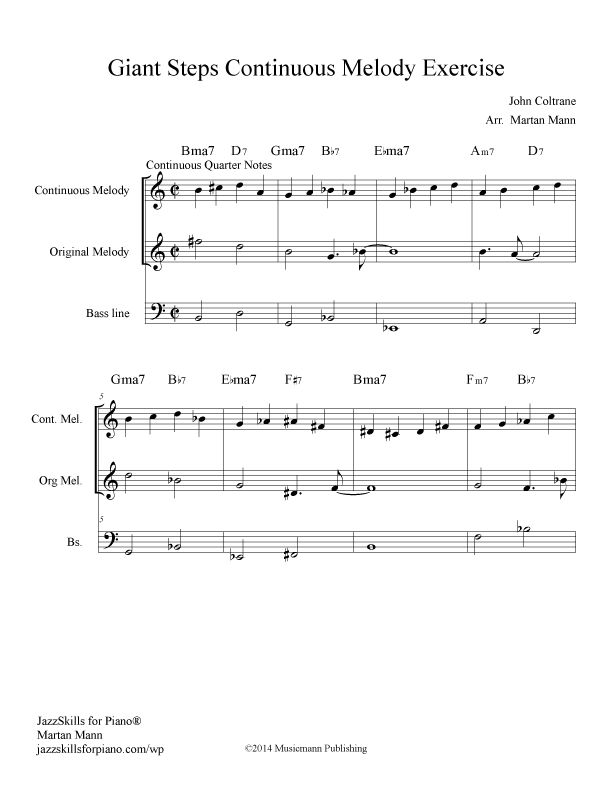
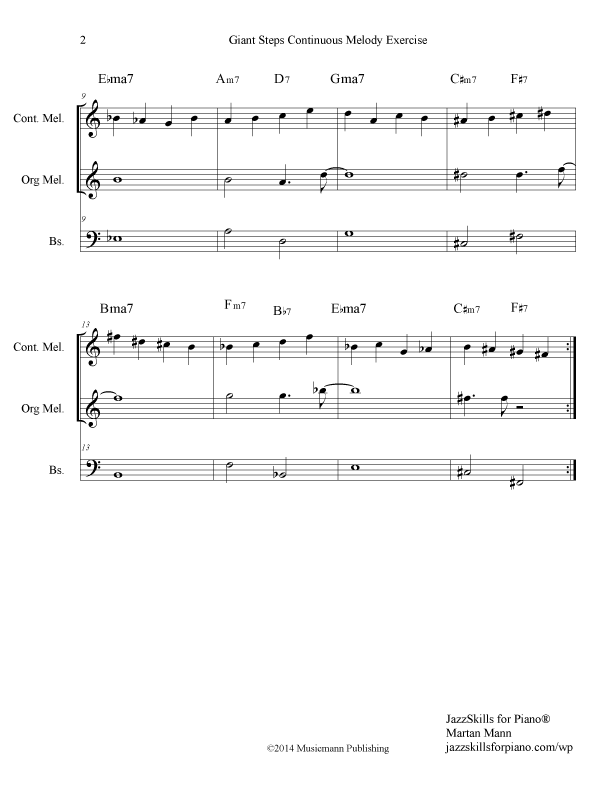
DOWNLOADABLE PDFS
