Modal Improv for the Jazz Pianist Introduction:
Modal playing is a very distinctive style for a jazz pianist. It “opens up” your playing, using the entire range of the piano. It increases your harmonic knowledge. This step-by-step lesson gives specific analysis, instruction and exercises to develop modal playing into your personal style. This is a very intensive lesson with eight videos, downloadable PDFs, text, playalong with Band-in-a-box and reference to modal tunes.
I’d also like to mention that I offer Skype lessons.
I’d love to hear your questions and feedback regarding this lesson. Please contact me at martan@jazzskillsforpiano.com. If you received this lesson as a “stand-alone” lesson . . . check out my online jazz piano course, JazzSkills for Piano (jazzskillsforpiano.com/wp).
Best to you –
–Martan 🙂

Videos
Video 1: Explanation of the modes
Video 2: Modal Parameters
Video 3: Chord Structure Exercise
Video 4: Diatonic Turnaround Progression
Video 5: Voicings
Video 6: Modal Soloing
Video 7: Modal Exercise - Comping (Playalong Practice)
Video 8: Modal Exercise - Soloing (Playalong Practice)
Step-by-Step
Step #1: Explanation of the modes.
To learn the modes, first find a scale. That scale is defined by having an specific arrangement of half steps and whole steps. For instance: the major scale has half steps between 2&3 and 7&8. A dorian mode (starting on the second degree) has half steps between 2&3 and 6&7.
The Modes of the Major Scale:
- Ionian 1-1
- Dorian 2-2
- Phrygian 3-3
- Lydian 4-4
- Mixolydian 5-5
- Aeolian 6-6
- Locrian 7-7
Step #2: How do you learn the modes?
The best way to think of the modes is to think off of chords. Every chord suggests a mode. For instance: a D minor 7 chord suggests using the dorian mode. The best way to think and hear the modes is from the bottom note of the mode. For instance: think of the D dorian mode as a D major scale with a flatted 3rd and 7th.
Learn the Modes from the bottom note:
- Ionian: 1-1 Major Scale
- Lydian: 4-4 Sharp 4
- Mixolydian: 5-5 Flat 7
- Dorian: 2-2 flat the 3 and 7
- Aeolian: 6-6 flat the 3, 6 & 7
- Phrygian 3-3: flat the 2,3,6,7
- Locrian 7-7: flat the 2,3,5,6,&7 (also think up a half step to the major scale)
Study each mode in all keys. Play each mode until it is automatic in your ears and fingers.
Step #3: What is modal improv?
Modal Improv is playing with, and blending scales. As a pianist, you "see" the scales in front of you. When you play modally, you are playing within one chord. You are thinking of one tonality at a time. Learning diatonic scales and modes is an important first step. Diatonic means playing within the major scale.
Step #4: Pentatonic Black Key Improv Exercise
In this exercise, you use only the black keys. That gives you a pentatonic scale (1,2,3,5,6). The main problem with improvising only on the pentatonics that that there is not a lot of tension. The tension notes, aka "leading tones" are not there. You do not have a tritone or a V7 to I.
How do you make sense with your improv when you don't have tension? You have to study all the other parameters of music. Parameters are the elements which create music. You must create drama. Drama is created by first having a "there there". You must set up a premise . . . and then manipulate the premise. First analyze the parameters of music.
Some Parameters of Music
- Rhythms
- Meter
- Rubato
- Tempo
- Melodic Sequences
- Phrasing and Touches
- High and Low
- Dynamics
- Dense or Sparse
- Modes or Chords
- Voicings
- Style
- Etc.
When you are playing, think: "how loud am I playing?". How fast . . . or dense? What is the meter? Observe what parameters you are using to create your improv. You need to create a "happening" for your improv to be successful. Play on and on and notice the point where you "lose it" . . . where you lose your premise and definition. It's difficult to recapture a "dramatic event".
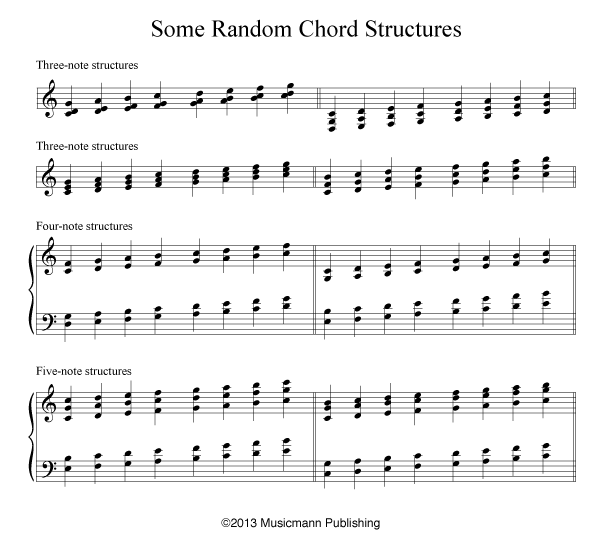
Step #5: Chord Structure Exercise
The best way to dive into modal playing is to study chord structures. Play in all scales and all keys. It's probably best to start with the major scale. Start with three-notes. Play different structures. Analyze them by their intervals. Don't judge the sounds. Just play the structures up the scale or make melodies. Also, use 4-note and 5-note structures. The structures, scales and keys are all your own choice. The purpose is to get these sounds into your hands and head.
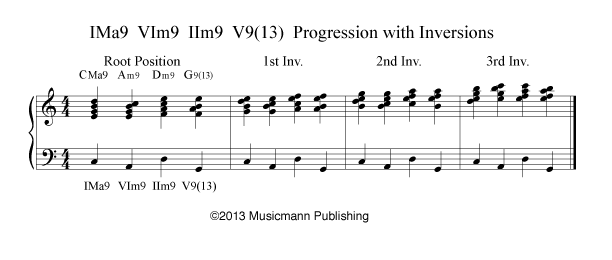
Step #6: Diatonic Turnaround Progression
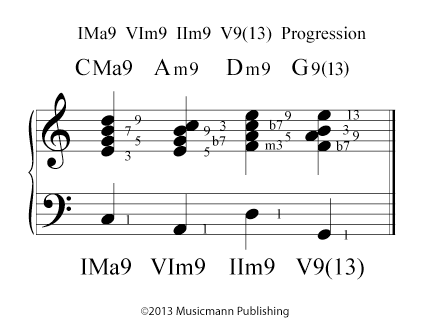
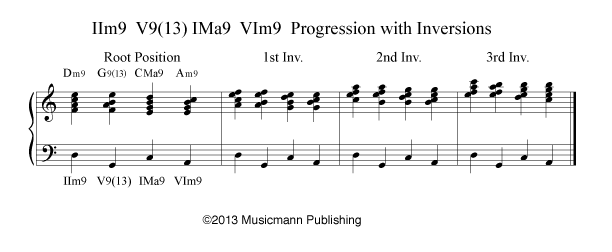
One of the most important progressions to help your modal improv is the diatonic turnaround progression. This is a IIm9, V9/13, IMa9, VIm9 or the IMa9, VIm9, IIm9, V9/13. Learn this progression in all keys and all inversions. Play with the bass root note and chord in RH and also chord in LH (sing the root). Play around the Cycle of Keys in 4ths and 5ths. Also, play up and down chromatically.
Step #7: Developing Strong Voicings
1) Core Voicings: Sometimes we can be too random in choosing voicings. This results in voicings that we may not want to use. Here are a couple of ideas to strengthen your voicings.
First, use "Core Voicings". You can find some of these core voicings in the Diatonic Turnaround Progression. Play the closed position voicing and then add in additional diatonic notes from the major scale. Use your ears to determine the choices that you like. You can also play the core voicing in the right hand and add in the additional notes in the left hand. You can also use the additional notes as melodies.
2) Using 2nds and 4ths: Play fourths in the left hand and add in 2nds in the right hand. You can also do the reverse: play the fourths in the right hand and add the seconds in the left hand. Do this by ear.
3) "So What Voicing": Another idea for strengthening your voicings is to use the "So What Chord". This is a prominent chord used throughout jazz. The intervals from the top down are 3, 4, 4, 4. This chord is ambiguous and can be used as a major 9 (add a root a major 3rd below), Minor 11 (the root is the bottom note of the "So What Chord", and Sus chord (add a root a major 6th below). Play this chord all over the piano. Think melodically.
Step #8: Modal Soloing
One of the problems with creating a modal solo . . . is that you usually stay on one chord or mode for a long time. For instance, if you are playing on a D minor 7, you will possibly be playing on a D Dorian Mode. Any of the notes of that mode are OK. However, this creates a problem. It's very easy to create a boring solo, where you are just "filling up space".
The left hand usually comps playing fourths. You might want to avoid the fourths which have a tri-tone. They are not as "smooth" as the perfect-fourth fourths.
Ideas for Modal Soloing
1) Use all the music parameters. Think about the parameters as you are soloing. Work on your phrasing.
2) Licks and musical phrases all should land on a specific destination point.
3) Sing as you play. Develop your own language and dialect to help your musical phrasing and style.
4) Think from V7 to I. You can do this diatonically. You can also use an V alt (#9, b13) to I.
5) Set up a pedal tone in the left hand bass. Then play different chords over the pedal tone in the right hand. I often use a pedal tone using the V - but, you can also use a I pedal tone. Make sure that you resolve this to the I chord.
6) Always create melodies for dramatic effect. Create interest.
Step #9: Modal Exercise #1 - Comping (Playalong Practice)
Use Modal Exercise #1. This is a simple exercise where you choose one mode . . . and then, play that mode in different keys. You can choose how many measures to play on each mode.
In my example: I have chosen the dorian mode in four different keys (Dm, Fm, Abm, Cbm). Each key is 8 measures. The entire play along solo is 3 choruses.
I am using Band-in-a-box using a sax lead. I am comping behind the sax player. Use chord structures. Think of the top note of the structure as a "melody" note. If you don't have band-in-a-box, you can "imagine" a solo and just comp using a metronome. Or perhaps you have a friend who can play a solo.
In the second example: It is your turn. You can play using the play along audio. Have fun.
Step #10: Modal Exercise #2 - Soloing (Playalong Practice)
Use the Modal Exercise #2: the Mixed Modal Exercise. In this exercise, you choose what mode, key, how long and style. It's totally arbitrary.
In the Band-in-a-box play along, I chose the following:
G7 - Mixolydian (b7)
Ebm9 - Phrygian (b2,3,6,7)
Am7(b5) Locrian (b2,3,5,6,7) (or think up a half step)
Fm7 - Dorian (b3 and b7)
This is in a swing jazz style. Three choruses.
If you don't have BIAB . . . then use a metronome.
Enjoy.
Some examples of jazz modal tunes:
EXAMPLES
EXAMPLE #1: Modes from each note in the scale.

EXAMPLE #2: Modes from bottom note of the scale.
EXAMPLE #3: Some Random Chord Structures in F Major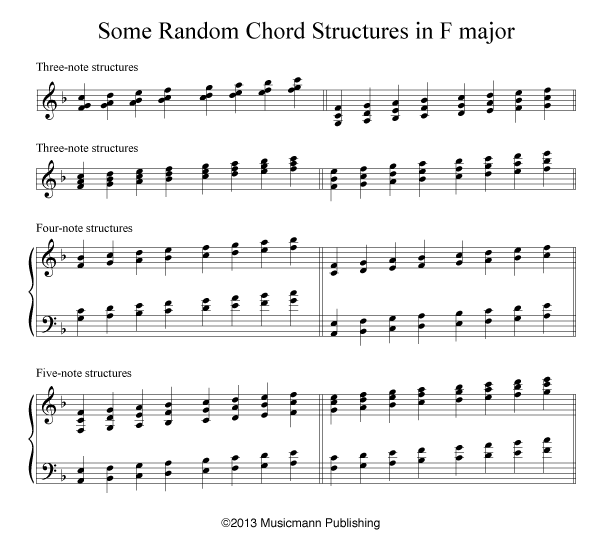
EXAMPLE #4: Diatonic Turnaround
EXAMPLE #5: "So What Chord"

EXAMPLE #6: Modal Exercise #1 and #2
DOWNLOADABLE PDFS
Downloads