


Learning Boogie Woogie Introduction:
I love playing Boogie Woogie. It’s a great solo piano style. It’s not difficult to play and it’s loved by audiences. Boogie Woogie is a wonderful way to develop the ability to play with groove and to learn the Blues in general. It is recommended that you study playing this style Step-by-Step.
To mention: this lesson is part of my online jazz piano course, “JazzSkills for Piano” (www.jazzskillsforpiano.com). If you are looking for a complete and serious course in jazz piano, this course is for you. Also, JazzSkills will help you to gain the basic skills to develop Stride Blues skills.
I am happy to answer your questions and hear your suggestions and feedback. Contact me at martan@jazzskillsforpiano.com.
Best –
Martan 🙂

Videos
Video 1: Learning a Basic Boogie Woogie Accompaniment

Video 2: Developing Soloing #1
Video 3: Developing Soloing #2
Video 4: Miscellaneous Thoughts on Boogie Woogie

Step-by-Step
Step #1: Explanation of the 12-Bar Blues.
The Basic 12-bar Blues is in three groups or sections of four-bars.
I Section: I I I I
IV Section: IV IV I I
V Section: IV V I V
Step #2: Boogie Woogie Accompaniment.
This is a basic Boogie Woogie Accompaniment. Learn this accompaniment thorougly so that you can play it freely and easily.
Step #3: Boogie Woogie Groove.
Work hard to develop a good groove playing the Boogie Woogie. Remember: a good groove pushes the beat of the metronome.
Step #4: Boogie Woogie with the Left Hand.
Now we are dropping the Right Hand and playing the BW in the Left Hand.
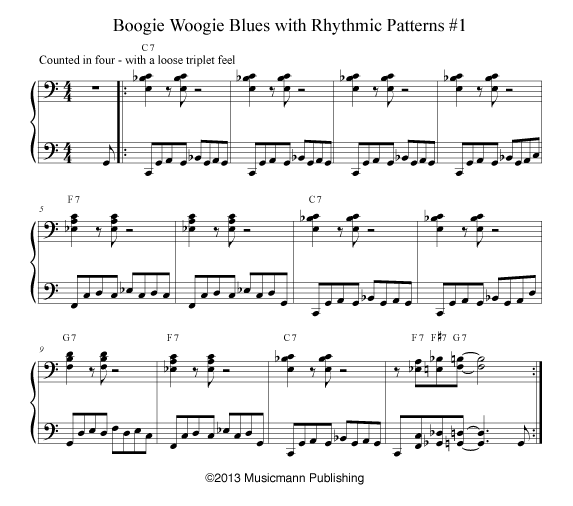
Step #5: Boogie Woogie Rhythmic Patterns.
A good idea before soloing . . . is to play rhythmic patterns.
Step #6: Boogie Woogie w/Mixolydian Mode.
Here we are using the Mixolydian Mode to create melodies.
Step #7: Boogie Woogie w/Mixolydian Mode with Chords.
We are playing the Mixolydian Mode with chords.
Step #8: Boogie Woogie Creating Melodies.
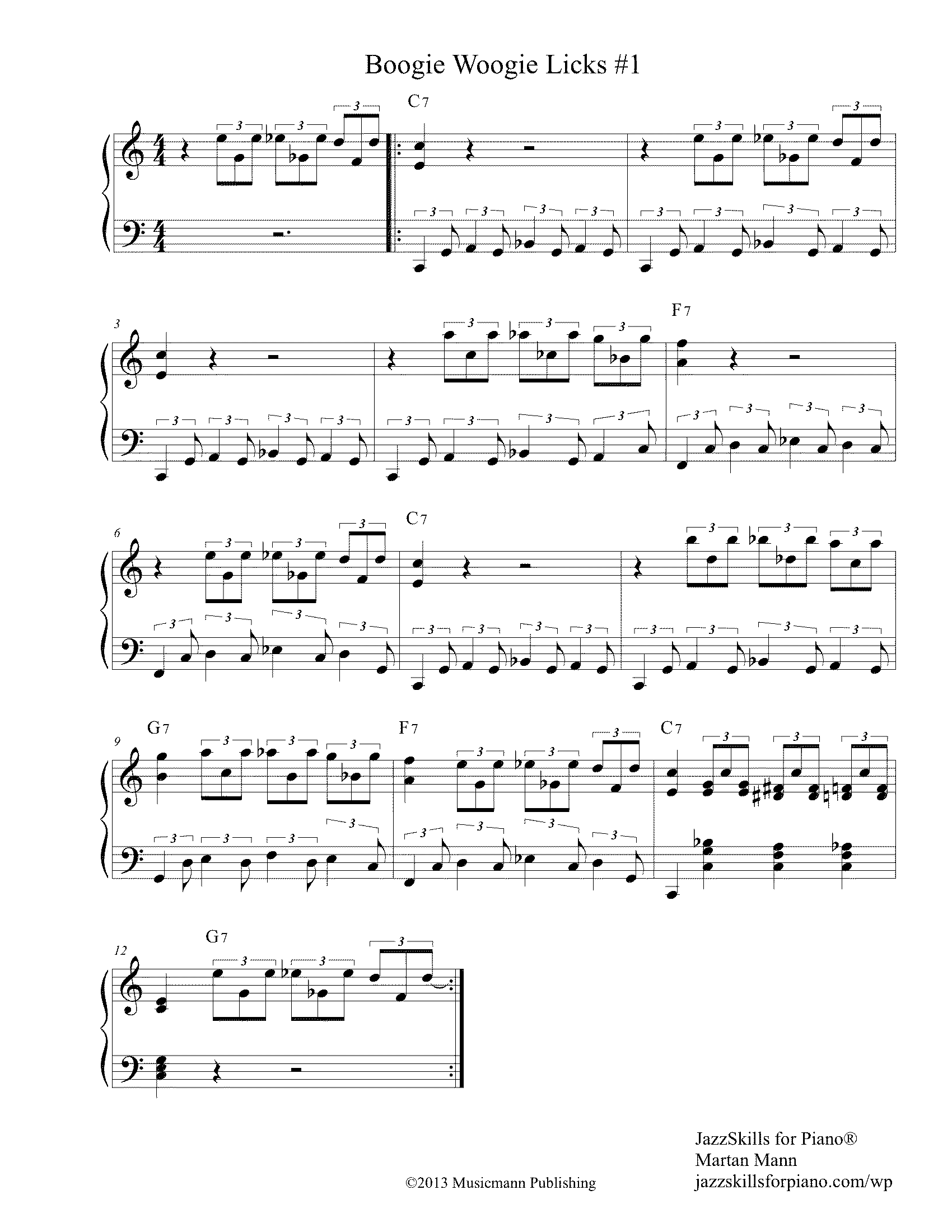
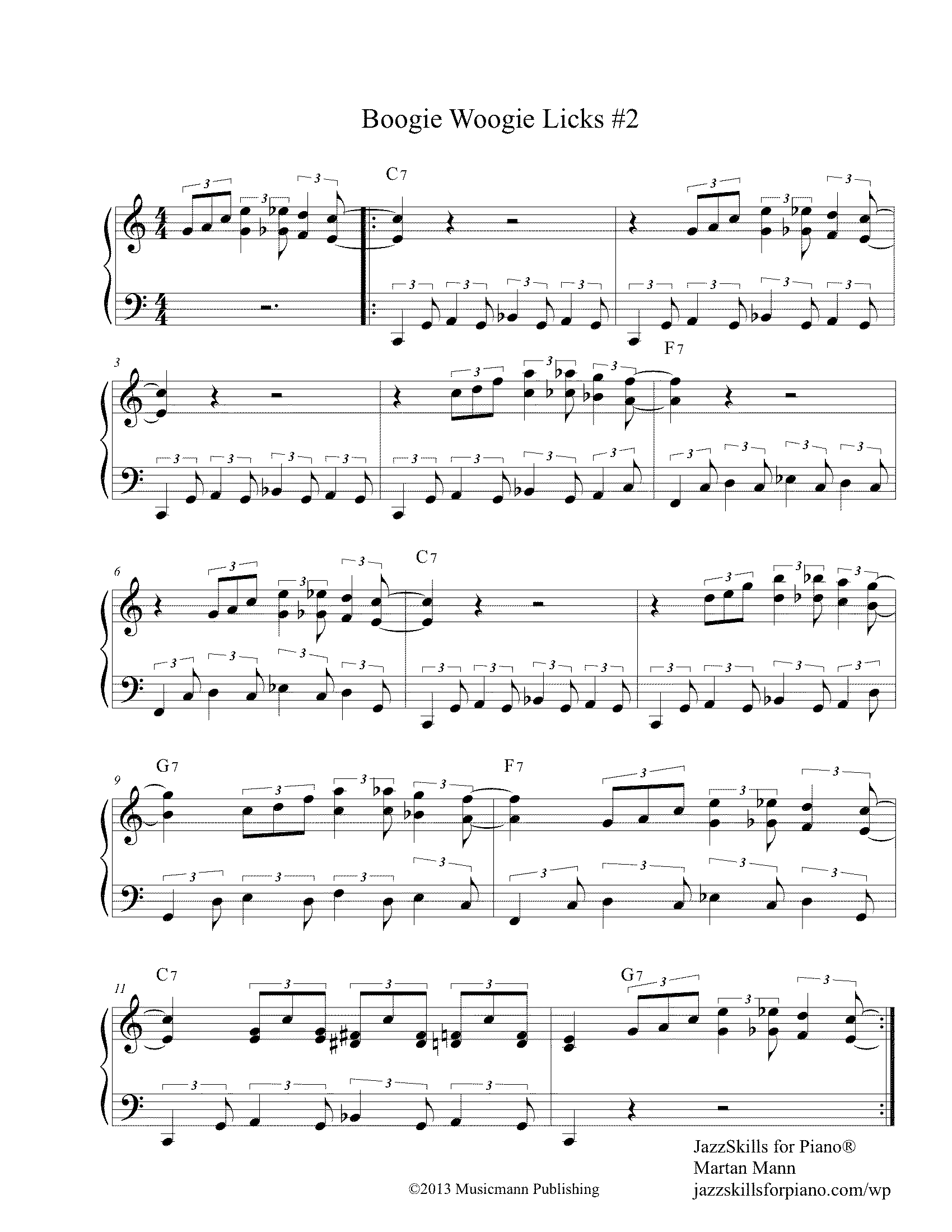
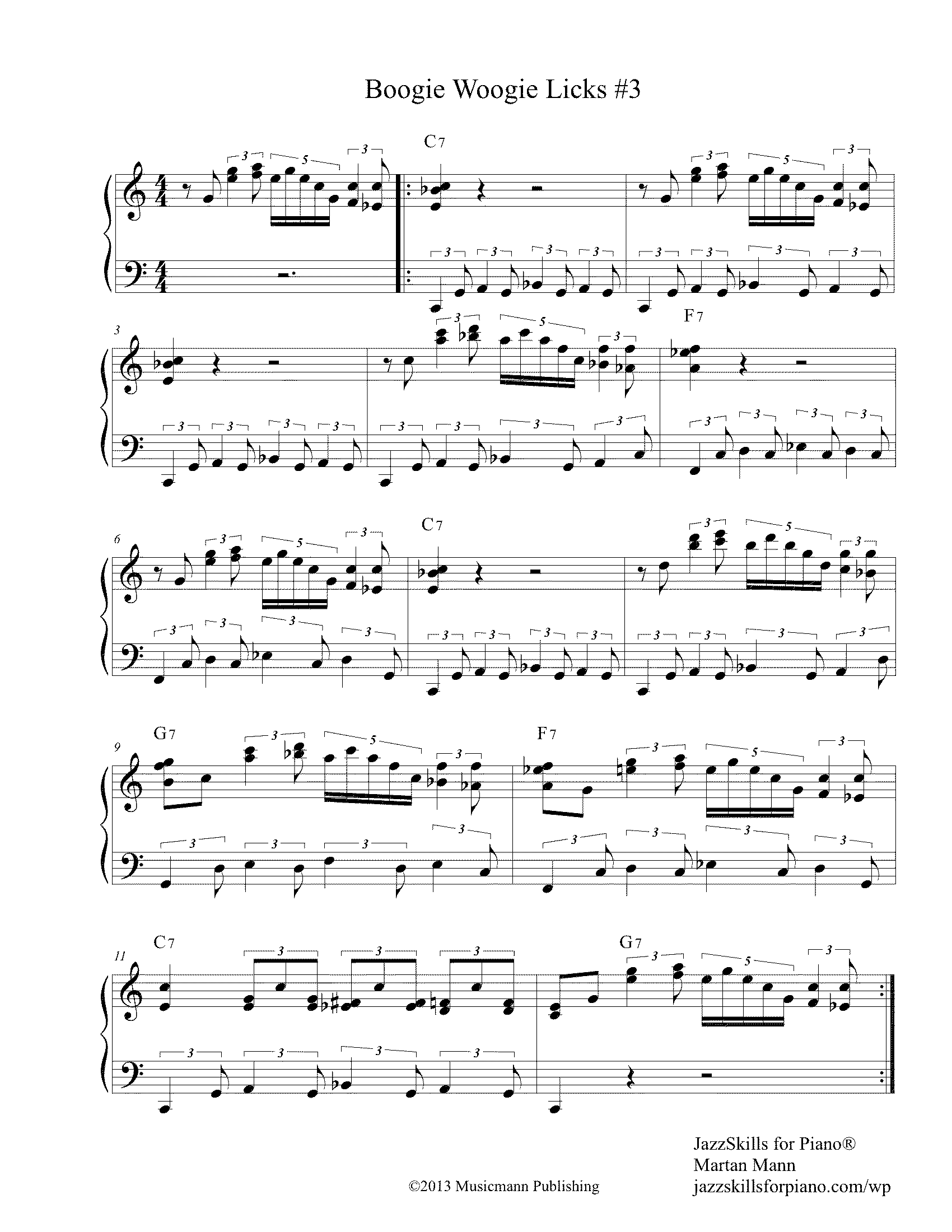
Here are three sample BW licks. Notice that they are all based on “pick ups” . . . which move forward to the next chord.
Step #9: Boogie Woogie Scales.
I offer two choices of scales: the Blues Scale and the Mixolydian Plus Scale (Mixolydian Mode plus a flatted 3 and 5).
Step #10: Continuous Melody Exercise.
This is a great way to learn how to solo (in all styles). Play continuously in Quarter Notes, Quarter-Note Triplets, Eighth Notes and Eighth-Note Triplets.
Step #11: Rhythmic Melody Exercise.
After you master the Continuous Melody Exercise, practice playing specific melodic rhythms through the 12-Bar Blues form.
Step #12: Boogie Woogie Ostinato Patterns.
Any Ostinato is a repeating pattern, usually in the bass. Study lots of Boogie Woogie Ostinato Patterns.
Step #13: Boogie Woogie Eight-Bar Blues.
The BW 8-Bar Blues leaves out the IV Section of the 12-Bar Blues Form.
I I I I V IV I V
Step #14: Boogie Woogie Endings.
Here are some sample BW endings and licks.
©2014 Musicmann Publishing
EXAMPLES
EXAMPLE #1: Basic 12-Bar Blues Form
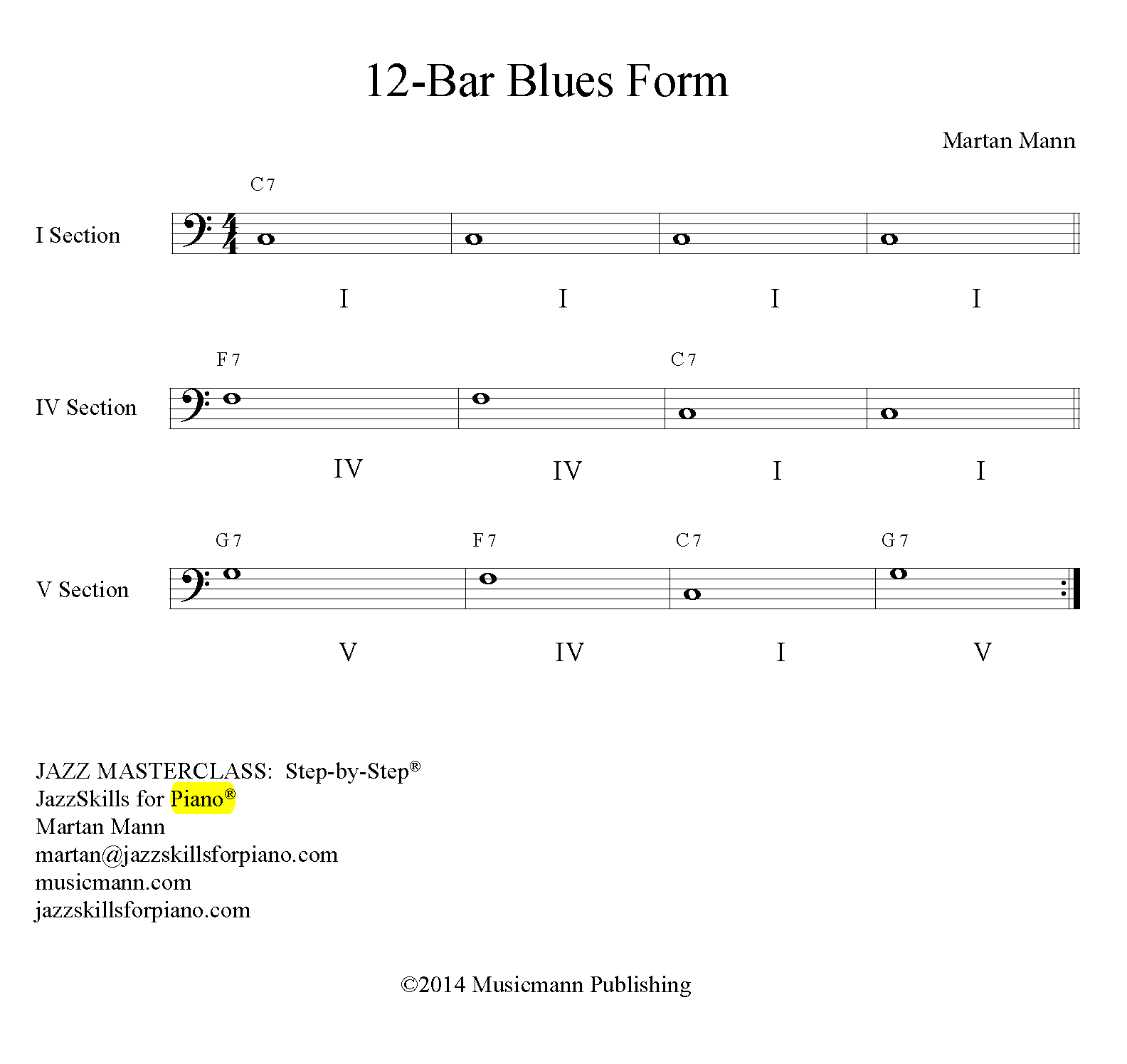
EXAMPLE #2: Boogie Woogie Blues - Accompaniment #1

EXAMPLE #3: Boogie Woogie Blues w/Rhythmic Patterns #1
EXAMPLE #4: Boogie Woogie w/Rhythmic Patterns #2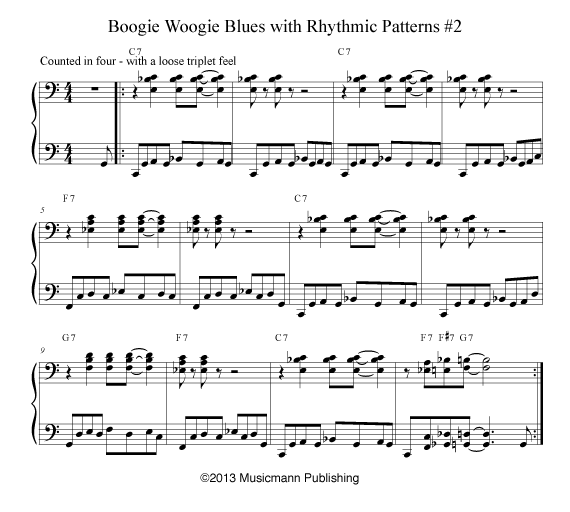
EXAMPLE #5: Boogie Woogie Mixolydian Mode

EXAMPLE #6: Boogie Woogie Licks. 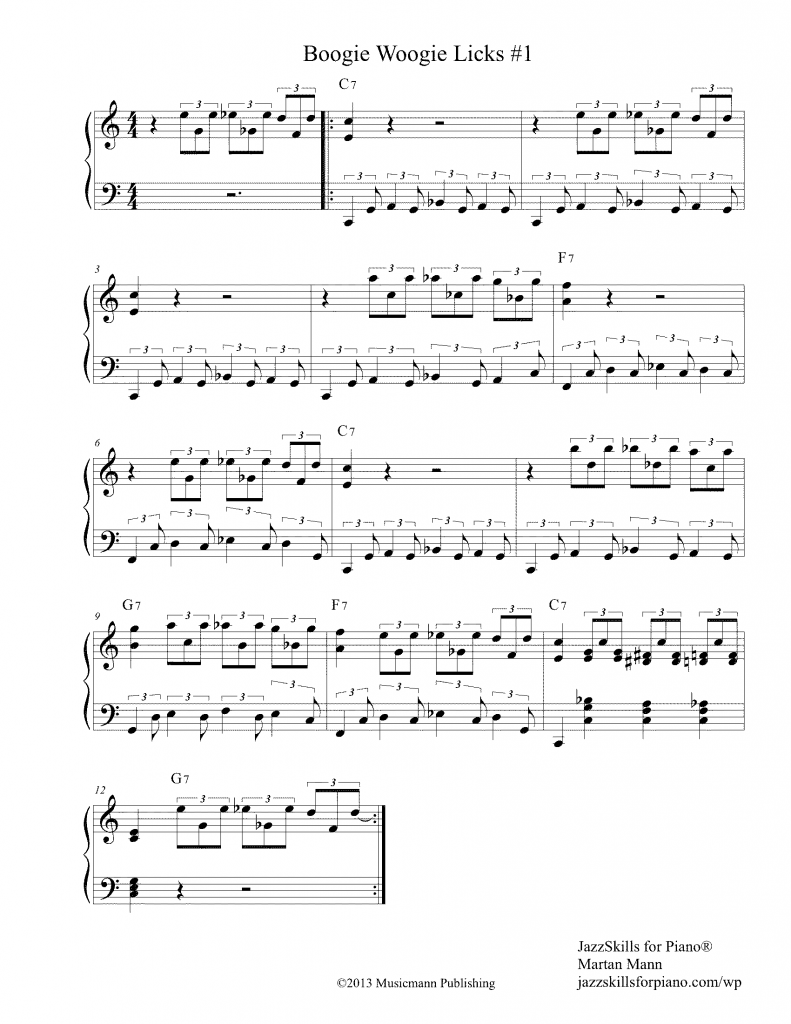
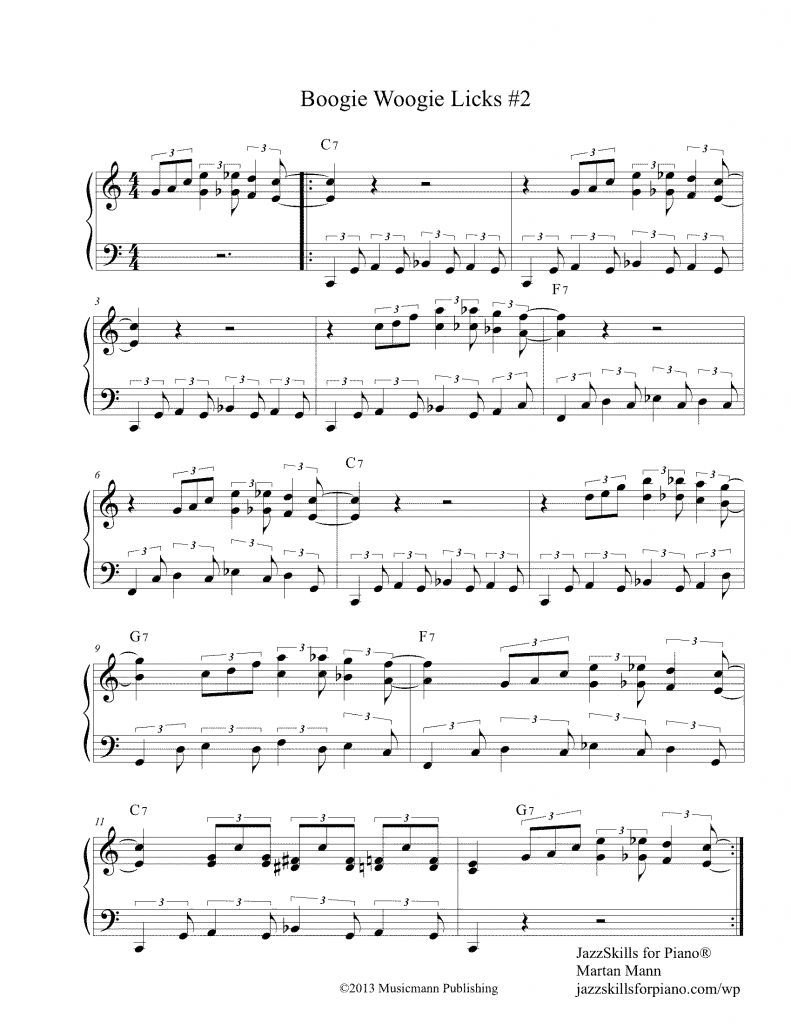
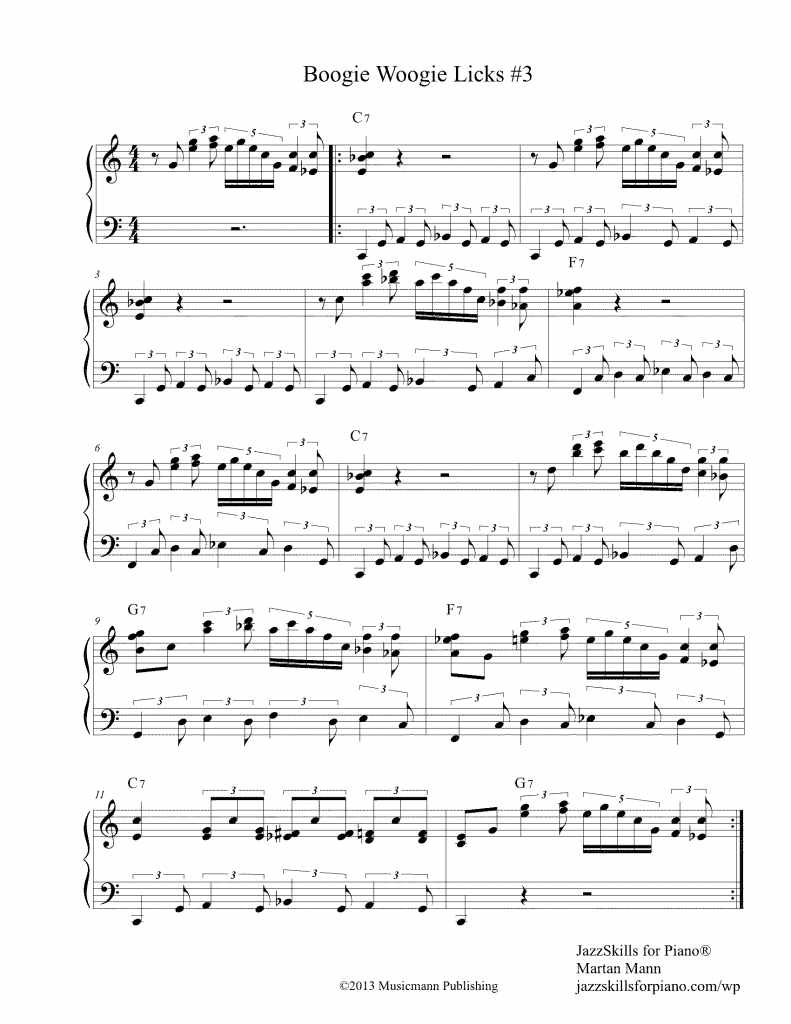
EXAMPLE #7: Blues Scale 
EXAMPLE #8: BW Continuous Melody Exercise


EXAMPLE #9: BW w/Rhythmic Patterns

EXAMPLE #10: Sample Boogie Woogie Ostinatos

EXAMPLE #11: BW 8-Bar Blues

EXAMPLE #12: BW Sample Endings

DOWNLOADABLE PDFS
Downloads
