Stride Groove Bass w/Melody 17-8-4

Stride Groove Bass w/Melody 17-8-4

[features_box_yellow width=”75%” + border=”2px”]Level:  Advanced

After you have mastered the Stride Groove Bass w/Continuous Melody, start learning the Stride Groove Bass w/Melody.[/features_box_yellow]
video
play-sharp-fill

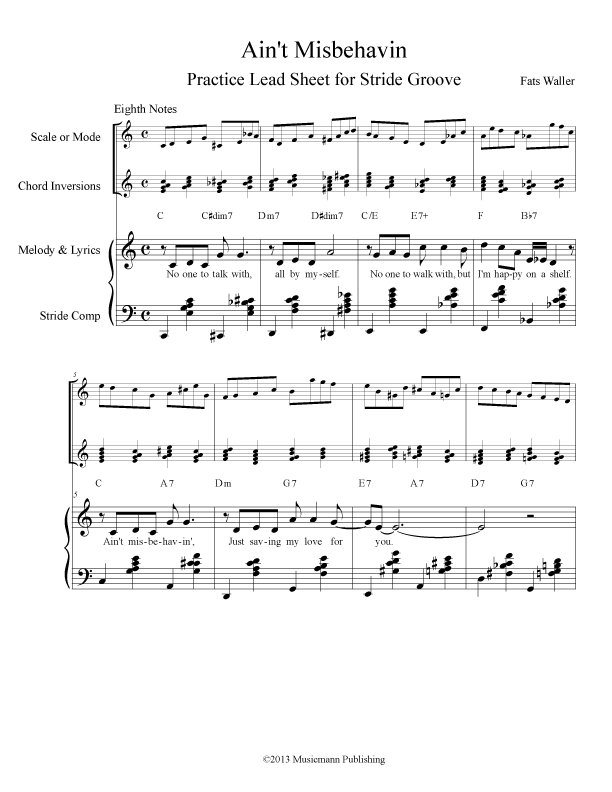
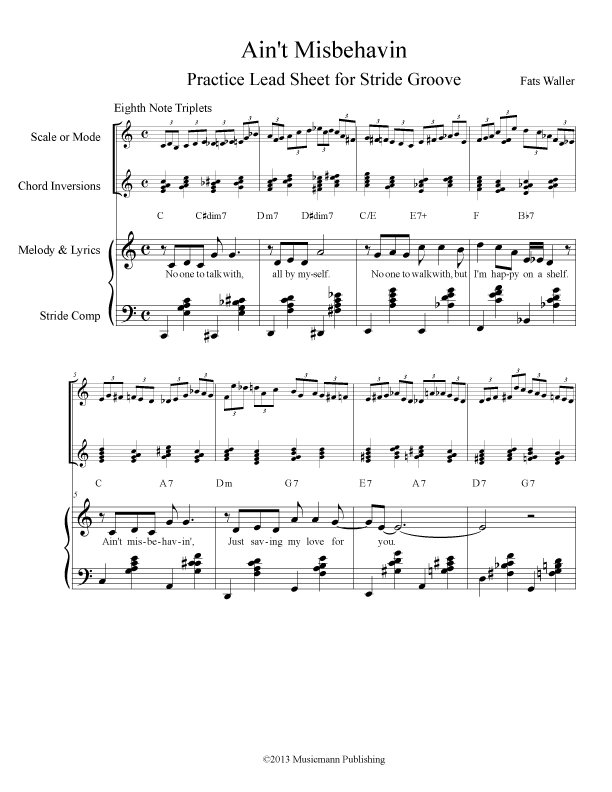
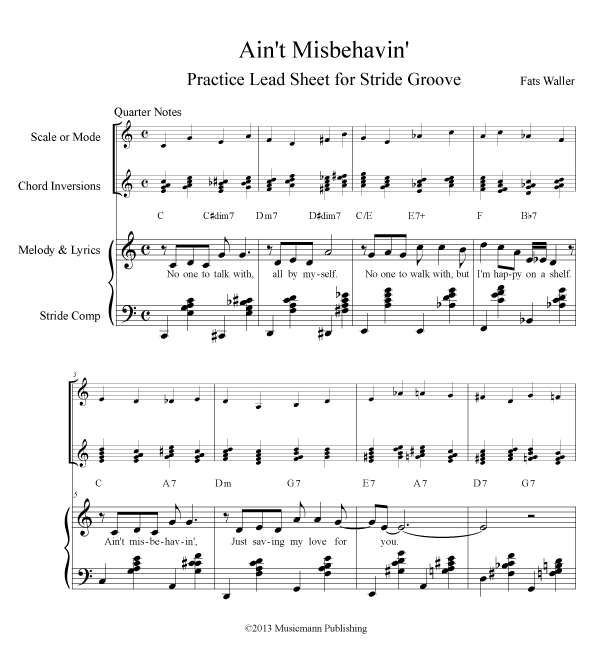
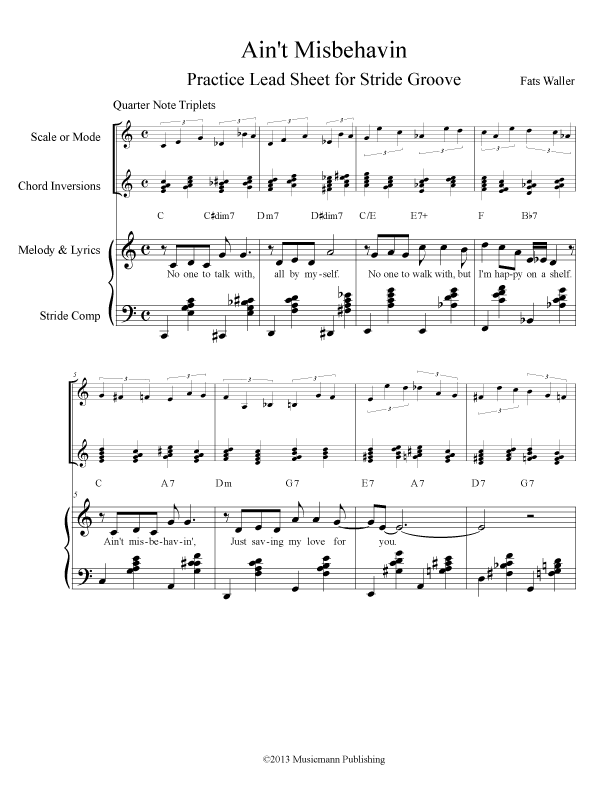
Developing playing and phrasing the melody of “Ain’t Misbehavin'”:

  1. Don’t play the melody the way it is written on a lead sheet.
  2. Speak and sing the lyrics.  Notice how many ways you can say the lyrics and the way that effects the way you play the melody.
  3. Left hand plays a simple bass note and you sing and say the lyrics through the tune.  Play a stride accompaniment with the left hand.
  4. Then play in the right hand what you are singing.
 

Ain'tMisbehavinContMelPg1Ain'tMisbehavinContMelPg2Ain'tMisbehavinContMelPg3Ain'tMisbehavinContMelPg4

[membership_download_item_pdf link=”http://jsfp.s3.amazonaws.com/Ain’tMisbehavinContMel.pdf” + target=”_self”]Ain’t Misbehavin’ Continuous Melody[/membership_download_item_pdf]


[features_box_blue width=”75%” + border=”2px”]Personal Evaluation

[green_tick_2_list width=”100%”]

  • I don’t play the melody the way it is written on a lead sheet.
  • I can speak and sing the lyrics.
  • I can play a simple bass note with the left hand sing and say the lyrics through the tune.  I am playing a stride accompaniment with the left hand.
  • I can then play in the right hand what you are singing.
[/green_tick_2_list]

[/features_box_blue]


Bossa Nova w/Modal Melodic Rhythm 14-1-7

Bossa Nova w/Modal Melodic Rhythm 14-1-7

[features_box_yellow width=”75%” + border=”2px”]Level:  Advanced

After you have studied the Bossa Nova w/Left Hand Melodic Rhythms, start studying Bossa Nova w/Modal Melodic Rhythm. [/features_box_yellow]

video
play-sharp-fill

Ideas for playing Bossa Nova with Modal Rhythms and Melody:

  1. Dorian Mode 2-2 (of C Major) or play a D Major Scale and flat the 3 and 7.  Mixolydian Mode 5-5 (of C major) or G Major Scale and flat the 7.
  2. The bottom bass note is a reference point.  It tells the ear what mode you are playing.
  3. Play structures (not chords).  Use your ear.  Think of the top note of the structure as the melody note of the structure.
  4. Metronome on 80.
  5. Experiment to find structures that you like.
  6. Start playing the BN Groove modally . . . first with the Dorian Mode . . . then play the Mixolydian Mode.
  7. Add in melody.
  8. Play in all keys.

[features_box_blue width=”75%” + border=”2px”]Personal Evaluation

[green_tick_2_list width=”100%”]

  • I can play the Dorian Mode (and then the Mixolydian Mode) modally, using the BN Modal Groove.
  • I can find structures that I prefer.
  • I can add in melodies while playing the BN Modal Groove.
[/green_tick_2_list]

[/features_box_blue]


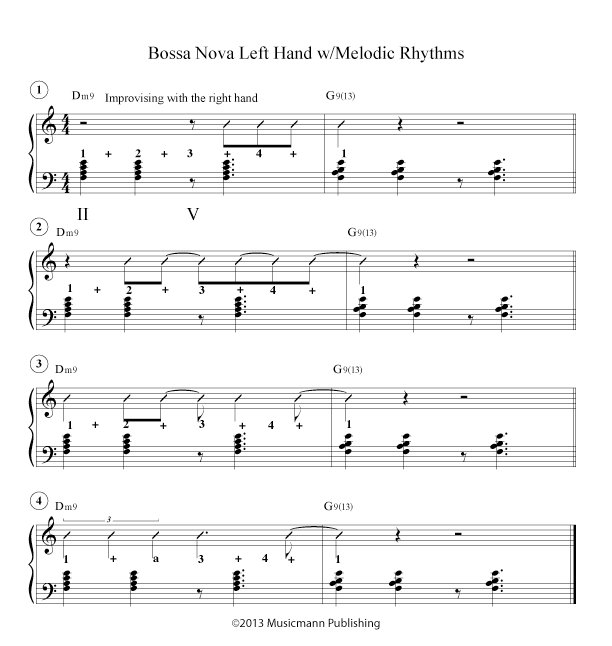
Bossa Nova w/Left Hand Melodic Rhythms 14-1-6

Bossa Nova w/Left Hand Melodic Rhythms 14-1-6

[features_box_yellow width=”75%” + border=”2px”]Level:  Advanced

After you have studied the Bossa Nova w/Melodic Rhythms, start studying Bossa Nova w/Left Hand Melodic Rhythms. [/features_box_yellow]

video
play-sharp-fill

Developing Melodic Rhythms (licks) over a BN Groove in the left hand:

  1. Play the BN Groove in the left hand.
  2. Sing a Rhythmic Event in the left hand.
  3. Put the metronome on 80.
  4. Count and clap the Rhythmic Event.  Note where the lick starts and where it ends (probably beat one of the next measure).
  5. Start playing the left hand BN Groove and count out loud the Rhythm Event that you have chosen.
  6. Sing melodic ideas over the Rhythmic Event (while playing the BN Groove in the left hand).  Never sing what you play.  Always play what you sing!

BossaLHMelRhy

[membership_download_item_pdf link=”http://jsfp.s3.amazonaws.com/BossaLHMelRhy.pdf” + target=”_self”]Bossa Nova w/Left Hand Melodic Rhythms[/membership_download_item_pdf]

[features_box_blue width=”75%” + border=”2px”]Personal Evaluation

[green_tick_2_list width=”100%”]

  • I can quickly and easily play the Bossa Nova w/Left Hand Melodic Rhythms Exercise.
  • Play in all keys.
[/green_tick_2_list]

[/features_box_blue]

Bossa Nova w/Melodic Rhythms 14-1-5

Bossa Nova w/Melodic Rhythms 14-1-5

[features_box_yellow width=”75%” + border=”2px”]Level:  Advanced

After you have studied the Bossa Nova Continuous Melody, start studying Bossa Nova w/Melodic Rhythms. [/features_box_yellow]

video
play-sharp-fill

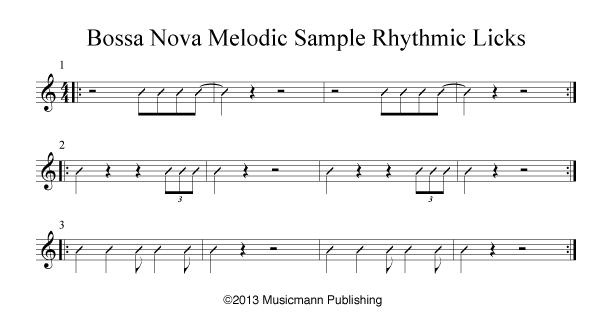
Steps for creating Melodic Rhythms:

Start by putting a metronome on 80 to the quarter note.

  1. Play the BN Groove in the left hand.
  2. Sing a melodic rhythm while playing the BN Groove in both hands.
  3. Sing a melody on top of the rhythm.
  4. Play on and on.  Then, change rhythms.  Use Quarter Notes, Eighth Notes, Quarter-note Rhythms and Eighth-note Rhythms.

BNMelRhyLicks

[membership_download_item_pdf link=”http://jsfp.s3.amazonaws.com/BNMelRhyLicks.pdf” + target=”_self”]Bossa Nova w/Melodic Rhythms[/membership_download_item_pdf]

[features_box_blue width=”75%” + border=”2px”]Personal Evaluation

[green_tick_2_list width=”100%”]

  • I can quickly and easily play the Bossa Nova Groove while singing various Melodic Rhythms.
[/green_tick_2_list]

[/features_box_blue]

Pachelbel Exercise Melody and Single Bass Note 8-1

Pachelbel Exercise Melody & Single Bass Note 8-1

[features_box_yellow width=”75%” + border=”2px”]Level:  Intermediate

Study the Pachelbel Exercise Melody & Single Bass Note after studying the Pachelbel Introduction.[/features_box_yellow]

video
play-sharp-fill

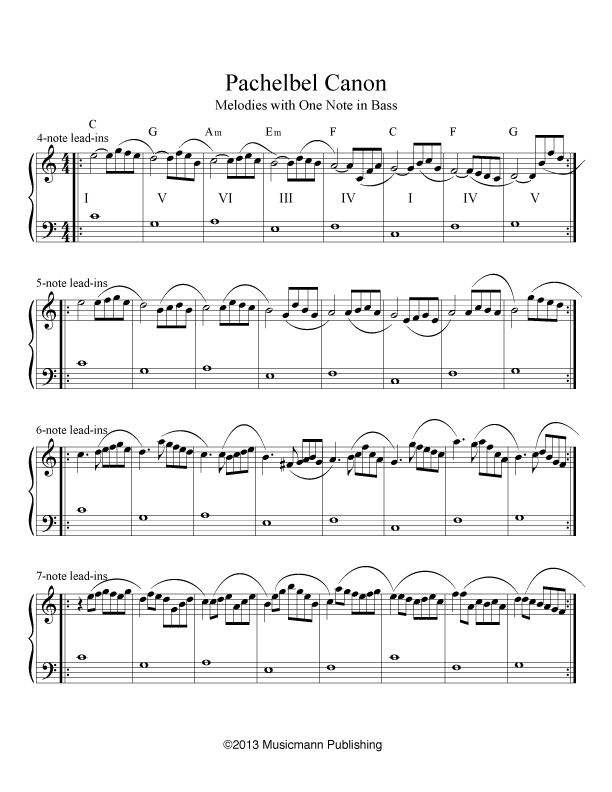
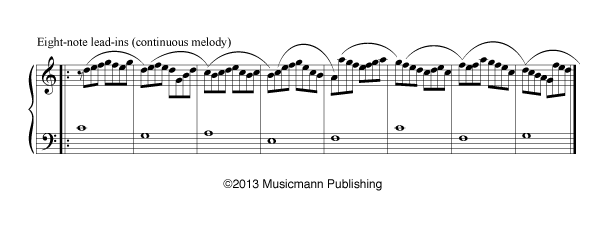
Let’s take the chords of Pachelbel and use them to make melody.  Remember – the chords are C-G-Am-Em-F-C-F-G.  Start with C – going to G.  When you make melody from one chord to another – think in “pick-ups”.  Decide when in the measure you are going to start your pick-up.  For instance, if you start on the and of three – you will have a four-note pick-up to the G triad.  So, start on a chord-tone in C (C-E-G) and end on a chord-tone in G (G-B-D).  Ask yourself:  “How many ways can I move from C to G?”  Once you have done this move from G to Am . . . and do this from chord to chord through the tune.

Once this is accomplished – play a five-note lead-in (starting on beat 3).  Then, play a six-note lead-in (starting on the and of 2).  Then, a seven-note lead-in (starting on beat 2).  Finally – play spontaneously through the Pachelbel Canon.  Play in all keys.

PachMel1aPachMel1b

[membership_download_item_pdf link=”http://jsfp.s3.amazonaws.com/PachMel1a.pdf” + target=”_self”]Pachelbel Exercise Melody & Single Bass Note Page 1[/membership_download_item_pdf]

[membership_download_item_pdf link=”http://jsfp.s3.amazonaws.com/PachMel1b.pdf” + target=”_self”]Pachelbel Exercise Melody & Single Bass Note Page 2[/membership_download_item_pdf]

[features_box_blue width=”75%” + border=”2px”]Personal Evaluation

[green_tick_2_list width=”100%”]

  • I have played many ways of creating melody with a four-note pick-up from C to G.
  • Then a five-note pick-up, six-note pick-up and seven-note pick-up.
  • Play from chord to chord.
  • Play spontaneously through the Pachelbel Canon.
  • Play in all keys.
[/green_tick_2_list]

[/features_box_blue]

Pachelbel Exercise Open Voicings w/Melody 8-5

Pachelbel Exercise Open Voicings w/Melody 8-5

[features_box_yellow width=”75%” + border=”2px”]Level:  Intermediate

Study the Pachelbel Exercise Open Voicings with Melody after studying the Pachelbel Exercise Random Melody Exercise.[/features_box_yellow]

video
play-sharp-fill

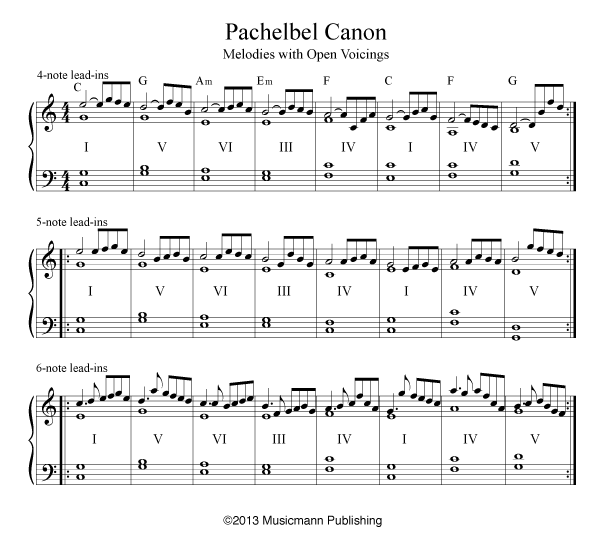
Now . . . let’s take one open voicing and move to another open voicing . . . for the purpose of creating a pick-up melody.  For instance, take a voicing in C and play a melody which ends on G open voicing.   Ask yourself:  “How many ways can I create different open voicings and different melodic paths from C to G.  Of course, start your pick-ups on different beats.

Then put on a metronome and choose one rhythmic patter to play through the entire Pachelbel Canon.  Then, play many different open voicings and melodic rhythmic patterns through the Pachelbel Canon.  Count out loud.  Do this in all keys.

PachOVwMel

[membership_download_item_pdf link=”http://jsfp.s3.amazonaws.com/PachOVwMel.pdf” + target=”_self”]Pachelbel Exercise Open Voicings w/Melody[/membership_download_item_pdf]

[features_box_blue width=”75%” + border=”2px”]Personal Evaluation

[green_tick_2_list width=”100%”]

  • I can play from C to G using different open voicings and different melodic pick-ups.  Then, I can continue this through the Pachelbel Canon.
  • I can play with a metronome through the Pachelbel Canon using different open voicings and different melodic rhythms.
  • I can do the above in all keys.
[/green_tick_2_list]

[/features_box_blue]

Pachelbel Exercise Random Melody 8-3

Pachelbel Exercise Random Melody 8-3

[features_box_yellow width=”75%” + border=”2px”]Level:  Intermediate

Study the Pachelbel Exercise Random Melody after studying the Pachelbel Exercise Continuous Melody & Single Bass.[/features_box_yellow]

video
play-sharp-fill

Play through the Pachelbel Canon using random starting points and random note time values.  Remember, you can use Quarter Notes, Eighth Notes, Quarter-note Triplets and Eighth-note Triplets (also sixteenths).   Put on a metronome (try Quarter-note to 70).  Count out loud – so that you know precisely when you are starting the pick-up lick.  Make sure that you end on the first beat of the next measure.  You can also land on “suspensions” (more on that later).

[features_box_blue width=”75%” + border=”2px”]Personal Evaluation

[green_tick_2_list width=”100%”]

  • I can easily play the Pachelbel Exercise Random Melody Exercise in all keys (this will take a lot of work).
[/green_tick_2_list]

[/features_box_blue]

Section 8: Pachelbel Canon Project

Pachelbel Canon Project Introduction

[features_box_yellow width=”75%” + border=”2px”]Level:  Intermediate

Study the Pachelbel Canon Project after studying the Question & Answer Exercises.[/features_box_yellow]

video
play-sharp-fill

Now that you are thoroughly familiar with Open Voicings . . . and “Making Up Your Own Progression” and Question and Answer, let’s begin to utilize your skills by developing the familiar Pachelbel Canon.  The Pachelbel Canon is created over a set chord progression, much the same as learning any tune.

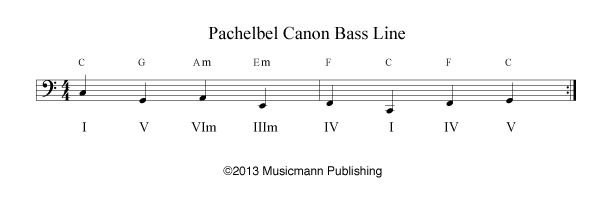
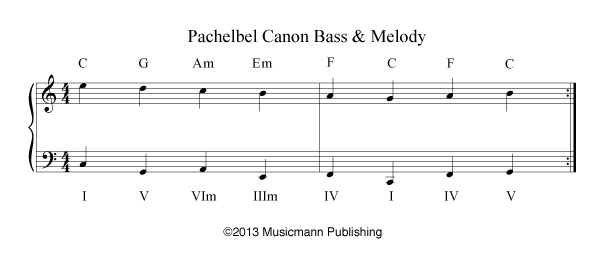
The first skill to develop is to be able to play the progression in any key.  I recommend learning the left hand bass notes first.  Think of the progression in Roman Numerals.  They are I, V, VIm, IIIm, IV, I, IV V.  (Notice that the VI and III are both in minor.) Play this bass line in all keys calling out the Roman Numerals.PachbasslinePachbassmel


[membership_download_item_pdf link=”http://jsfp.s3.amazonaws.com/Pachbassline.pdf” + target=”_self”]Pachelbel bass line[/membership_download_item_pdf]

[membership_download_item_pdf link=”http://jsfp.s3.amazonaws.com/Pachbass&mel.pdf” + target=”_self”]Pachelbel bass line with melody[/membership_download_item_pdf]

[features_box_blue width=”75%” + border=”2px”]Personal Evaluation

[green_tick_2_list width=”100%”]

  • I can easily play the Pachelbel bass line in all keys.
  • I can easily play the Pachelbel bass line and melody in all keys.
[/green_tick_2_list]

[/features_box_blue]

Question and Answer Minor 7-8

Question and Answer Minor 7-8

[features_box_yellow width=”75%” + border=”2px”]Level:  Intermediate

Study Question and Answer Minor after studying the Question & Answer I IV V I Chord Changes.[/features_box_yellow]

video
play-sharp-fill

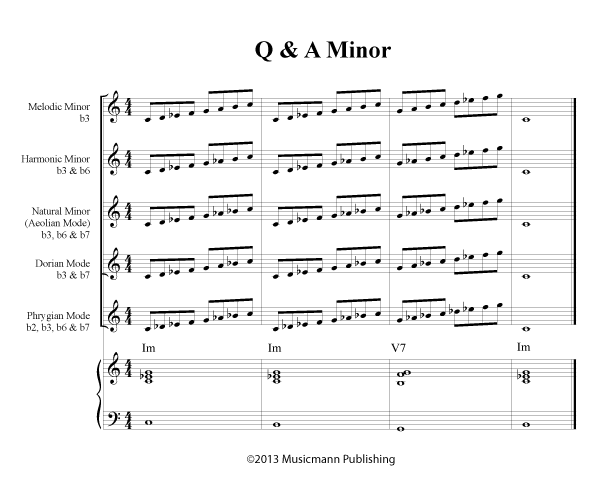
To play the Im IVm V7 Im Q & A – first, study various minor scales and minor-type modes.  For instance:  Melodic (b3), Natural b3, b6 & b7), & Harmonic Minor (b3 & b6).  Also use the Dorian (b3 & b7) and Phrygian (b2 b3 b6 b7) Modes.  Practice and familiarize yourself with these scales first.

Then, make melodies using your ear.  If you play the Bb . . . then avoid the B natural.  If you play the Ab . . . then avoid the A natural.  Always use the flatted third.  You often use the harmonic minor scale from the I chord when playing melodies over the V7 chord.

Q-AMinor

[membership_download_item_pdf link=”http://jsfp.s3.amazonaws.com/Q-AMinor.pdf” + target=”_self”]Question and Answer Minor[/membership_download_item_pdf]

[features_box_blue width=”75%” + border=”2px”]Personal Evaluation

[green_tick_2_list width=”100%”]

  • I have familiarized myself with the minor modes and scales.
  • I have created minor melodies over the Im IVm V7 Im chord progression (in all keys).
[/green_tick_2_list]

[/features_box_blue]

Question and Answer I IV V I Chord Changes 7-7

Question and Answer I IV V I Chord Changes 7-7

[features_box_yellow width=”75%” + border=”2px”]Level:  Intermediate

Study Question and Answer I IV V I after studying the Question & Answer Chord Changes.[/features_box_yellow]

video
play-sharp-fill

Now, practice Q & A with the I IV V7 I progression.  Start by practicing the Ionian Mode (Major Scale), Lydian Mode (#4) (for the IV chord and Mixolydian Mode (b7) (for the V chord).   Then, play a single note for the bass and single note for the melody.  Then, add in tones.  Then, play modally.  Take this step-by-step.

Q-ACh1451

[membership_download_item_pdf link=”http://jsfp.s3.amazonaws.com/Q-ACh1451.pdf” + target=”_self”]Question and Answer I IV V I Chord Changes[/membership_download_item_pdf]

[features_box_blue width=”75%” + border=”2px”]Personal Evaluation

[green_tick_2_list width=”100%”]

  • I have practiced the Ionian, Lydian and Mixolydian Modes.
  • I have played Q & A with a single note in the bass and single note in the melody.
  • I have then created Added Tones.
  • I can now play I IV V7 I modally.
[/green_tick_2_list]

[/features_box_blue]