Swing Groove Soloing through the Tune 16-7-8
[features_box_yellow width=”75%” + border=”2px”]Level: Advanced
After you have mastered the Swing Groove Comping w/Modes, start learning the Swing Groove Comping w/Modes.[/features_box_yellow]
Steps to play on a tune:
- Learn all the chords, modes and form of the tune.
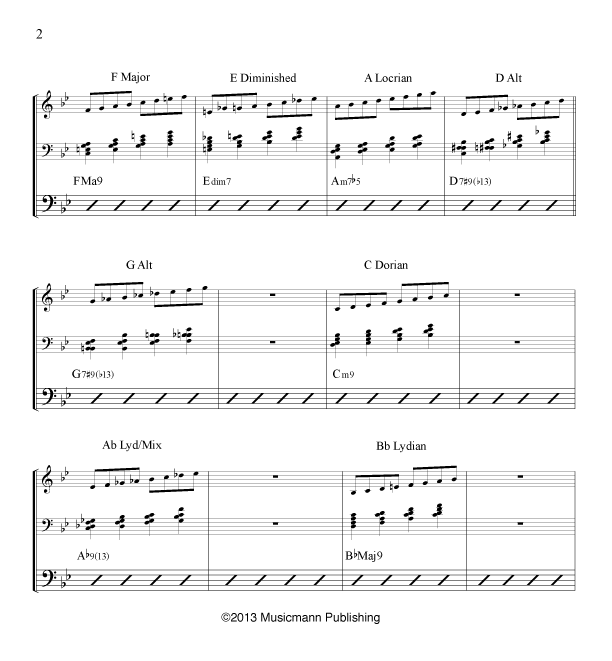
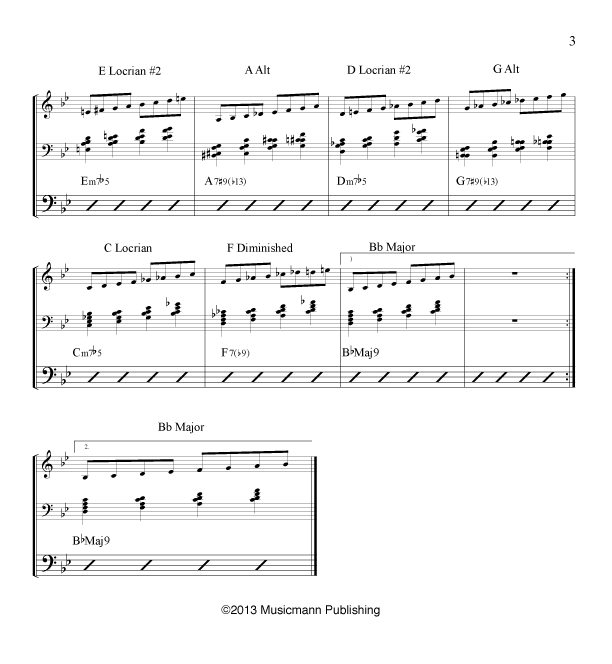
- Think in rhythmic figures. Practice by playing one rhythmic figure through the entire tune. Start slowly. Analyze: “How many ways can I play from any chord (or tonality) to any other chord (or tonality). For instance: play from E #2 Locrian to A Alt. Play a single note in the bass.
- Always resolve ideas forward to a destination point. You can also extend ideas over two or more chords. It’s OK to play notes out of the mode. Be careful how you resolve those notes.
- Develop continuity in your soloing. Make your ideas follow logically. Try repeating licks. Seek for tension an the release of tension.
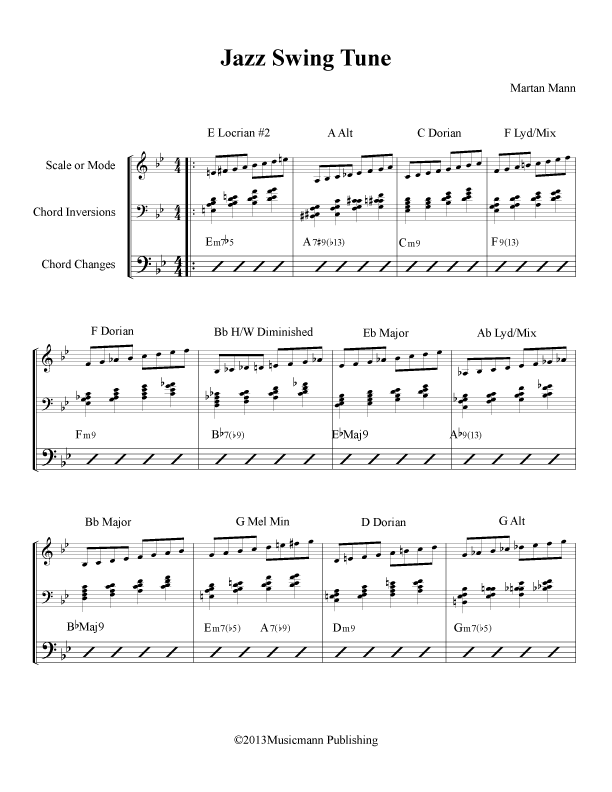
 [membership_download_item_pdf link=”http://jsfp.s3.amazonaws.com/JazzSwingTune1a.pdf” + target=”_self”]Swing Jazz Tune Page 1[/membership_download_item_pdf][membership_download_item_pdf link=”http://jsfp.s3.amazonaws.com/JazzSwingTune1b.pdf” + target=”_self”]Swing Jazz Tune Page 2[/membership_download_item_pdf][membership_download_item_pdf link=”http://jsfp.s3.amazonaws.com/JazzSwingTune1c.pdf” + target=”_self”]Swing Jazz Tune Page 3[/membership_download_item_pdf]
[features_box_blue width=”75%” + border=”2px”]Personal Evaluation
[green_tick_2_list width=”100%”]
- I have learned all the chords, modes and form of the Jazz Swing Tune.
- I always think in rhythmic figures. I practice by playing one rhythmic figure through the entire tune, starting slowly. I can analyze: “How many ways can I play from any chord (or tonality) to any other chord (or tonality). For instance: play from E #2 Locrian to A Alt. Play a single note in the bass.
- I always resolve ideas forward to a destination point. I can also extend ideas over two or more chords. I am always careful how I resolve notes.
- I always intend to develop continuity in my soloing. I make my ideas follow logically. I seek for tension an the release of tension.
[/green_tick_2_list]
[/features_box_blue]
Swing Groove Comping w/Modes 16-7-7
[features_box_yellow width=”75%” + border=”2px”]Level: Advanced
After you have mastered the Swing Groove Comping and Melody, start learning the Swing Groove Comping w/Modes.[/features_box_yellow]
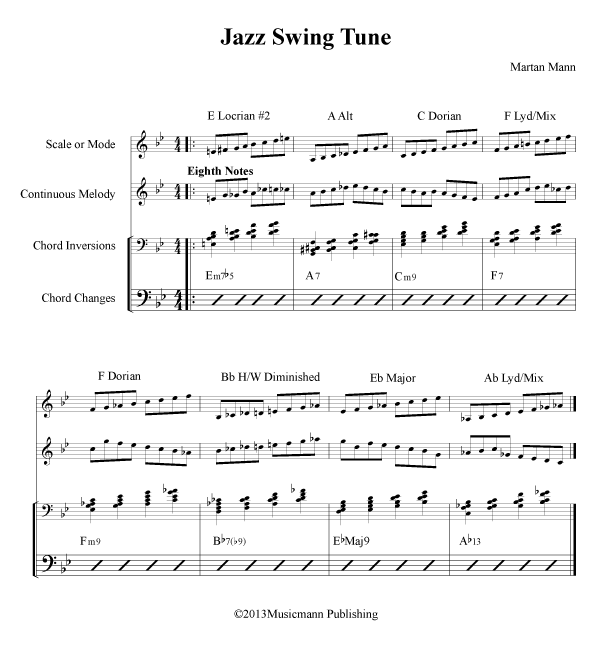
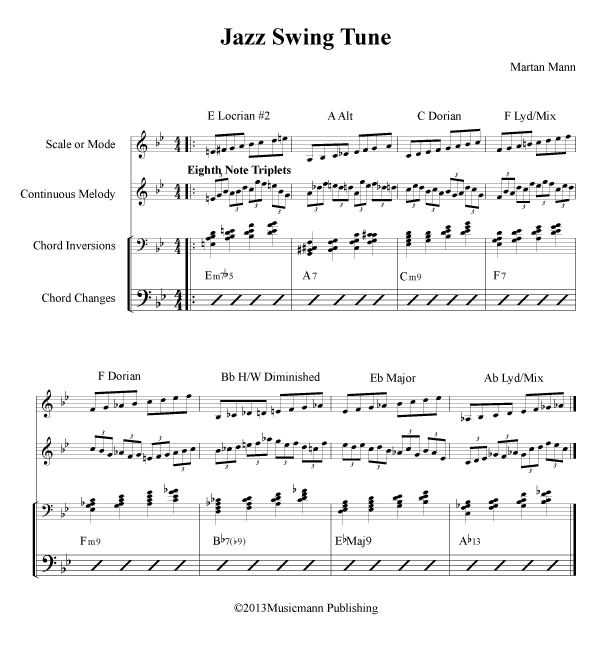
Studying the Modes for each chord in the “Jazz Swing Tune”:
- Take each chord in the “Jazz Swing Tune” and completely learn the scales which work with that chord.
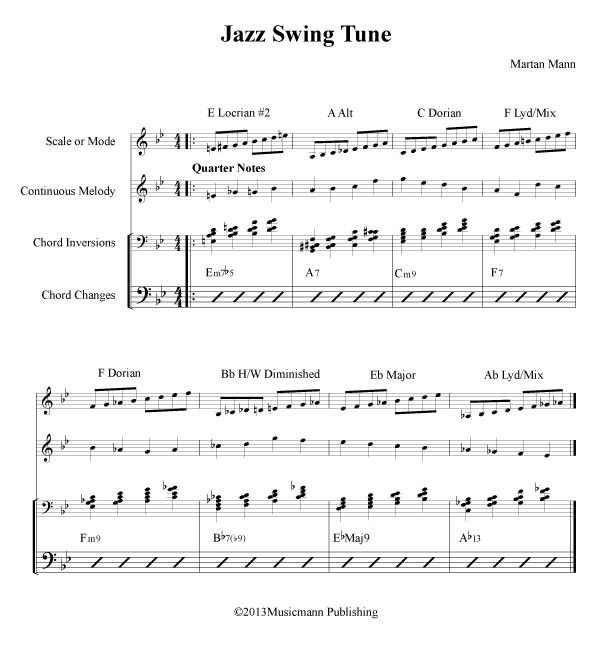
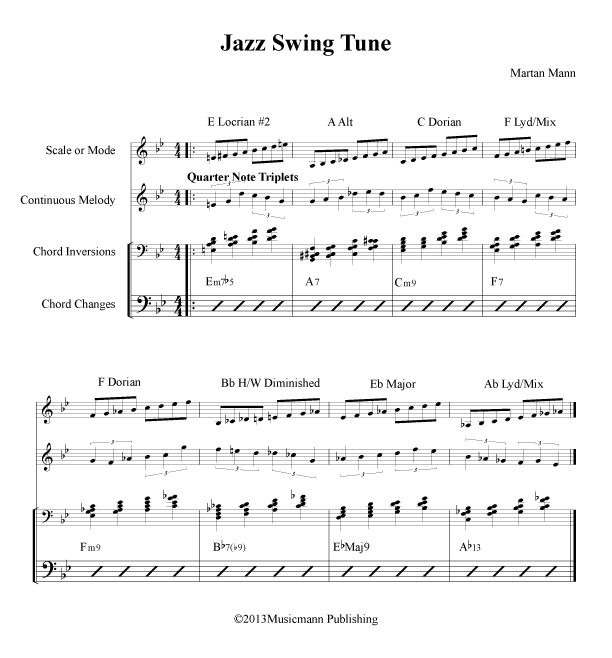
- For instance: the first chord in the tune is an Em7(b5). You can use either the Locrian Mode (7-7) or the Sharp 2 Locrian (6-6 of the Melodic Minor).
- Take the #2 Locrian Mode and play it in Triads up the scale. (See the example and video).
- Take the #2 Locrian Mode and play it in Sevenths up the scale.
- Make up chord structures using the E #2 Locrian Mode. Play in 3-notes, 4-notes, 4-note open structures and 5-note open structures.


[membership_download_item_pdf link=”http://jsfp.s3.amazonaws.com/JazzSwingTunew-CMEQN.pdf” + target=”_self”]Continuous Melody Exercise – Quarter Notes[/membership_download_item_pdf]
[membership_download_item_pdf link=”http://jsfp.s3.amazonaws.com/JazzSwingTunew-CMEQT.pdf” + target=”_self”]Continuous Melody Exercise – Quarter Note Triplets[/membership_download_item_pdf]
[membership_download_item_pdf link=”http://jsfp.s3.amazonaws.com/JazzSwingTunew-CMEEN.pdf” + target=”_self”]Continuous Melody Exercise – Eighth Notes[/membership_download_item_pdf]
[membership_download_item_pdf link=”http://jsfp.s3.amazonaws.com/JazzSwingTunew-CMEET.pdf” + target=”_self”]Continuous Melody Exercise – Eighth Note Triplets[/membership_download_item_pdf]
[membership_download_item_pdf link=”http://jsfp.s3.amazonaws.com/JSTModeStructEloc2.pdf” + target=”_self”]E Locrian Mode Chord Structures Page 1[/membership_download_item_pdf]
[membership_download_item_pdf link=”http://jsfp.s3.amazonaws.com/JSTModeStructEloc2b.pdf” + target=”_self”]E Locrian Mode Chord Structures Page 2[/membership_download_item_pdf]
[membership_download_item_pdf link=”http://jsfp.s3.amazonaws.com/JSTModeStructAalt.pdf + target=”_self”]A Alt Chord Structures[/membership_download_item_pdf]
[features_box_blue width=”75%” + border=”2px”]Personal Evaluation
[green_tick_2_list width=”100%”]
- I have studied the first chord in the tune is an Em7(b5) and used either the Locrian Mode (7-7) or the Sharp 2 Locrian (6-6 of the Melodic Minor).
- I can take the #2 Locrian Mode and play it in Triads up the scale. (See the example and video).
- I can take the #2 Locrian Mode and play it in Sevenths up the scale. (See the example and video).
- I can make up chord structures using the E #2 Locrian Mode. Play in 3-notes, 4-notes, 4-note open structures and 5-note open structures.
- I can take all of the chords of the “Jazz Swing Tune” and play the above.
[/green_tick_2_list]
[/features_box_blue]
Swing Groove Continuous Melody Exercise 16-7-5
[features_box_yellow width=”75%” + border=”2px”]Level: Advanced
After you have mastered the Swing Groove Chord Inversions and Bass Lines, start learning the Swing Groove Continuous Melody Exercise.[/features_box_yellow]
Developing the Continuous Melody Exercise playing through the “Jazz Swing Tune”:
Play through the tune very slowly with Quarter Notes, Eighth Notes, Quarter-note Triplets and Eighth-note Triplets. Always think forward to the first beat of the next measure. Put the metronome on 2 & 4.
[membership_download_item_pdf link=”http://jsfp.s3.amazonaws.com/JazzSwingTunew-CMEQN.pdf” + target=”_self”]Continuous Melody Exercise – Quarter Notes[/membership_download_item_pdf]
[membership_download_item_pdf link=”http://jsfp.s3.amazonaws.com/JazzSwingTunew-CMEQT.pdf” + target=”_self”]Continuous Melody Exercise – Quarter Note Triplets[/membership_download_item_pdf]
[membership_download_item_pdf link=”http://jsfp.s3.amazonaws.com/JazzSwingTunew-CMEEN.pdf” + target=”_self”]Continuous Melody Exercise – Eighth Notes[/membership_download_item_pdf]
[membership_download_item_pdf link=”http://jsfp.s3.amazonaws.com/JazzSwingTunew-CMEET.pdf” + target=”_self”]Continuous Melody Exercise – Eighth Note Triplets[/membership_download_item_pdf]
[features_box_blue width=”75%” + border=”2px”]Personal Evaluation
[green_tick_2_list width=”100%”]
- I can play through the tune very slowly with Quarter Notes, Eighth Notes, Quarter-note Triplets and Eighth-note Triplets. I always think forward to the first beat of the next measure.
[/green_tick_2_list]
[/features_box_blue]
Swing Groove Chord Inversions and Bass Lines 16-7-4
[features_box_yellow width=”75%” + border=”2px”]Level: Advanced
After you have mastered the Swing Groove Swing Groove Chord Inversions, start learning the Swing Groove Chord Inversions and Bass Lines.[/features_box_yellow]
Developing Bass Lines while playing Chord Inversions:
- Practice playing bass lines slowly through the tune while comping with the chord inversions (bouncing).
- Play bass lines faster with the metronome on 2 & 4 and comp with the chord inversions. (This will take awhile to master).
[membership_download_item_pdf link=”http://jsfp.s3.amazonaws.com/JazzSwingTune1a.pdf” + target=”_self”]Swing Jazz Tune Page 1[/membership_download_item_pdf]
[membership_download_item_pdf link=”http://jsfp.s3.amazonaws.com/JazzSwingTune1b.pdf” + target=”_self”]Swing Jazz Tune Page 2[/membership_download_item_pdf]
[membership_download_item_pdf link=”http://jsfp.s3.amazonaws.com/JazzSwingTune1c.pdf” + target=”_self”]Swing Jazz Tune Page 3[/membership_download_item_pdf]
[features_box_blue width=”75%” + border=”2px”]Personal Evaluation
[green_tick_2_list width=”100%”]
- I have practiced playing bass lines slowly through the tune while comping with the chord inversions (bouncing).
- I can easily play bass lines faster with the metronome on 2 & 4 and comp with the chord inversions. (This will take awhile to master).[/green_tick_2_list]
[/features_box_blue]
Stride Groove w/Bass Lines 17-8-1
[features_box_yellow width=”75%” + border=”2px”]Level: Advanced
After you have mastered the Swing Groove Soloing Through the Tune, start learning the Stride Groove w/Bass Lines.[/features_box_yellow]
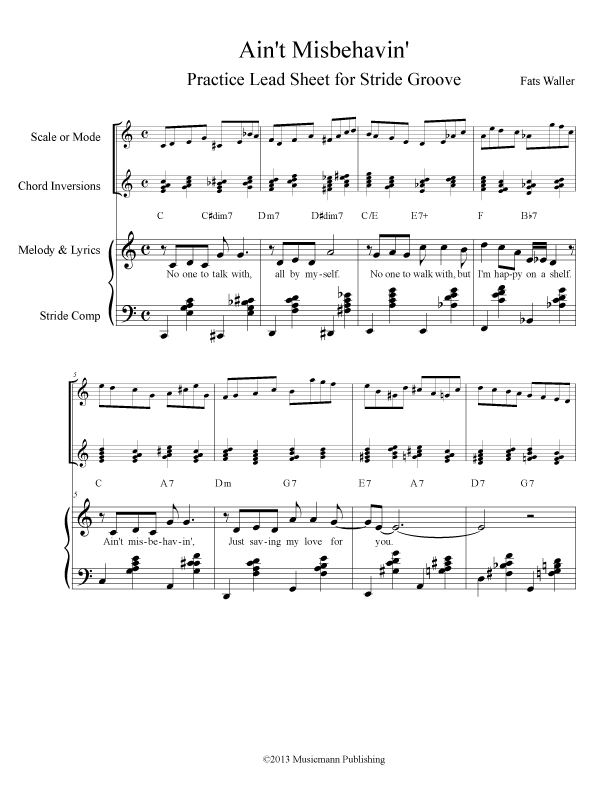
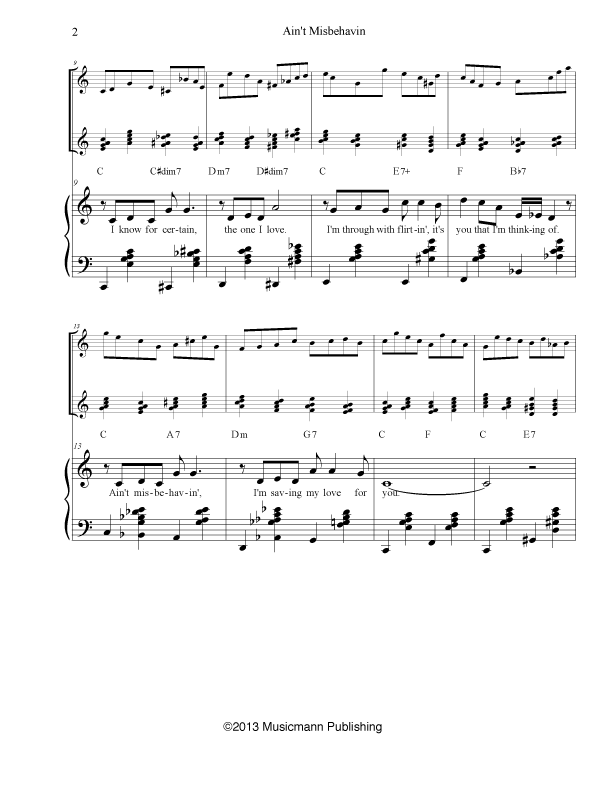
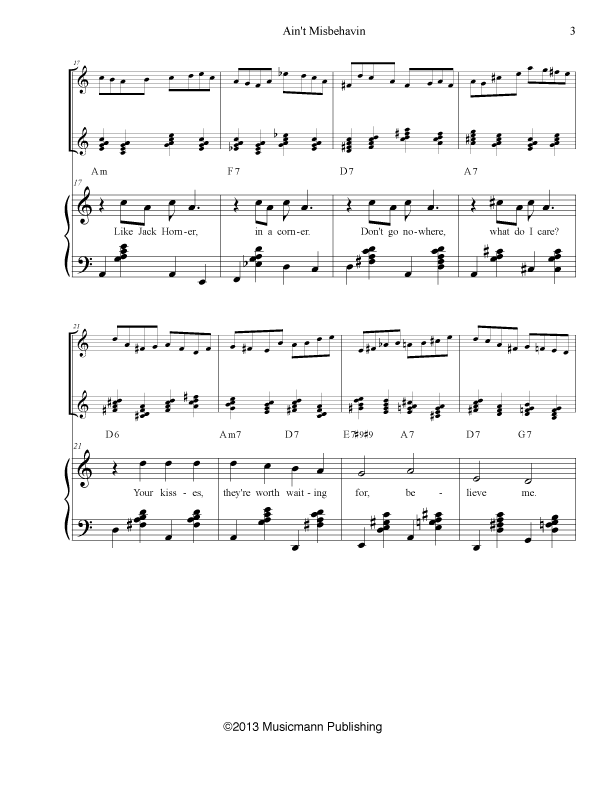
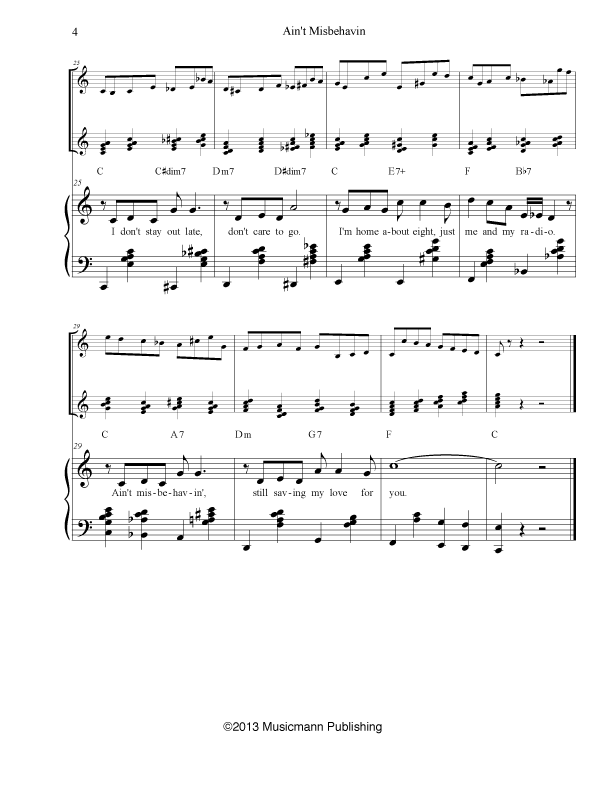
Learning to play “Ain’t Misbehavin”:
- We often think of the Stride Groove as being an older jazz style . . . but, it can also be played in a more modern jazz style. There are lots of tunes in the Stride Jazz Style.
- Start with playing through “Ain’t Misbehavin'” using a Bass Line in 2-beat Stride Style. Use “lead-ins” in the bass. Emulate what a bassist would play. Sing the melody while playing the bass note.
- Can use 10ths, 6ths and 3rds-7ths (tritone) in the bass.
[membership_download_item_pdf link=”http://jsfp.s3.amazonaws.com/Ain’tMisbehavinALL.pdf” + target=”_self”]Ain’t Misbehavin’ Tune[/membership_download_item_pdf]
[features_box_blue width=”75%” + border=”2px”]Personal Evaluation
[green_tick_2_list width=”100%”]
- I can play through “Ain’t Misbehavin'” using a Bass Line in 2-beat Stride Style. I am using left hand “lead-ins” in the bass.
- I am using 10ths, 6ths and 3rds-7ths (tritone) in the bass.
[/green_tick_2_list]
[/features_box_blue]
Jazz Waltz Groove w/Modal Soloing 15-6-6
[features_box_yellow width=”75%” + border=”2px”]Level: Advanced
After you have mastered the Jazz Waltz Groove w/Melodic Figures, start learning the Jazz Waltz Groove w/Modal Soloing.[/features_box_yellow]
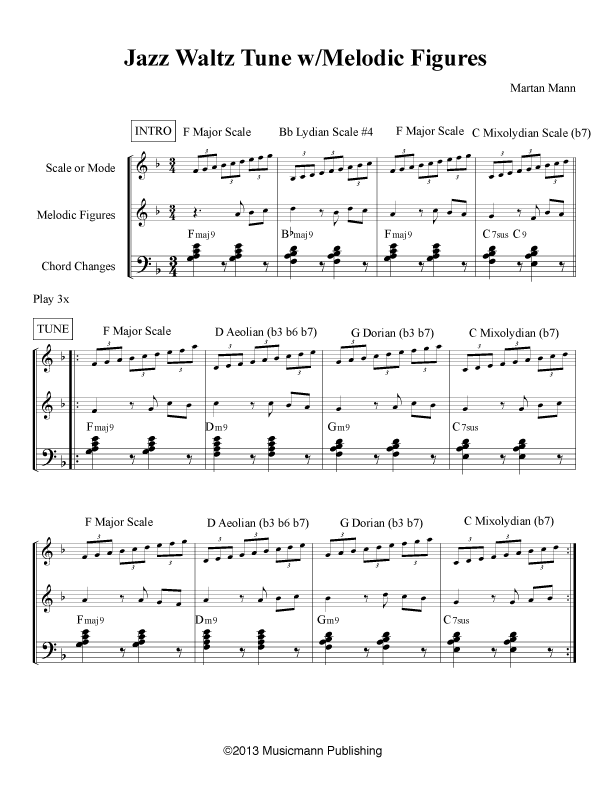
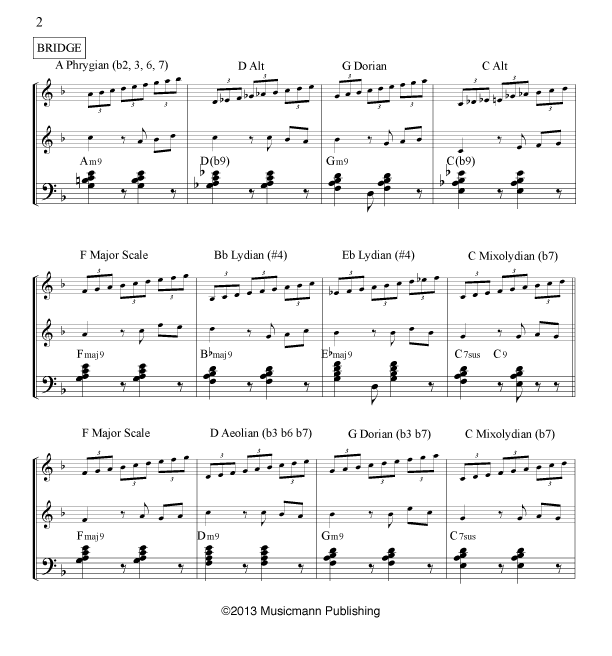
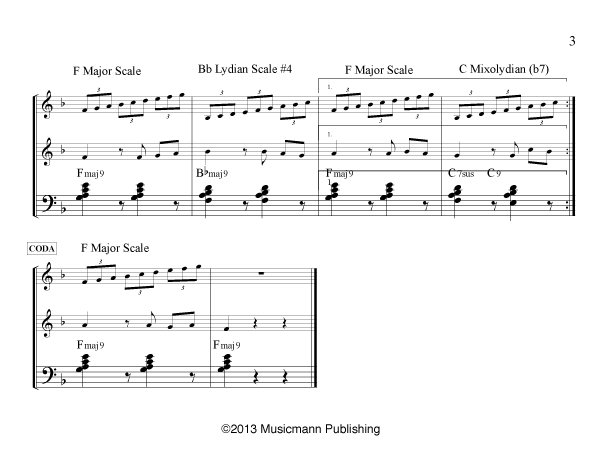
Developing the Jazz Waltz Groove with Modal Soloing:
- Practice “Stop on the Chord”. Take each chord through the tune and explore it fully. Play voicings all over the piano.
- When you comp . . . think of the top note of the comping chords as a melody note.
- Play the tune using modal playing. Remember all licks move forward. Play all the rhythmic values in the Continuous Melody Exercise.
[membership_download_item_pdf link=”http://jsfp.s3.amazonaws.com/JazzWaltzTuneA.pdf” + target=”_self”]Jazz Waltz Groove w/Melodic Figures Page 1[/membership_download_item_pdf]
[membership_download_item_pdf link=”http://jsfp.s3.amazonaws.com/JazzWaltzTuneMelB.pdf” + target=”_self”]Jazz Waltz Groove w/Melodic Figures Page 2[/membership_download_item_pdf]
[membership_download_item_pdf link=”http://jsfp.s3.amazonaws.com/JazzWaltzTuneMelC.pdf” + target=”_self”]Jazz Waltz Groove w/Melodic Figures Page 3[/membership_download_item_pdf]
[features_box_blue width=”75%” + border=”2px”]Personal Evaluation
[green_tick_2_list width=”100%”]
- I have practiced the “Stop on the Chord” by taking each chord through the tune to explore it fully.
- I can comp . . . thinking of the top note of the comping chords as a melody note.
- I can play the tune using modal playing.
[/green_tick_2_list]
[/features_box_blue]
Jazz Waltz Groove w/Continuous Melody 15-6-4
[features_box_yellow width=”75%” + border=”2px”]Level: Advanced
After you have mastered the Jazz Waltz Groove w/Bass Lines, start learning the Jazz Waltz Groove w/Continuous Melody.[/features_box_yellow]
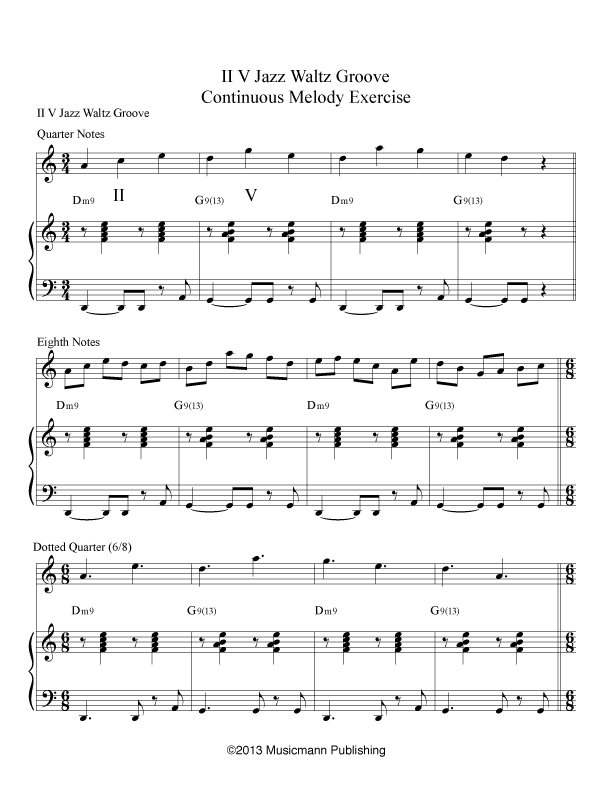
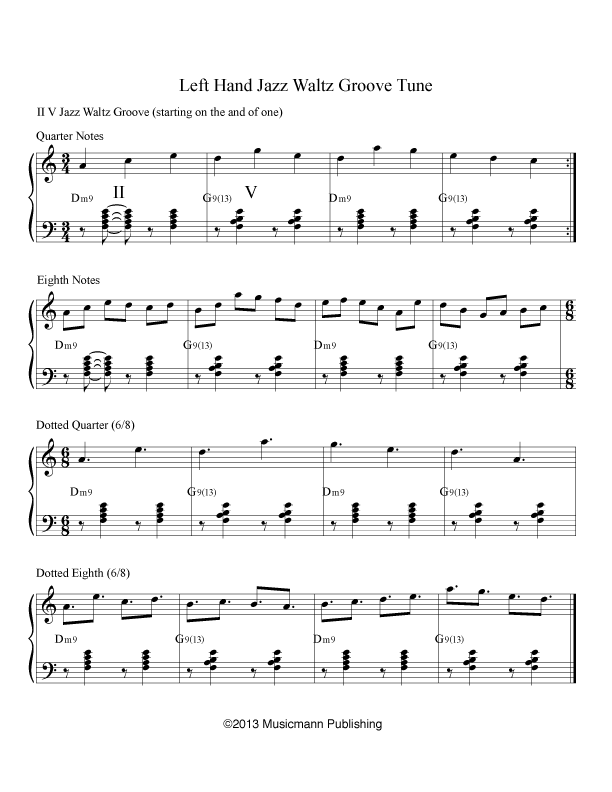
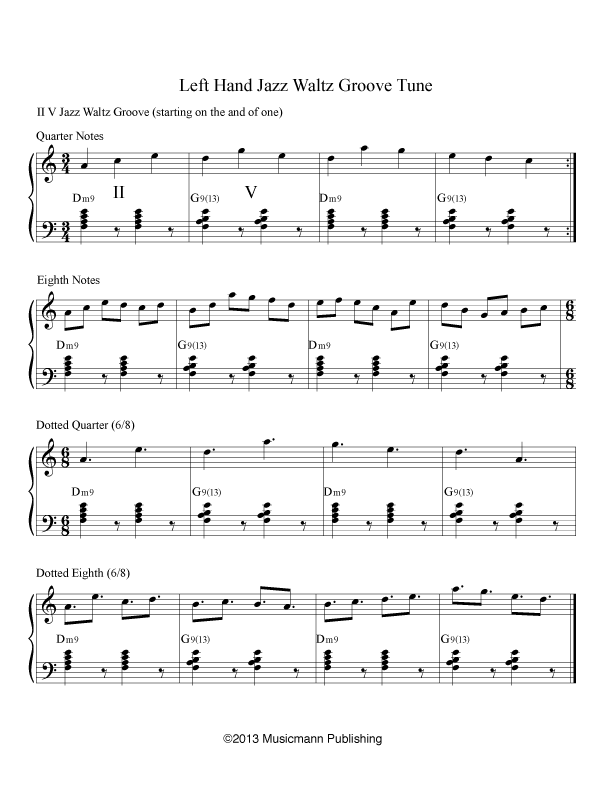
Developing the Jazz Waltz Groove with the Continuous Melody Exercise:
- The purpose of the Continuous Melody Exercise is to create melodic independence from the groove.
- Play or Sing all the time values (Quarter Notes, Eighth Notes, Quarter-note Triplets and Eighth-note Triplets.
- Think in 6/8 time. (3 against 2)
- Put the metronome on 80 and count the time values out loud while playing the Jazz Waltz Groove.
- Play the JW Groove in the left hand and play all the time values using melody in the right hand.
[membership_download_item_pdf link=”http://jsfp.s3.amazonaws.com/JazzWaltzCMEA.pdf” + target=”_self”]Jazz Waltz Groove w/Continuous Melody Page 1[/membership_download_item_pdf]
[membership_download_item_pdf link=”http://jsfp.s3.amazonaws.com/JazzWaltzCMEB.pdf” + target=”_self”]Jazz Waltz Groove w/Continuous Melody Page 2[/membership_download_item_pdf]
[membership_download_item_pdf link=”http://jsfp.s3.amazonaws.com/LHJazzWaltzCMEA.pdf” + target=”_self”]Jazz Waltz Groove w/Left Hand Continuous Melody Page 1[/membership_download_item_pdf]
[membership_download_item_pdf link=”http://jsfp.s3.amazonaws.com/LHJazzWaltzCMEbB.pdf” + target=”_self”]Jazz Waltz Groove w/Left Hand Continuous Melody Page 2[/membership_download_item_pdf]
[features_box_blue width=”75%” + border=”2px”]Personal Evaluation
[green_tick_2_list width=”100%”]
- I understand that the purpose of the Continuous Melody Exercise is to create melodic independence from the groove.
- I can play or sing all the time values (Quarter Notes, Eighth Notes, Quarter-note Triplets and Eighth-note Triplets.
- I can put the metronome on 80 and count the time values out loud while playing the Jazz Waltz Groove.
- I can play the JW Groove in the left hand and play all the time values using melody in the right hand.
[/green_tick_2_list]
[/features_box_blue]
Jazz Waltz Groove w/Bass Lines 15-6-3
[features_box_yellow width=”75%” + border=”2px”]Level: Advanced
After you have mastered the Jazz Waltz Ballad Style, start learning the Jazz Waltz Groove w/Bass Lines.[/features_box_yellow]
Develop Bass Lines for the Jazz Waltz Tune:
- Most important . . . listen to bass players. Bass players flow through chords. They set up the groove.
- Practice the Jazz Waltz Tune as a bass player, playing from chord to chord. How many ways can you move from any chord to the following chord?
- Comp in the right hand while slowly playing bass lines in the left hand.
- Put the metronome on about 110. Play bass lines in the left hand and comp in the right hand through the tune.
- If you have Band in a Box – listen to just the bass (and drums) play through the tune. Listen to all the slight inflections.
[membership_download_item_pdf link=”http://jsfp.s3.amazonaws.com/JazzWaltzTuneA.pdf” + target=”_self”]Jazz Waltz Tune Page 1[/membership_download_item_pdf]
[membership_download_item_pdf link=”http://jsfp.s3.amazonaws.com/JazzWaltzTuneB.pdf” + target=”_self”]Jazz Waltz Tune Page 2[/membership_download_item_pdf]
[membership_download_item_pdf link=”http://jsfp.s3.amazonaws.com/JazzWaltzTuneC.pdf” + target=”_self”]Jazz Waltz Tune Page 3[/membership_download_item_pdf]
[features_box_blue width=”75%” + border=”2px”]Personal Evaluation
[green_tick_2_list width=”100%”]
- I constantly listen to bass players.
- I have practiced the Jazz Waltz Tune as if I was a bass player, playing from chord to chord.
- I have comped in the right hand while slowly playing bass lines in the left hand.
- I have put the metronome on about 110 and played bass lines in the left hand and comp in the right hand through the tune.
- (If you have Band in a Box) – I have listened to just the bass (and drums) play through the tune and listened to all the slight inflections.
[/green_tick_2_list]
[/features_box_blue]
Bossa Nova Modal Tune w/Continuous Melody 14-5-4
[features_box_yellow width=”75%” + border=”2px”]Level: Advanced
After you have mastered Bossa Nova Modal Tune Soloing w/Tonalities, start studying Bossa Nova Modal Tune w/Continuous Melody.[/features_box_yellow]
Developing melodies:
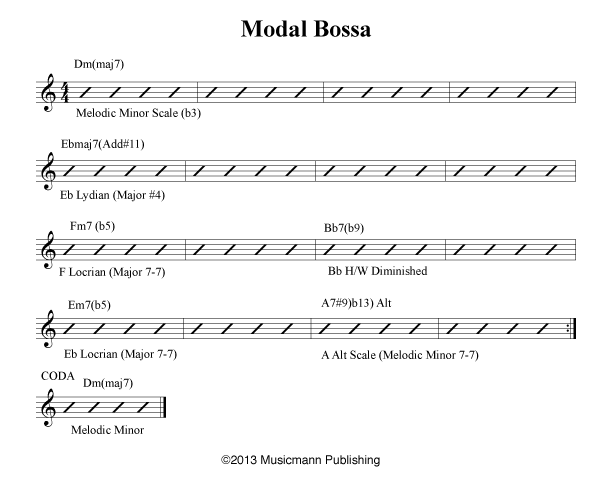
- Left hand chords must be totally subconscious. Practice each chord in the tune in all positions (inversions).
- Practice the right hand using the Continuous Melody Exercise. Play Quarter Notes, Eighth Notes, Quarter-note Triplets, Eighth-note Triplets using the scales suggested by the chords. Always think forward (you can leave out the first note of the phrase to move forward).
- Play the Modal Bossa Tune with a metronome with “bouncing” left hand chords and the continuous melody exercise with all of the time values.


[membership_download_item_pdf link=”http://jsfp.s3.amazonaws.com/ModalBossa.pdf” + target=”_self”]Modal Bossa Chord Chart[/membership_download_item_pdf]
[membership_download_item_pdf link=”http://jsfp.s3.amazonaws.com/ModalBossaTunew-ModesA.pdf” + target=”_self”]Modal Bossa Tune with Modes Page 1[/membership_download_item_pdf]
[membership_download_item_pdf link=”http://jsfp.s3.amazonaws.com/ModalBossaTunew-ModesB.pdf” + target=”_self”]Modal Bossa Tune with Modes Page 2[/membership_download_item_pdf]
[features_box_blue width=”75%” + border=”2px”]Personal Evaluation
[green_tick_2_list width=”100%”]
- I have practiced the left hand chords and inversions until they are totally subconscious.
- I have practiced the right hand using the Continuous Melody Exercise.
- I can play the Modal Bossa Tune with a metronome with “bouncing” left hand chords and the continuous melody exercise with all of the time values.
[/green_tick_2_list]
[/features_box_blue]
Bossa Nova Altered Turnaround Tune w/BIAB 14-5-9
[features_box_yellow width=”75%” + border=”2px”]Level: Advanced
After you have mastered Bossa Nova Tritone Turnaround Chart, start studying Bossa Nova Altered Turnaround Tune w/BIAB.[/features_box_yellow]
Practicing a tune:
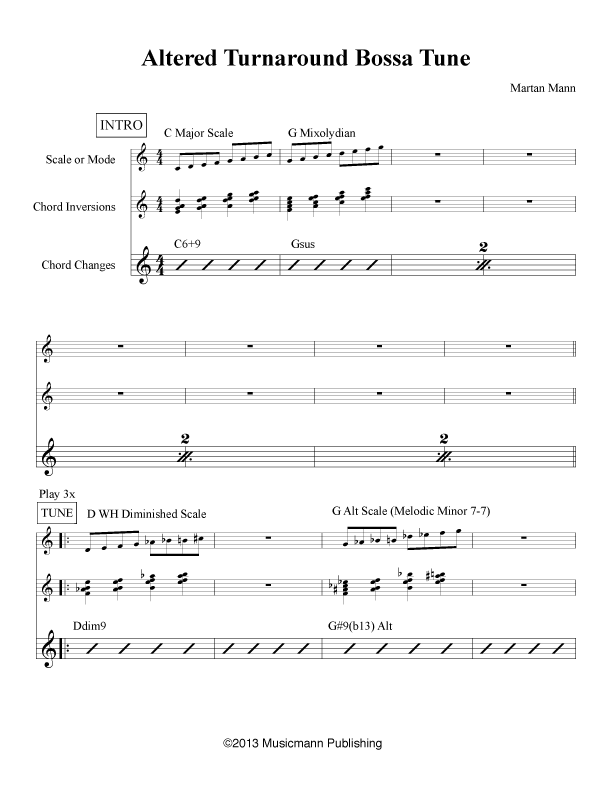
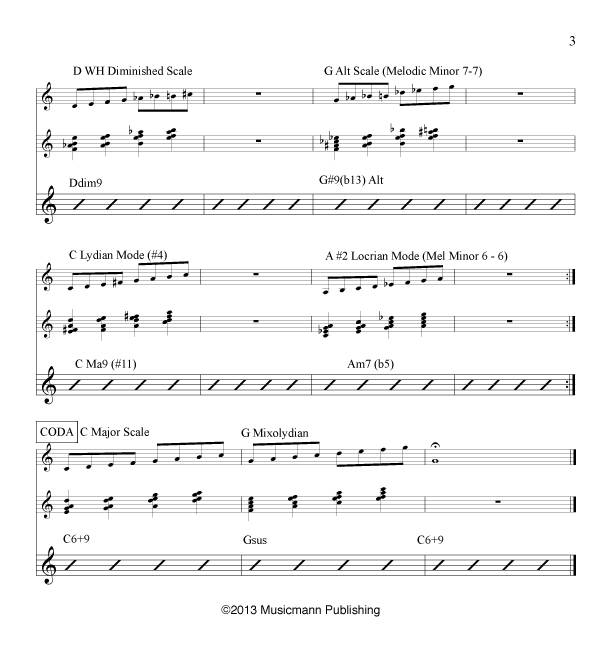
- Make a chart. Include chord symbols, bass note, melody, lyrics, modes.
- Learn the chords in closed position playing all the inversions.
- Comp the groove while using left hand on bass and right hand bouncing through the chord inversions.
- Comp the chords in the left hand while playing the Continuous Melody Exercise in the right hand.
- Play a single note in the left hand bass and melodic licks in the right hand.
- Comp while singing licks.
- Use the “Stop on the Chord” Exercise.
- Play entire tune with a metronome or BIAB.

[membership_download_item_pdf link=”http://jsfp.s3.amazonaws.com/Alt Turn BossaTuneA.pdf” + target=”_self”]Bossa Nova Altered Turnaround Tune Page 1[/membership_download_item_pdf]
[membership_download_item_pdf link=”http://jsfp.s3.amazonaws.com/AltTurn BossaTuneB.pdf” + target=”_self”]Bossa Nova Altered Turnaround Tune Page 2[/membership_download_item_pdf]
[membership_download_item_pdf link=”http://jsfp.s3.amazonaws.com/AltTurnBossaTuneC.pdf” + target=”_self”]Bossa Nova Altered Turnaround Tune Page 3[/membership_download_item_pdf]
[features_box_blue width=”75%” + border=”2px”]Personal Evaluation
[green_tick_2_list width=”100%”]
- I have made a chart – with chord symbols, bass note, melody, lyrics, modes.
- I have learned the chords in closed position playing all the inversions.
- I can comp the groove while using left hand on bass and right hand bouncing through the chord inversions.
- I can comp the chords in the left hand while playing the Continuous Melody Exercise in the right hand.
- I can play a single note in the left hand bass and melodic licks in the right hand.
- I can comp while singing licks.
- Use the “Stop on the Chord” Exercise.
- I can play entire tune with a metronome or BIAB.
[/green_tick_2_list]
[/features_box_blue]