Preparing to Play in All Keys Introduction
It is universal. All jazz pianists want to freely play in all keys. The problem is that each new key appears to us as a "new world". The look is different and the fingerings are different. The one constant which is the same in all keys is . . . . the numbers. Therefore, in order for us to be "free" in all keys, we must think in numbers. It's a "numbers language". Once this is accomplished, then the only next step is to analyze each tune by the numbers. It takes preparation and training. But . . . it is very doable . . . especially if you learn step-by-step.
It is highly recommended that after completing Preparing to Play in All Keys . . . Continue on to part two of the "Preparing" series . . . . Preparing to Learn a Tune. You will need to purchase a subscription to have access. Go HERE to purchase access.
I'd love to hear your questions and feedback regarding this lesson. Please contact me at martan@jazzskillsforpiano.com. If you received this lesson as a "stand-alone" lesson . . . check out my online jazz piano course, JazzSkills for Piano (jazzskillsforpiano.com/wp).
Best to you -
--Martan 🙂

Videos
Video 1: Thinking in Numbers

Video 2: White Key Exercise
Video 3: Beyond the White Key Exercise

Video 4: Learning Progressions

Step-by-Step
Video 1: Thinking in Numbers
Step #1: Thinking in Numbers and Intervals.
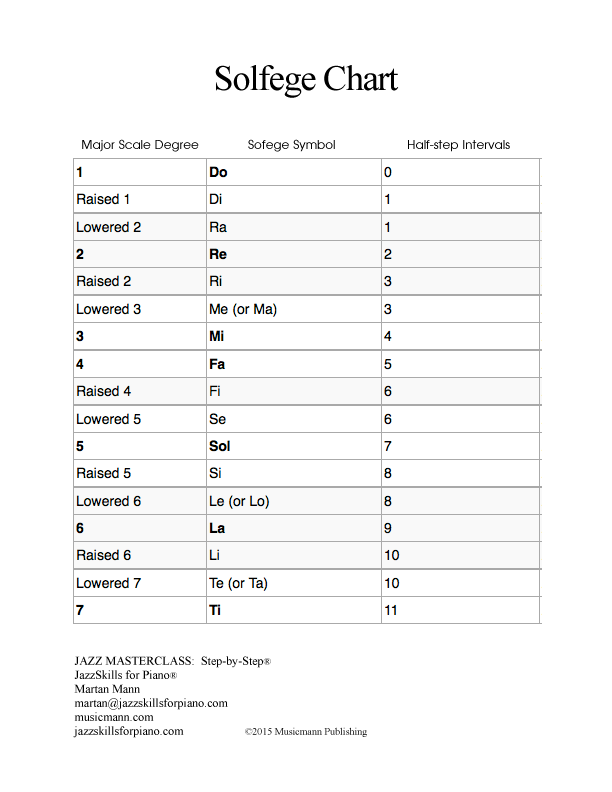
In Europe and parts of Asia, they teach a music system called Solfege. This is also known as "moveable Do". That is like singing the first five notes of the major scale as "Do, Re, Mi, Fa, So . . .".
My personal system is to think in numbers. To do this, look at intervals. We want to be able to think, hear and play intervals freely and easily. Take a look at the Interval Chart. One idea of learning intervals is to to think of a song. Analyze the first interval(s) of the song. That will help you to remember the interval.
However you choose to learn your intervals, you have to spend a lot of time doing this. Keep working on intervals until it is part of your musical language.
Step #2: Thinking in Chord Structures.
My suggestion is that you think more in chord structures, than chord names. For instance: a major triad in the root position is a major third on the bottom (5 half steps) and a minor third on the top (4 half steps). When we play the major triad in the first inversion, we think of a perfect fourth on the bottom (6 half steps) and a minor third on the top (4 half steps). Likewise, if we play the major triad in the second inversion, we think of a perfect fourth on the bottom and a major third on the top.
We can do this with all chords. And once we analyze the structures in intervals, it is relatively easy to play the same intervals in all keys. The numbers stay the same, even though the notes on the piano are different.
Step #3: Thinking in Scale Structures.
What gives a major scale a special sound and feeling is the location of the half steps. In this case, the half steps are between 3 & 4 and 7 & 8. Think of this as playing from one to one.
If we move our hand up one note to the second degree of the major scale . . . and then play from 2 - 2, this called the dorian mode. Dorian sounds kind of minor. This is because the third degree of the scale is now a minor third.
Depending on which note you start in the major scale, the half steps move accordingly. Make a project to start identifying the different feelings of each mode.
Video 2: White Key Exercise
Explaining the White Key Exercise
As we look down on the piano keyboard, we can easily see all the white keys. All of the white keys are actually OK to play. But, at the same time, it is very difficult to make music out of this.
We need to choose our notes very carefully. It's choice that we want. We can't just play random.
Step #4: The Music Parameters.
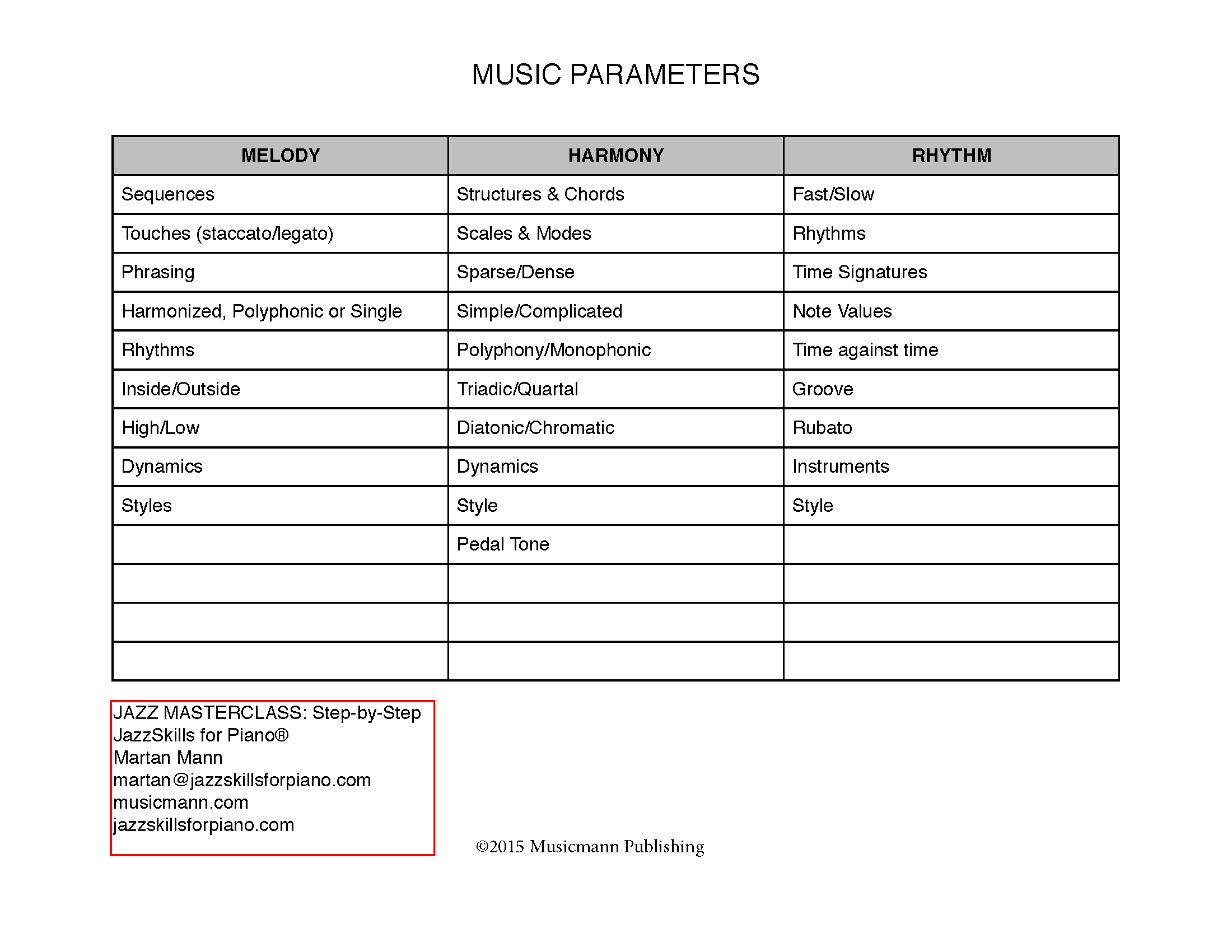
The music parameters are the elements which make up music as a whole. Prepare a list of music parameters. I did this under three predominant headings: Melody, Harmony and Rhythm. Under each of these headings, we can have many many subsets or parameters. Make your own study of this. This adds to your total jazz improvisation. Jazz improvisation is not just a "stream" of notes.
Step #5: Chord Structures.
An interesting way to begin making sense of the white keys is to use chord structures. For instance, you can create a chord structure which uses a major second on the bottom, then the interval of a fourth above that, then another major second above that (the exact intervals will adjust as you play all over the white keys). Play that structure all over the white keys. The idea is to get that structure in your head and ears. Also the main idea is to think down from the top note. Always treat the structures as a melodic event.
Step #6: Modes.
A simple explanation of the moes can be seen by observing the white keys. If you play a scale from C to C, or 1 to 1, (Ionian Mode) the half steps are between 3/4 and 7/8. In this case, you will have a major third and the total sound will be major. However if you play from D to D or 2 to 2 (Dorian Mode), the half steps are now between 2/3 and 6/7. The third is now minor and the total sound of this mode is minor. Ionian sounds major and Dorian sounds minor. Take a look at all the modes:
The Modes of the Major Scale
Ionian (Major Scale) 1 - 1
Dorian 2 - 2
Phrygian 3-3
Lydian 4-4
Mixolydian 5-5
Aeolian 6-6
Locrian 7-7
It matters what mode we are playing on the white keys because each mode has its own sound and feeling. We define what mode is being played by repetition of the bottom bass note. Experiment with each mode until you get that mode in your ears.
Step #7: You Play a White Key Improvisation.
Think about what you are playing. Be very choosy. There should be a definite pattern to your improv. There should be a . . . . "there - there". Give it a try.
Step #8: Twinkle Exercise.
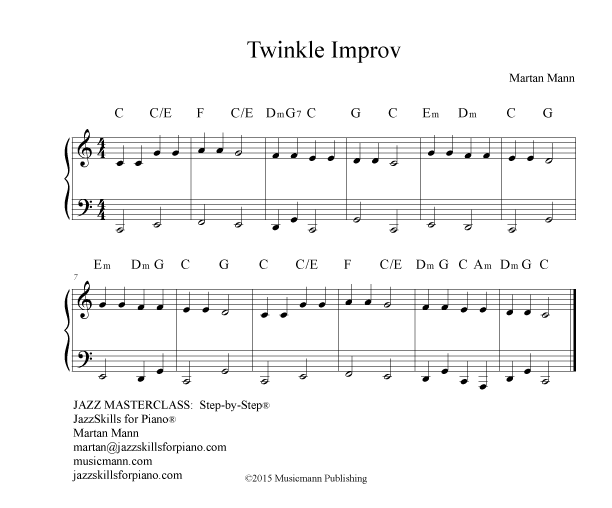
Let's take a look at the White Key Exercise from another perspective. I'm going to use a simple tune, Twinkle, Twinkle Little Star. This tune is totally White-Key (which is diatonic).
First, play the melody. Then construct a bas line. Don't just use the root note of the chord. Sometimes play a third in the bass, or a fifth. This creates a contrapuntal bass line.
Now create an improv using chord structures. So, instead of thinking of chord names, take a look at the territory between the bass note and the melody note. Then "imagine" the tones you want to play in the middle. There are many choices of notes that you can play either melodically or harmonically as structures.
Video 3: Beyond the White Key Exercise
Step #9: Learning all the Major Scales.
Start now playing all the Major Scales. Play them with two hands, up-and-down, without thinking. The scales should be totally effortless. Make sure you know the sharps and flats in every key. Know all the notes in every scale.
Step #10: Playing Diatonic Improv in All Keys.
In this step, we are using the skills developed in the White Key Exercise and playing in all keys. It is suggested that you start with the easiest key for you. Then, once you master that key, move on to the "next easiest key".
Let's say you are playing in the key of G major. Take a look at the scale. Play it up and down. Notice the F sharps.
Eventually work your way through ALL the keys and scales.
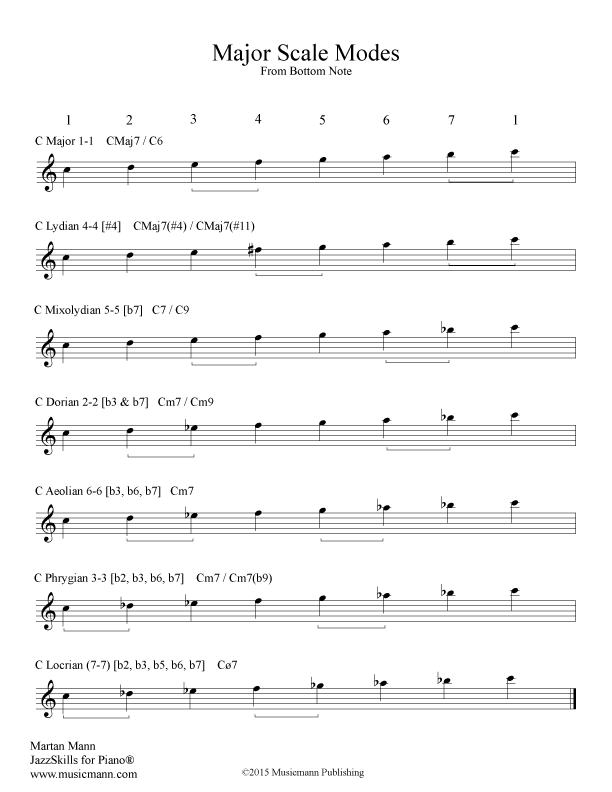
Step #11: Learning the Major Scale Modes from the Bottom Note.
When we learn the Major Scale Modes from the "jazz perspective", we have to learn the modes from the bottom note. For instance, when we learn a scale we usually learn and play it from the bottom note. A C Major Scale usually is played from C to C.
If we learn the Lydian Mode (4-4), we have the option to learn it from the fourth degree of the scale. That would be from F to F (of the C Major Scale).
But, I'm suggesting that instead you learn the Lydian Mode from the bottom note (in this case it is C). This means that the mode would in reality be a G Major Scale starting on the bottom note of C. This would appear to be a C Major Scale with a sharp fourth degree (F#).
Why do we do this? We do this because we learn modes which "attach" themselves to chords. In this way we can translate all chords into modes.
Learning the Major Scale Modes from the Bottom Note
Ionian Mode (Major Scale) 1-1
Lydian Mode 4-4 (#4)
Mixolydian Mode 5-5 (b7)
Dorian Mode 2-2 (b3, 7)
Aeolian Mode 6-6 (b3, 6, 7)
Phrygian Mode 3-3 (b2, 3, 6, 7)
Locrian Mode 7-7 (b2, 3, 5, 6, 7)
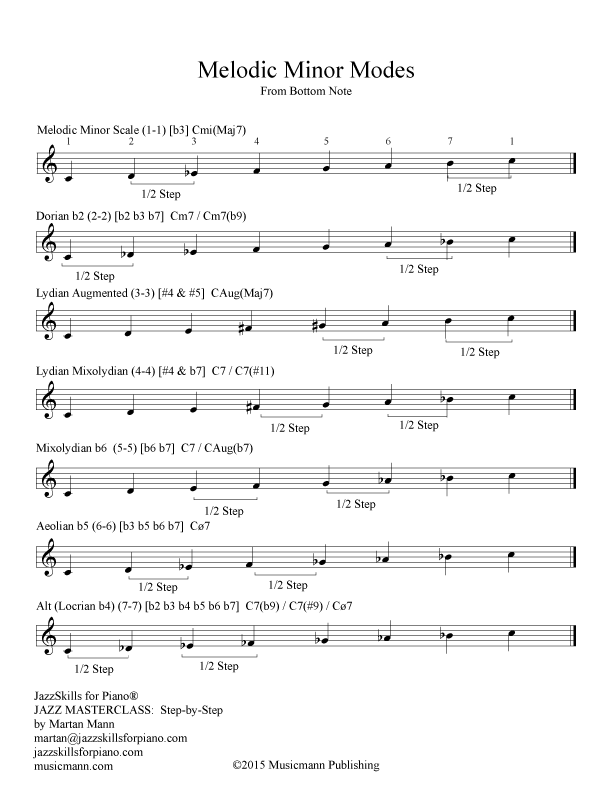
Step 12: Learning the Melodic Minor Scale Modes from the Bottom Note.
There are many scales that we can learn the modes from the bottom note. On of the most popular jazz scales is the Melodic Minor Scale. Learning the Melodic Minor Scale is easy. Just play a Major Scale and flat the third degree. This makes it sound minor.
In classical music theory, the scale goes up with the flatted third and major seventh. But, it comes down flatting the 7th and 6th degrees. This gives the scale one sound on the way up and a different sound on the way down (it's the Aeolian Mode). We don't do this in jazz because we want to identify a specific sound with a specific chord.
For instance, if you are playing a Minor/Major Seventh Chord, the appropriate scale or mode does not exist in the Major Scale. It does exist, though, in the Melodic Minor Scale (1-1).
Learn all of the modes of the Melodic Minor Scale starting from the bottom note.
Learning the Melodic Minor Scale Modes from the Bottom Note
Melodic Minor Scale (1-1) (b3)
Dorian b2 (2-2) (b2, 3, 7)
Lydian Augmented (3-3) (#4, & 5)
Lydian Mixolydian (4-4) (#4 & b7)
Mixolydian b6 (5-5) (b6, 7)
Aeolian b5 (6-6) (b3, 5, 6, 7)
Alt (Locrian b4) (7-7) (b2, 3, 4, 5, 6, 7)
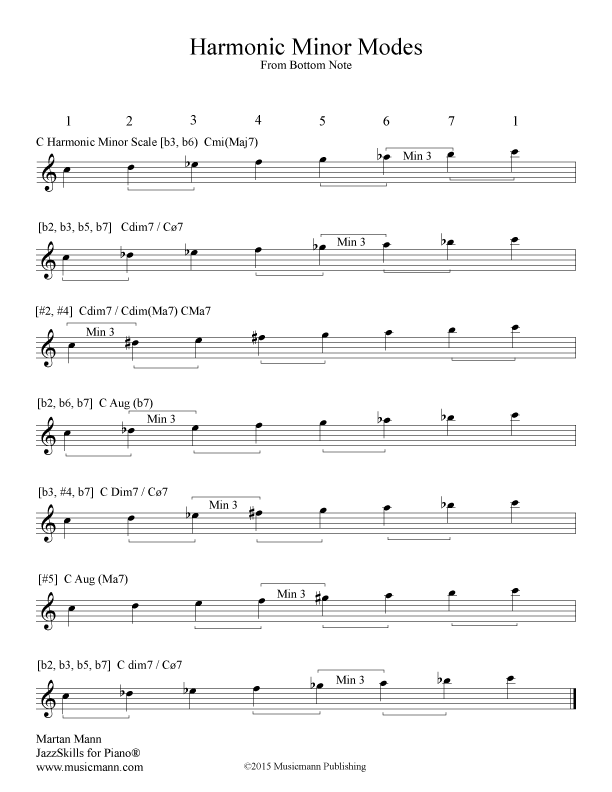
Step #13: Learning the Harmonic Minor Scale Modes from the Bottom Note.
The Harmonic Minor Scale has a flat 3 and flat 6. It works very well with a minor/major 7th. It is also used when you are playing two-five-one progressions in minor.
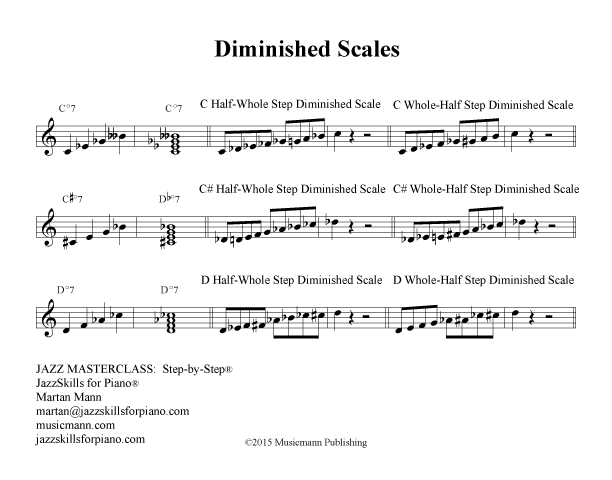
Step #14: Learning the Diminished Scale.
The Diminished Seventh Chord is made up of minor thirds. It is an "equal-distant" chord. You can create two equal-distant scales from this chord: the Half/Whole and the Whole/Half Diminished Scale. This scale works when you are playing any Diminished Chord or a dominant seventh with a flatted 9.
There are only three Diminished Scales: C, C# and D.
Video 4: Learning Progressions
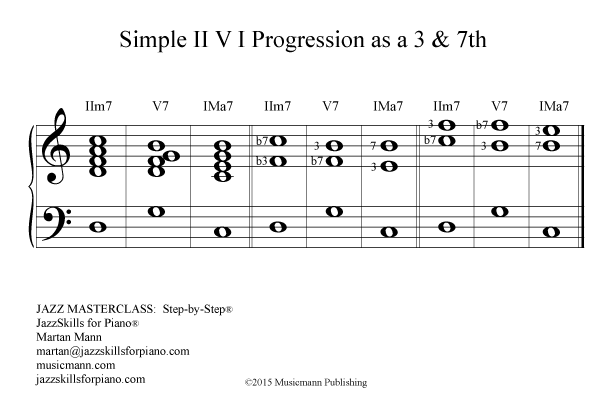
Step #15: Simple II V I Progression w/ 3 & 7
The Simple II V I uses mostly seventh chords. There is a IIm7, V7 & IMa7. The core these progressions is usually the 3 & &. It should be learned in all keys, around the cycle of fourths and fifths, and up-and-down chromatically. Learn it in all inversions. Learn with only the left hand playing the chords.
The Third and Seventh
Minor 7 . . . minor 3rd / flatted 7th
Dominant 7 . . . major 3rd / flatted 7th
Major 7 . . . major 3rd / major 7
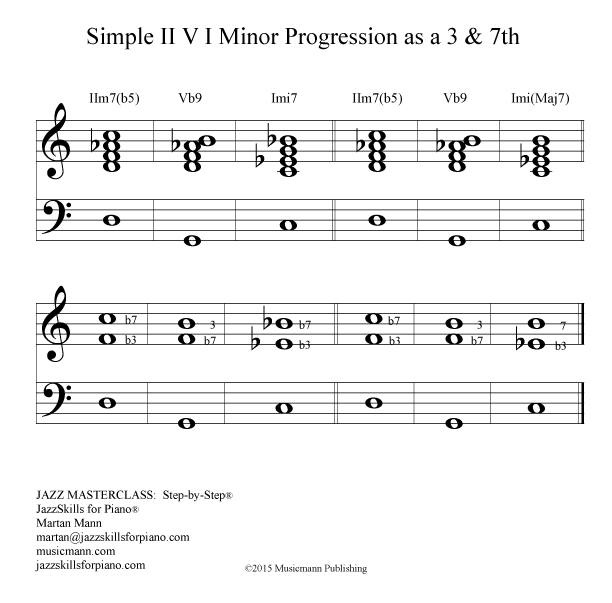
Step #16: Simple Minor II V I Progression w/ 3 & 7
When using the Simple II V I Minor Progression, you flat the fifth on the minor II chord. Then, you flat the ninth on the V7 chord. Finally, you have three choices for the minor I chord: Im7, Im(Ma7), Im6. It should be learned in all keys, around the cycle of fourths and fifths, and up-and-down chromatically. Learn it in all inversions. Learn with only the left hand playing the chords.
You can also use the 3/7 core with the minor progression.
The Minor Third and Seventh
Minor 7 . . . minor 3rd / flatted 7th
Dominant 7 . . . major 3rd / flatted 7th
Major 7 . . . minor 3rd / minor 7, minor 3rd / major 7th, & minor 3rd / major 6
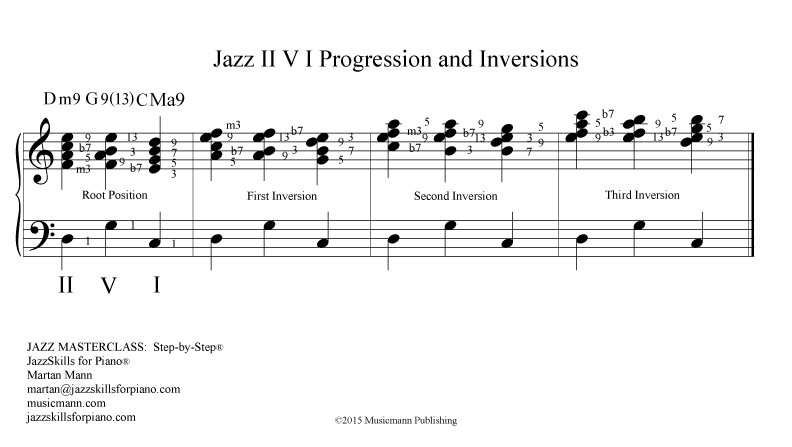
Step #17: Jazz II V I Progression and Inversions
The Jazz II V I Progression uses the 9th interval. This is the standard jazz progression which is learned by all jazz pianists. It should be learned in all keys, around the cycle of fourths and fifths, and up-and-down chromatically. Learn it in all inversions. Learn with only the left hand playing the chords.
It is a IIm9 / V9(13) / IMa9 Progression.
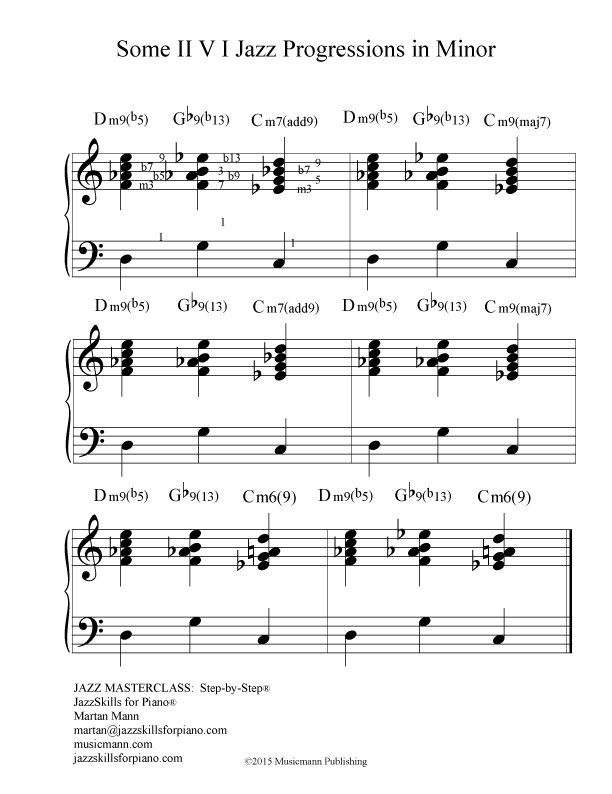
Step #18: Jazz Minor II V I Progression and Inversions
The Jazz Minor II V I Progression IIm9(b5), Vb9(b13), and Im9 (or I m9(Ma7). This is the standard minor jazz progression which is learned by all jazz pianists. It should be learned in all keys, around the cycle of fourths and fifths, and up-and-down chromatically. Learn it in all inversions. Learn with only the left hand playing the chords.
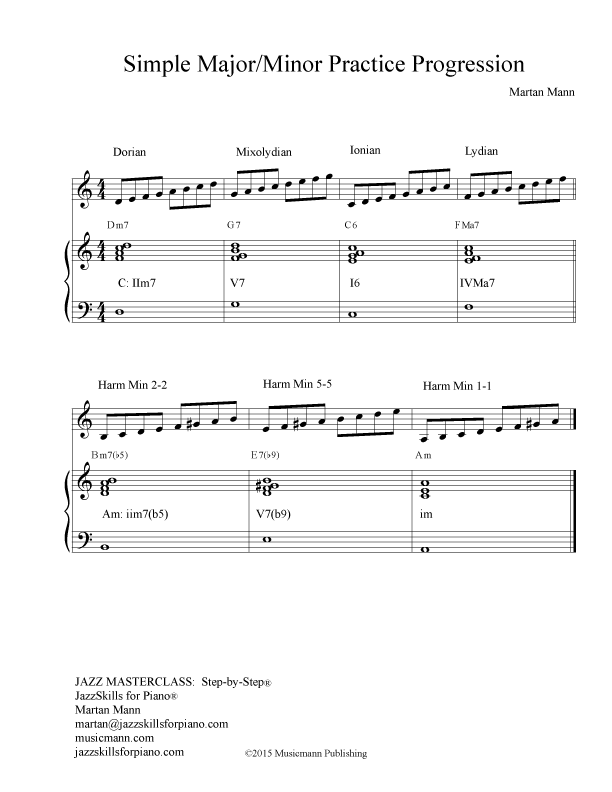
Step #19: Simple Major/Minor Progression
This is a progression which uses a II, V, I, IV (in major) and the II, V I (in the relative minor).
The Simple Major/Minor Progression uses mainly seventh chords: IIm7, V7, C6 (or major seventh), IVMa7. Then the bass line goes down a flatted fifth (tritone) to the IIm7(b5), Vb9, and Im (in the relative minor). It should be learned in all keys, around the cycle of fourths and fifths, and up-and-down chromatically. Learn it in all inversions. Learn with only the left hand playing the chords.
Each chord has it's appropriate scale.
Scales and Modes for the Simple Major/Minor Progression
IIm7 (Dorian 2-2)
V7 (Mixolydian 5-5)
I6 (Ionian - Major 1-1)
IVMa7 (Lydian 4-4)
In the Relative Minor (bass line down a flatted 5 (tritone)):
IIm7(b5) (Harmonic Minor 2-2)
V7(b9) (Harmonic Minor 5-5)
Im (Harmonic Minor 1-1)
Improvise using the Simple Major/Minor Progression.
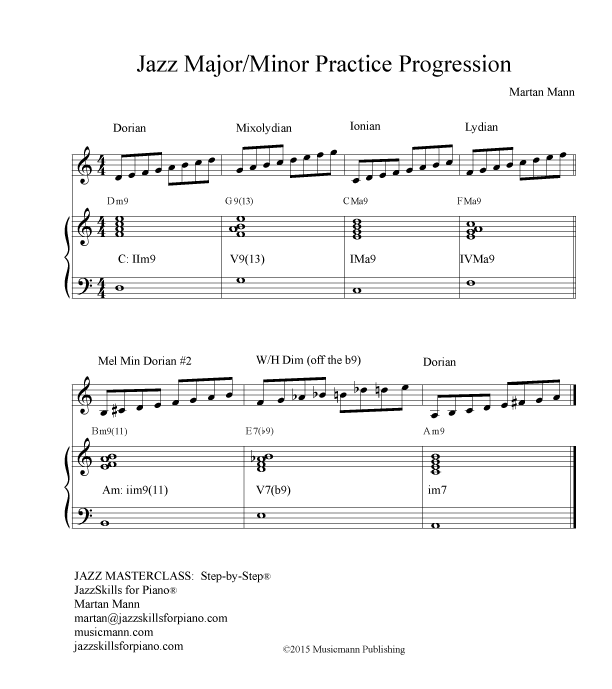
Step #20: Jazz Major/Minor Progression
This is a progression which uses a II, V, I, IV (in major) and the II, V I (in the relative minor).
The Jazz Major/Minor Progression uses mainly ninth chords: IIm9, V9(13), CMa9, IVMa9. Then the bass line goes down a flatted fifth (tritone) to the IIm9(b5), Vb9(b13), and Im9 (in the relative minor). It should be learned in all keys, around the cycle of fourths and fifths, and up-and-down chromatically. Learn it in all inversions. Learn with only the left hand playing the chords.
Each chord has it's appropriate scale.
Scales and Modes for the Jazz Major/Minor Progression
IIm9 (Dorian 2-2)
V9(13) (Mixolydian 5-5)
IMa9 (Ionian - Major 1-1)
IVMa9 (Lydian 4-4)
In the Relative Minor (bass line down a flatted 5 (tritone)):
IIm9(11) (Melodic Minor Dorian #2 (2-2)
V7(b9) (Whole/Half Diminished (off the b9th)
Im (Dorian 2-2)
Improvise using the Jazz Major/Minor Progression.
©2015 Musicmann Publishing
End of Preparing to Play in All Keys.
This is the end of "Preparing to Play in All Keys". Consider continuing on to the followup lesson: "Preparing to Learn a Tune". In this lesson, you will utilize all your new skills by applying them to developing any tune. Start today!
EXAMPLES
EXAMPLE #1: Solfege Chart
EXAMPLE #2: Chromatic Intervals

EXAMPLE #3: Triads and Inversions

EXAMPLE #4: Sevenths and Inversions

EXAMPLE #5: Modes from Each Note and from the Bottom Note


EXAMPLE #6: Music Parameters
EXAMPLE #7: Twinkle Improv
EXAMPLE #8: Modes from Bottom Note
EXAMPLE #9: Diminished Scales
EXAMPLE #10: Progressions
EXAMPLE #11: Major/Minor Practice Progression
DOWNLOAD FINALE NOTEPAD FILES
DOWNLOADABLE PDFS