

Stride Blues for the Jazz Pianist Introduction:
Stride Blues is an older piano blues style. It is a wonderful way to play solo piano. It’s not hard to learn . . . but you have to learn it step-by-step. Learn each step thoroughly before moving on to the next step.
I’d love to hear your questions and feedback regarding this lesson. Please contact me at martan@jazzskillsforpiano.com. If you received this lesson as a “stand-alone” lesson . . . check out my online jazz piano course, JazzSkills for Piano (jazzskillsforpiano.com/wp).
Best to you –
–Martan 🙂

Videos
Video 1: Explanation of the Blues Form
Video 2: Developing the Stride Blues Style
Video 3: Open Voicings for Stride Blues

Video 4: Putting it all together
Stride Blues Step-by-Step
Step #1: Explanation of the basic blues form.
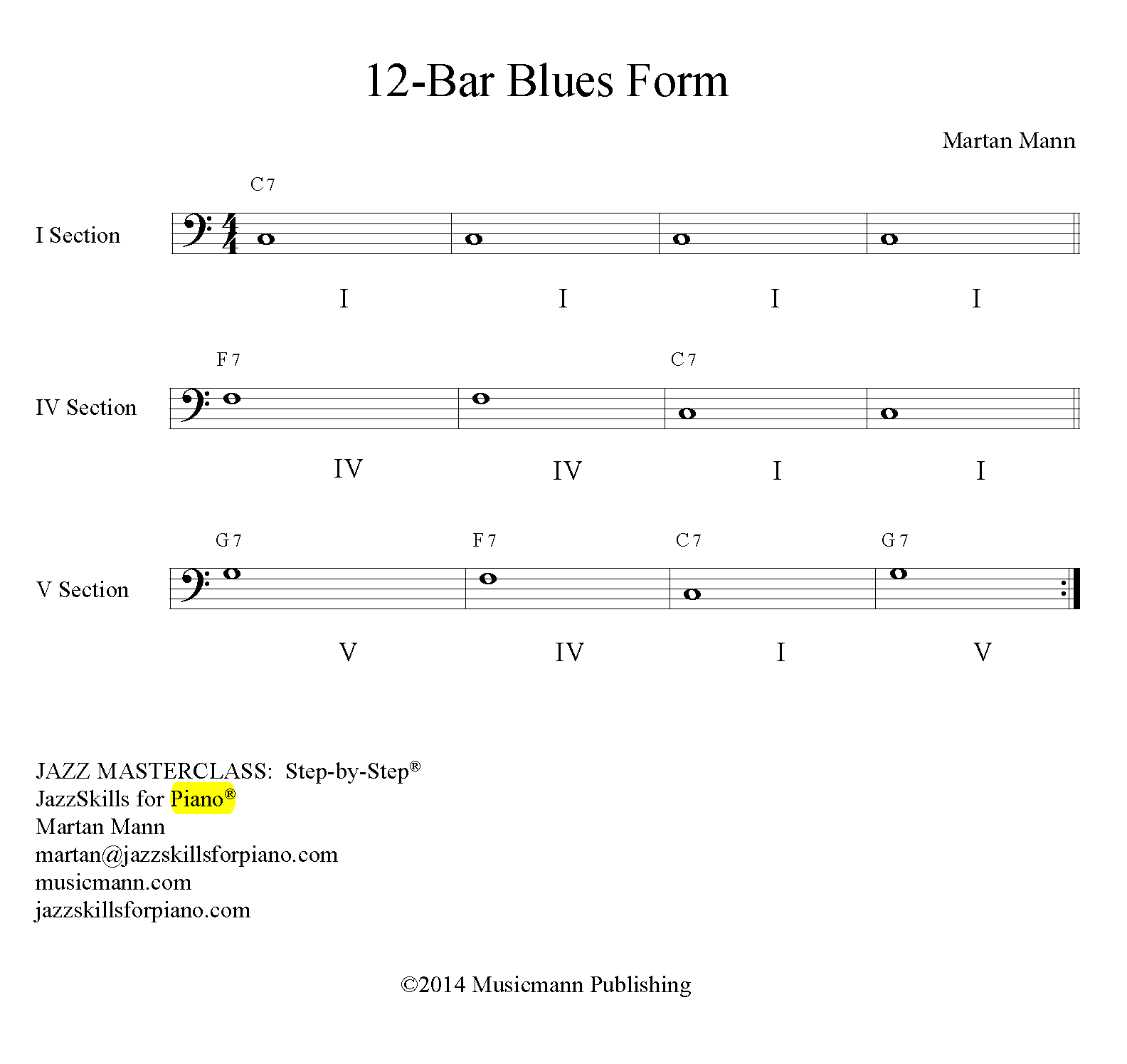
The Basic 12-bar Blues Form consists of three groups of four measures. Familiarize yourself with this form in all keys.
The Basic 12-bar Blues Form:
Section I: I I I I
Section IV: IV IV I I
Section V: IV V I V
Step #2: The Stride Blues 12-bar Blues Form.
Below is one of many variations of the Basic 12-Bar Blues. This is a good example of a 12-Bar Blues form used for Stride Blues. It is a great idea to learn this form thoroughly. First learn it in C. Then play it in all keys.
Stride 12-Bar Blues Form
(key of C - all chords are dominants)
Section I: ||:C7 C7/E | F7 F#dim7 | C7 G7 | C7 |
Section IV: | F7 F7/C | F#dim7 | C7 B7 | Bb7 A7 |
Section V: | D7 |G7 G7/B | C7 A7 | D7 G7 :||
Step #3: Learn the Bass Note w/Lead-ins.
Develop the bass line . . . almost like you are a bass player. Bass players play "lead-ins". This leads them from chord to the next chord.
There are a number of ways to play lead-ins:
1) You can repeat and jump to the next chord.
2) You can move chromatically.
3) You can move diatonically (within the key).
Play bass lines over and over until they are comfortable.
Step #4: Developing the Chord Inversions
In this step, you play chords and their inversions in the right hand. Remember, the blues uses mostly dominant 7th chords. This means you have four notes and consequently, four inversions. Play through the entire Stride Blues form playing all the chords in all inversions. Do this until you are completely comfortable.
Step #5: Combine LH Bass & RH Chord Inversions.
Normally the stride blues is performed primarily in the left hand. But, for the purpose of initial practice, we will play the bass note (with lead-ins) in the left hand and the chord (with inversions) in the right hand.
Step #6: Developing the Stride Groove.
The best way that I know to develop a groove . . . is to sing it first. Then play through the stride blues form over and over until the groove is natural and easy.
Step #7: Playing all with the left hand.
Play the bass note and the chord in only the left hand. This is very difficult. I suggest that you practice this slowly. Then, pick up tempo as your skill increases.
Step #8: Playing fast stride.
Practice playing the left hand stride fast. To play faster, you must simplify lead-ins and chord inversions. Take a long time to work on this step.
Step #9: Open Voicings Inversion Exercise
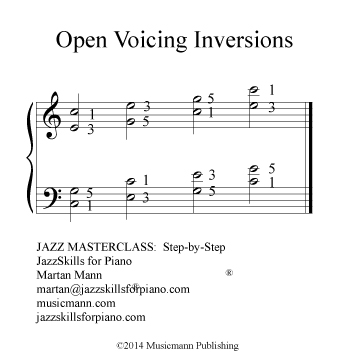
Open voicings are a valuable tool to use in the Stride Blues style. It creates good voice leading.
To create an open voicing, take a closed position triad. Remove the third and place it an octave above. Then add another tone above that. That should create a four-part soprano, alto, tenor, bass voice leading.
For Step #9: Play the Open Voicings in inversions. Do this in all keys.
Step #10: Open Voicings Series Exercise
Practice the Open Voicing Series Exercise. Notice that it is organized by the left hand. Learn this series of voicings in all keys.
Step #11: Open Voicings Bouncing Chords
Establish two of the voicings in the right hand. Notice that the top voicing is the melody. Once we have done that, we can play two voicings in the left hand. If the right hand has a third in it, then do not play a third in the left hand. This prevents playing a double-third.
Practicing freely "bouncing" through all the voicings in one-chord, noticing the top melody note. You can do this for all triads and all keys. Eventually play this quickly and fluently.
Step #12: Make Up Your Own Progression
To start with "Make up your own progressions", take one of the open voicings and ask yourself: "How many ways can I move to the IV chord with good voice leading?" Try not to double the third. Practice playing this in all keys.
Then, take one of the open voicings and ask yourself: "How many ways can I move to the V chord with good voice leading?"
Then, move to a new open voicing of the I chord and repeat this exercise.
Then, play various voice leadings using variations of the I IV V I. In this case, this will sound like creating a hymn.
Step #13: Add in Seventh Chords
Now, play through the Stride Blues using Open Voicing Dominant Seventh Chords. Think melodically. Try not to double the third.
Step #14: Play with thirds, sixths and tenths
When you are playing Step #13 above, look at your hands for thirds, sixths and tenths. Then you can create melodic ideas moving in harmony. Always think musically.
Step #15: Using 10ths and Sixths in the bass
When you are playing a stride left hand, you can play a single note in the bass. But, you can also play a tenth. If you can't reach a tenth, then consider arpeggiating to the tenth (over the fifth). Or you can play a single bass note to a sixth. So, when you are playing in the left hand, use single notes, tenths and sixths.
Play through the Stride Blues using only the left hand.
Step #16: RH & LH with Open Voicings
Now play the left hand stride with single note bass, tenths and sixths with the right hand playing open voicings. You are doing a little bit of both. Use your ears and musicality. Always play forward to the next chord.
Step #17: Ideas for Soloing
Soloing is all about thinking forward to a destination point. Start playing with the LH. When you can think when you have a little space to think about it, add in some melody notes. In setting up a priority, always think of the left hand first. Then, add in the melody. Don't lose the left hand in your mind. It's about "waiting" for melodic ideas.
Think of the Blues Scale. Also use the Mixolydian Plus scale. When making up melodies, think melodically. Often sing the melodies and play what you are singing. Think the way a singer sings, or an instrumentalist phrases. Play "bluesy licks". You can amass a repetoire of these licks, which you will play over and over.
EXAMPLES
EXAMPLE #1: Basic 12-Bar Blues Form
EXAMPLE #2: 12-Bar Stride Blues Form

EXAMPLE #3: 12-Bar Stride blues with Inversions

EXAMPLE #4: Open Voicing Inversions
EXAMPLE #5: Open Voicings Series Exercise

EXAMPLE #6: Open Voicings Bouncing Exercise

EXAMPLE #7: Make Up Your Own Progression

EXAMPLE #8: Blues Scale

EXAMPLE #9: Blues Scale & Mixolydian Plus Scale

EXAMPLE #10: Some Sample Blues Endings

DOWNLOADABLE PDFS
Downloads
- Basic 12-Bar Blues
 12-Bar Stride Blues Form
- 12-Bar Stride Blues Inversions
- Open Voicing Inversions
- Open Voicing Series Exercise
- Make Up Your Own Progression
- Blues Scale
- Blues Scale and Mixolydian Plus Scale
- Some Sample Blues Endings