Pachelbel Exercise Random Melody 8-3

Pachelbel Exercise Random Melody 8-3

[features_box_yellow width=”75%” + border=”2px”]Level:  Intermediate

Study the Pachelbel Exercise Random Melody after studying the Pachelbel Exercise Continuous Melody & Single Bass.[/features_box_yellow]

video
play-sharp-fill

Play through the Pachelbel Canon using random starting points and random note time values.  Remember, you can use Quarter Notes, Eighth Notes, Quarter-note Triplets and Eighth-note Triplets (also sixteenths).   Put on a metronome (try Quarter-note to 70).  Count out loud – so that you know precisely when you are starting the pick-up lick.  Make sure that you end on the first beat of the next measure.  You can also land on “suspensions” (more on that later).

[features_box_blue width=”75%” + border=”2px”]Personal Evaluation

[green_tick_2_list width=”100%”]

  • I can easily play the Pachelbel Exercise Random Melody Exercise in all keys (this will take a lot of work).
[/green_tick_2_list]

[/features_box_blue]

Question and Answer Minor 7-8

Question and Answer Minor 7-8

[features_box_yellow width=”75%” + border=”2px”]Level:  Intermediate

Study Question and Answer Minor after studying the Question & Answer I IV V I Chord Changes.[/features_box_yellow]

video
play-sharp-fill

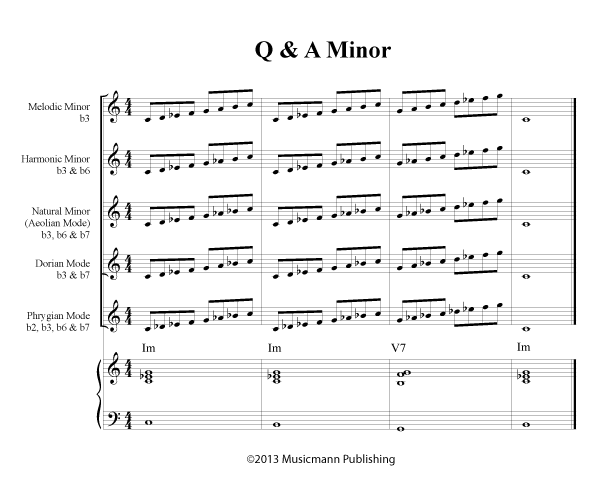
To play the Im IVm V7 Im Q & A – first, study various minor scales and minor-type modes.  For instance:  Melodic (b3), Natural b3, b6 & b7), & Harmonic Minor (b3 & b6).  Also use the Dorian (b3 & b7) and Phrygian (b2 b3 b6 b7) Modes.  Practice and familiarize yourself with these scales first.

Then, make melodies using your ear.  If you play the Bb . . . then avoid the B natural.  If you play the Ab . . . then avoid the A natural.  Always use the flatted third.  You often use the harmonic minor scale from the I chord when playing melodies over the V7 chord.

Q-AMinor

[membership_download_item_pdf link=”http://jsfp.s3.amazonaws.com/Q-AMinor.pdf” + target=”_self”]Question and Answer Minor[/membership_download_item_pdf]

[features_box_blue width=”75%” + border=”2px”]Personal Evaluation

[green_tick_2_list width=”100%”]

  • I have familiarized myself with the minor modes and scales.
  • I have created minor melodies over the Im IVm V7 Im chord progression (in all keys).
[/green_tick_2_list]

[/features_box_blue]
Question and Answer Added Tones 7-4

Question and Answer Added Tones 7-4

[features_box_yellow width=”75%” + border=”2px”]Level:  Intermediate

Study Question and Answer Added tones after studying the V7 to I Accompaniments.[/features_box_yellow]

video
play-sharp-fill

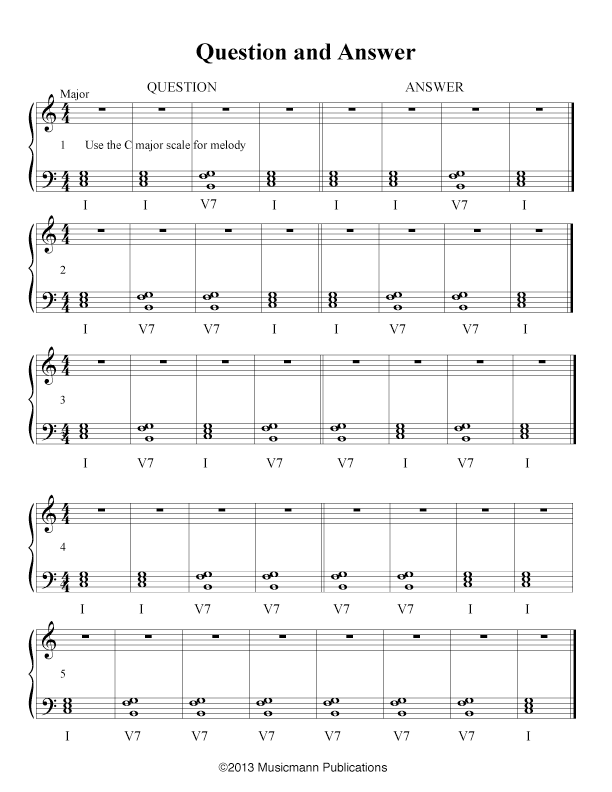
We started Q & A by playing simply a single bass note and single melody note.  Now, use your “ears” to add in additional tones.  They can be chord tones, suspended tones, thirds, sixths, etc.  You can also move the bass line to another chord tone, such as the third.  After you have practiced adding in a single extra note (that would give you three notes) . . . then, use “open voicings” and add in additional tones.  (Open Voicings will be discussed in another lesson.)

Q-AChPatterns

[membership_download_item_pdf link=”http://jsfp.s3.amazonaws.com/Q-AChPatterns.pdf” + target=”_self”]Question and Answer Chord Changes[/membership_download_item_pdf]

[features_box_blue width=”75%” + border=”2px”]Personal Evaluation

[green_tick_2_list width=”100%”]

  • I have practiced using Added Tones in Question and Answer in all keys.
  • I have added in extra tones – ie:  suspended tones, four tones, five tones, etc.
  • Of course, all melodies move forward.
[/green_tick_2_list]

[/features_box_blue]

Question and Answer Accompaniments 7-3

Question and Answer Accompaniments 7-3

[features_box_yellow width=”75%” + border=”2px”]Level:  Intermediate

Study Question and Answer Accompaniments after studying the V7 to I Syncopated Melody.[/features_box_yellow]

video
play-sharp-fill

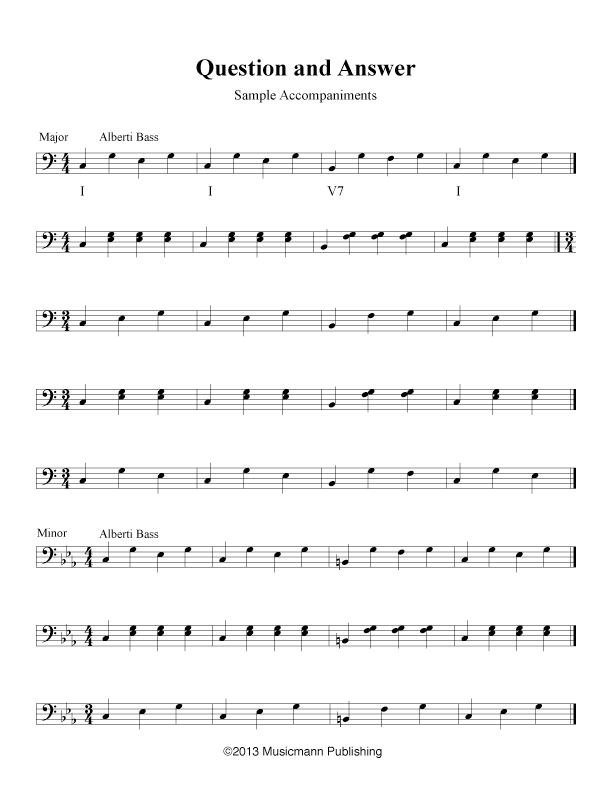
The purpose of these accompaniment patterns is to keep the music moving forward.  Practice all the sample accompaniments and make up your own.  Keep them simple and easy.  Then, have fun making up simple melodic phrases over the accompaniment patterns.   The accompaniment patterns can be in different rhythms, ie:  2/4, 3/4, 4/4, 5/4, etc.  Play in all tempos and in different keys.

Below are some possible accompaniments.  Experiment with your own accompaniment patterns.

Q-Aaccomp

[membership_download_item_pdf link=”http://jsfp.s3.amazonaws.com/Q-Aaccomp.pdf” + target=”_self”]Question and Answer Accompaniments[/membership_download_item_pdf]

[features_box_blue width=”75%” + border=”2px”]Personal Evaluation

[green_tick_2_list width=”100%”]

  • I can play all the different Accompaniment Patterns using Question and Answer Patterns in all keys.
[/green_tick_2_list]

[/features_box_blue]
V7 to I Added Tones 6-5

V7 to I Added Tones 6-5

[features_box_yellow width=”75%” + border=”2px”]Level:  Intermediate

Study Added Tones after you have practiced the other V7 – I Exercises.[/features_box_yellow]

video
play-sharp-fill

This is an way to develop continuity to your soloing.  Instead of always ending your phrases on a chord tone . . . add a couple (or more) tones.  This causes your phrases to be “unexpected”.  That is a great way to develop a creative solo.

[features_box_blue width=”75%” + border=”2px”]Personal Evaluation

[green_tick_2_list width=”100%”]

  • I can play the V to I Added Tones Exercise in all keys.
[/green_tick_2_list]

[/features_box_blue]



Seventh Chord Minor Scale Structures 4-5

Seventh Chord Minor Scale Structures 4-5

[features_box_yellow width=”75%” + border=”2px”]Level:  Advanced

Before practicing the Seventh Chords Minor Scale Structures . . . make sure that you have thoroughly mastered the Seventh Chords Major Scale Structures.  Be advised that learning chord structures for the Melodic Minor Scale and Harmonic Minor Scales is a long-term study.  Definitely, keep at it![/features_box_yellow]

video
play-sharp-fill

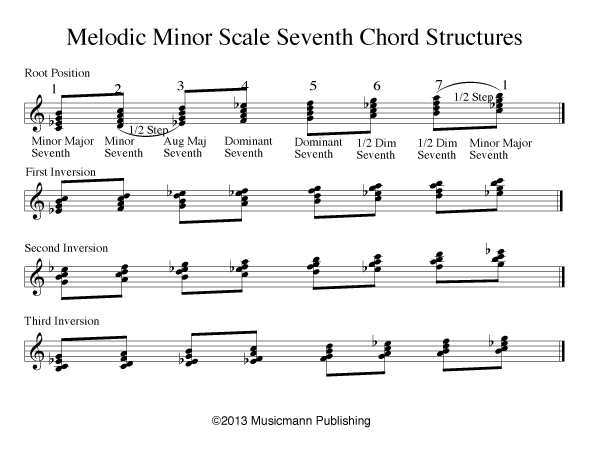
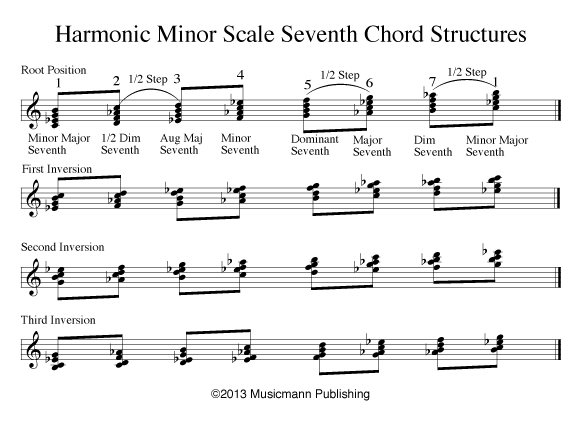
SevMelMinStructSevHarMinStruct

[membership_download_item_pdf link=”http://jsfp.s3.amazonaws.com/SevMelMinStruct.pdf” + target=”_self”]Seventh Chord Melodic Minor Scale Structures[/membership_download_item_pdf]

[membership_download_item_pdf link=”http://jsfp.s3.amazonaws.com/SevHarMinStruct.pdf” + target=”_self”]Seventh Chord Harmonic Minor Scale Structures[/membership_download_item_pdf]

[features_box_blue width=”75%” + border=”2px”]Personal Evaluation

[green_tick_2_list width=”100%”]

  • I have memorized the Seventh Chord types up the Melodic Minor Scale.
  • I can quickly play the Seventh Chords in each inversion up the Melodic Minor Scale in all keys.
  • I have memorized the Seventh Chord types up the Harmonic Minor Scale.
  • I can quickly play the Seventh Chords in each inversion up the Harmonic Minor Scale in all keys.
  • I can play different open voicing Seventh Chord Structures up the Melodic Minor Scale in all keys.
  • I can play different open voicing Seventh Chord Structures up the Harmonic Minor Scale in all keys.
[/green_tick_2_list]

[/features_box_blue]
Playing Random Scales and Arpeggios 1-7

Playing Random Scales and Arpeggios 1-7

[features_box_yellow width=”75%” + border=”2px”]Level:  Intermediate and Advanced

This exercise should be practiced after you have mastered the Major Scales.  This is a fun way to experience scales and arpeggios in unexpected musical ways.  The fingerings are fresh and new . . . as are the sounds you will be hearing.  This is a great preliminary way to develop creative soloing skills.  I suggest that you play to a metronome.  Start slowly and increase speed as your competency improves. [/features_box_yellow]

video
play-sharp-fill

Here is an interesting exercise using scales and arpeggios.  Play any scales up and down, changing direction at any time.  Start with one hand and later progress to playing with both hands in octaves.  You can also play random arpeggios.

One of the benefits of this practice is that it helps to develop the ability to develop fingering “on-the-fly”.  It is important to develop an effective and easy approach to creating fingering which works.  Fingering is an important element in improvisation and sight reading.

Try to put your thumbs always on a white key.  Play to a metronome, first slowly . . . then at a quicker pace.

Have fun with this.

[features_box_blue width=”75%” + border=”2px”]Personal Evaluation[green_tick_2_list width=”100%”]

  • I have mastered the basic scales before applying parameters.
  • I can apply different parameters to the right and left hand.
  • I can “mix and match” parameters.
  • I am always discovering new parameters to keep scale practice fresh.

[/green_tick_2_list][/features_box_blue]

Playing Scales and Arpeggios with Musical Parameters 1-6

Playing Scales and Arpeggios with Musical Parameters 1-6

[features_box_yellow width=”75%” + border=”2px”]Level:  Intermediate

This is a way to add musicality to your scales and arpeggios . . . and all your playing.  I suggest that you thoroughly learn the fingerings for the major scales and arpeggios before using parameters.  [/features_box_yellow]

video
play-sharp-fill

Once you have learned to play a scale with both hands . . . you can increase your musical ability by playing the scales using musical parameters.  Below are some parameters.  You can easily create more.  This adds variety, musicality and . . . fun to your scale and arpeggio practice.

Musical parameters for scale and arpeggio practice:

  • Dynamics
  • Phrasing
  • Tempo, Rhythm & Meter
  • Rhythm Independence
  • Direction
  • Independence

Add these (and other) parameters to your daily practice.  Enjoy!

[features_box_blue width=”75%” + border=”2px”]Personal Evaluation[green_tick_2_list width=”100%”]

  • I have mastered the basic scales before applying parameters.
  • I can apply different parameters to the right and left hand.
  • I can “mix and match” parameters.
  • I am always discovering new parameters to keep scale practice fresh.

[/green_tick_2_list][/features_box_blue]

Minor Scales 1-5

The Minor Scales 1-5

[features_box_yellow width=”75%” + border=”2px”]Level:  Intermediate

I suggest that you do not start studying the minor scales until the major scales have been completely learned.  Once the major scales are learned, the minor scales will be much easier to master.  All the fingerings for the minor scales are the same as for the major scales . . . except in the left hand for Bb and Eb (those minor scales start with the second finger).[/features_box_yellow]

video
play-sharp-fill

When analyzing the minor scales . . . all the minor scales flat the third.  The difference between the minor scales all exist in the top four notes of the scale (called a tetrachord).

Here are the minor scales:

  • Melodic Minor (b3).  The top tetrachord is major.  It should be noted that classical theory states that the melodic minor scale consists of a melodic minor going up and natural minor (b3, b6 & b7) on the way down.  In jazz theory, most jazz players use the melodic minor scale up and down.
  • Harmonic Minor (b3 & b6)
  • Natural Minor (b3, b6 & b7).  This is also known as the Aeolian Mode (6-6) and Relative Minor.
  • Dorian Mode (b3 & b7) (2-2)  This is not technically a minor scale . . . however it does use the flatted 3rd and sounds minor.  I use it in practice because it helps to hear the subtle difference between all the minor scales.  Remember . . . the difference all exists in the upper tetrachord.  I’ll be discussing all the modes in future lessons.

[membership_download_item_pdf link=”http://jsfp.s3.amazonaws.com/Scales Exercise  – Two Octaves.pdf” + target=”_self”]Minor Scales Exercise[/membership_download_item_pdf]

[features_box_blue width=”75%” + border=”2px”]Personal Evaluation[green_tick_2_list width=”100%”]

  • I have mastered the Major Scales before mastering the Minor Scales.
  • I can play the Minor Scales with rhythmic evenness.
  • I can play the Minor Scales with a beautiful legato touch.
  • My fingerings are automatic.
  • Practicing Minor Scales is part of my daily practice.

[/green_tick_2_list][/features_box_blue]

Melodic Chord Exercise Part 1 3-4

Melodic Chord Exercise Part 1  3-4

[features_box_yellow width=”75%” + border=”2px”]Level:  Intermediate

Study the Melodic Chord Exercise after you have mastered playing all the triad inversions.  It would also be a good idea to know how to spell all the major scales.

[/features_box_yellow]

video
play-sharp-fill

This is a “crazy” way to add new harmonies into your ears and to master the major triad.  I warn you, it will sound strange, but the result is that you will start hearing harmonies in fresh ways. This is also a great way to learn the minor triads augmented triads, sevenths or any chord. Also it teaches you to hear a melody in a harmonic way.  In other words, if you play a single note melody, the tendency is to only hear the melody note which you are playing. However, implied in that melody note are hundreds, maybe thousands of ways to harmonize underneath it. This teaches you to hear harmonies from the top down.

Start with any major triad in the root position.  Pick a simple melody of your choice  (i.e. major scale or a nursery rhyme, etc.) and harmonize that melody using only the root position major triads. The melody will entirely be harmonized with major triads. This makes the fifth of the triad the melody note.

Next harmonize the same melody with the major triad in the first inversion. Now the melody note (on top) will be the 3rd of the triad.

Now use the triad in the 2nd inversion. The melody note will now be harmonized by the root of the triad.

Next mix and match any triad in any random order which you choose. This means that any melody note has three possible chord choices depending whether or not you are using the root, third, or fifth of the major triad. (I know, it doesn’t sound very musical.)

[membership_download_item_pdf link=”http://jsfp.s3.amazonaws.com/Melodic Chords New.pdf” + target=”_self”]Melodic Chord Exercise[/membership_download_item_pdf]


[features_box_blue width=”75%” + border=”2px”]Personal Evaluation

[green_tick_2_list width=”100%”]

  • I can quickly and easily play all the the Melodic Chord Exercise Part 1 in all keys.
[/green_tick_2_list]

[/features_box_blue]