Question and Answer Introduction
[features_box_yellow width=”75%” + border=”2px”]Level: Intermediate
Study Question and Answer after studying the V7 to I Exercises.[/features_box_yellow]
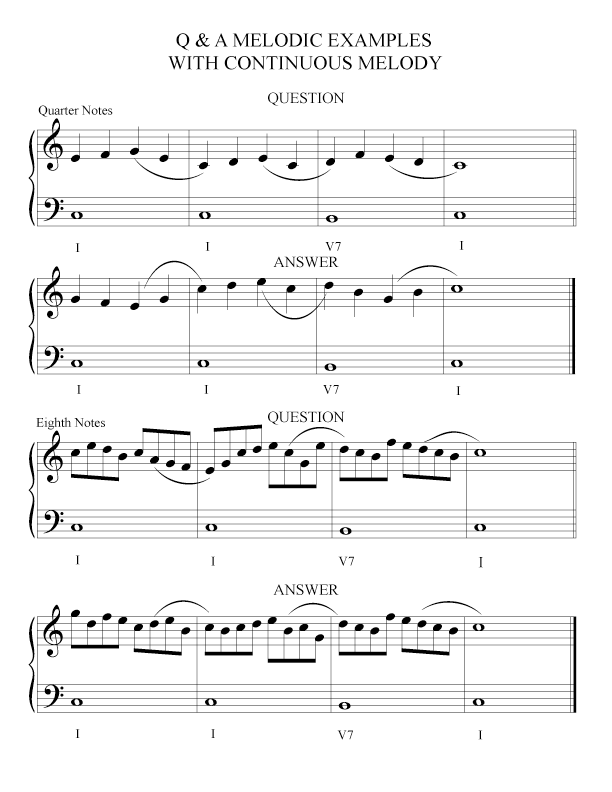
Now that we have explored resolving the restless V7 chord to the stable I chord, let’s put this into other settings. A simple way to start is to create a four-bar “question”. Then, we follow that with a four-bar “answer”. In a way, the entire question is like a V7 chord. It makes us feel “anxious” until we receive the “stable” answer.
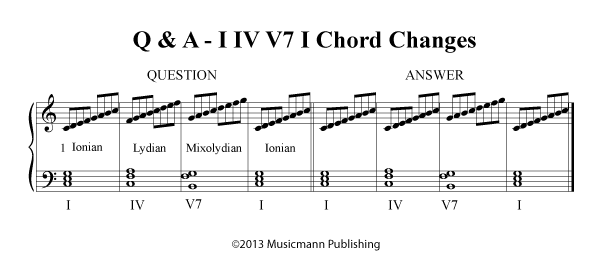
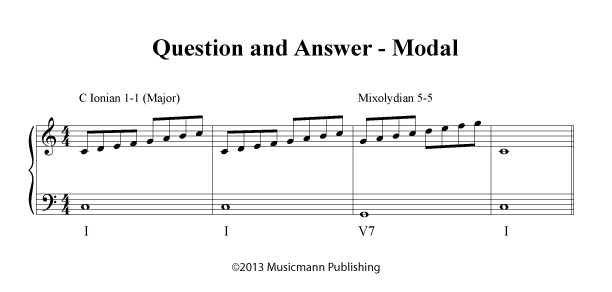
Once we create a chord pattern, then we can start creating melodies. Let’s say we start with a I, I, V7, I question and a I, I, V7, I answer. In the first two bars, there are two measures of the I chord. We won’t find a lot of movement here, because the changes are stagnant. However, once we play the V7 chord, that sets up the important resolution to the I chord. In other words, play closer attention to the selection of notes in the last two measures. Use a metronome to keep the improv moving forward.
Question and Answer solves the problem: “How do I begin to improvise?” Improvising is a lot like skiing. If you stand at the top of the hill without pushing off, you never know the experience of coming down the hill. We often stare at the piano, waiting for an idea to strike us before we start improvising . . . and never get started. More than any other factor, just learning where and how to start is most important. To begin with, the very nature of improvising demands that you have basic elements. Then, the challenge is to change those elements. For example, you can improvise from a melodic idea, or a rhythmic idea, or a chord pattern, or even a “sound effect”. The main issue is to set up some parameters that will serve as the basis for the improvisation.
In jazz, improvisation usually means a set chord progression. If we play a tune, like “Misty”, the chords are an integral part of the tune. All musicians will rely on those chords and will improvise their melodies accordingly. It is also possible to construct a type of improvisation where the chords would change according to the whims of the melody, but, in most cases, especially when more than one musician is playing, the improv feeds off the basic chord changes.
That is why Question & Answer is so important to this study, because it makes you think along the “mental tracks” of a jazz musician. Of course, you must start simply, using, perhaps, children’s melodies or simple Mozart-like melodies. The idea is to keep your melodies musical, simple and logical. Melodies have tension and release. It is the precise `handling of this tension and release that creates a good melody.
Let’s Begin!
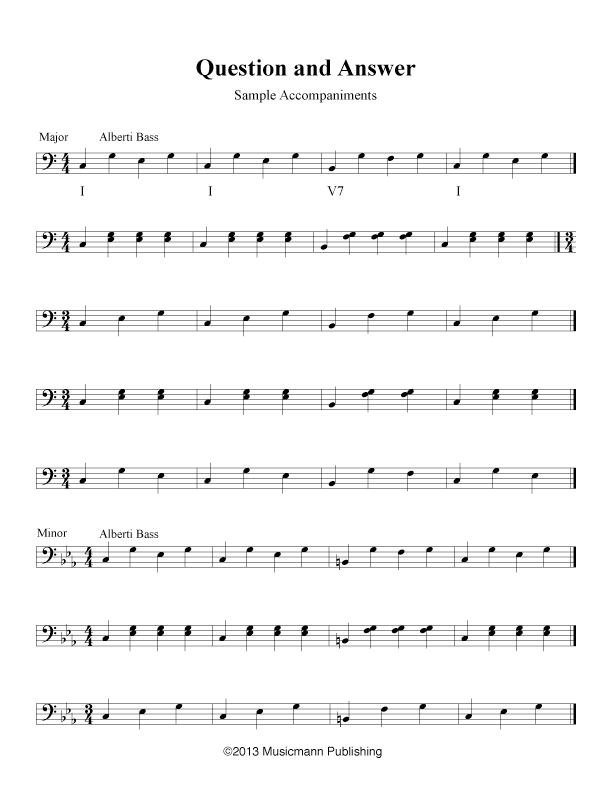
Here are some chord patterns.
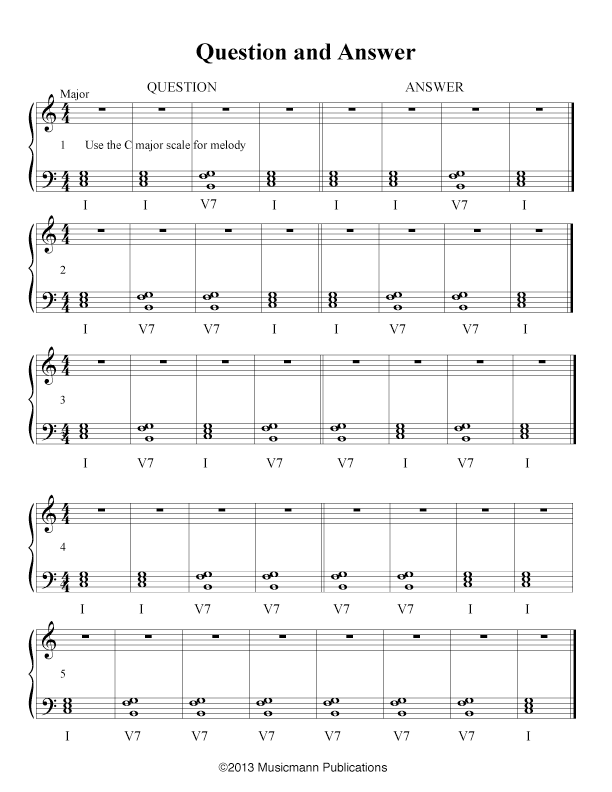
First start playing the left hand chord patterns in whole notes, straight across, first playing the Question and then the Answer. Also, play one of these question and answer accompaniment chord patterns until you are thoroughly in command of it. When learning in this manner, it is important to keep at it until the pattern simply flows from the subconscious. (See Example )
Then move on to the next step. Start creating simple and logical melodies over the chord pattern. Listen to the tension and release created by the chord pattern. The I Chord has a “static” feel and the V7 chord has a “restless’ feel. Your melody should reflect the tensions of the chord changes. Try singing as you play. Let the fingers follow your singing.
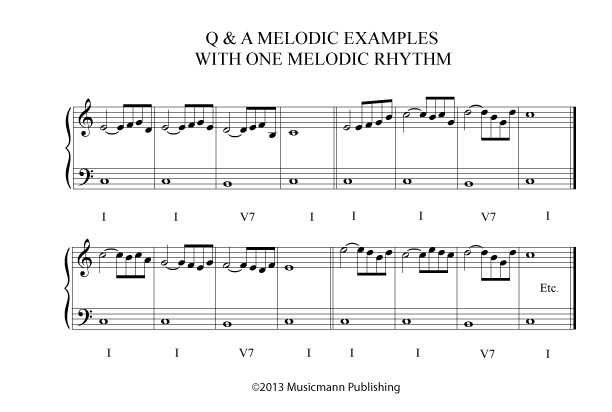
Play the chord patterns over and over, each time seeking for new melodic patterns and fresh ideas. This will be the toughest part, because you will have trouble dealing with the simplicity of the ideas that will be coming. You will possibly be frustrated, thinking that the ideas should be more profound and more varied.
However, the advice that I give to my private students is to not be judgmental. The main idea in this exercise is to develop familiarity with playing over chord changes and to come to terms with the difficulty of creating many simple melodies. If you play on and on, the subconscious will eventually become comfortable with this activity. Remember, the study of improvisation is mental game. We have to make changes in our subconscious mind so that we can freely speak the language of music. Then, after you are totally comfortable using the chord progressions as given, you can mix and match any chord pattern question with any chord pattern answer. For instance, you might play Question #1 and Answer #4. Notice how this completely changes your melody. The examples are given in 4/4, but any time signature can be substituted. For now, it is probably better to stick with 4/4 and 3/4. Later, try 2/4, 6/8, 5/4, 7/4, etc.
Also, any accompaniment pattern can be substituted. The idea is to play one pattern over and over. Try to keep the accompaniment patterns simple so that your main attention can be given to the melody. Usually melodies will come out of the major scale of the key you are playing, but you can explore other notes. Don’t use too many rules. Be musical, let your ear and innate musicianship guide you toward these melodies. If you get stuck in the middle of a melody, or if the melody does not come out right, that’s OK. If that happens, perhaps you can break the rhythm at that point, and slow down or even stop. Then compose a melody which works. If you solve enough melodic problems, pretty soon you will begin pre-hearing these solutions before they derail you.
Try the idea of repeating the first two bars of the question in the first two bars of the answer. Be logical and simple. You want your ideas to come out at a proper resolution point. Begin soon to stretch out your ideas over a two octave range and more. The main emphasis is to not panic, and do not become frustrated if your ideas bore you. Remember, this is a simple exercise. You will probably not play the world’s most profound melodies. The main point is to keep on doing it. The subconscious mind needs to experience that act of improvising. You will grow, but only if you continue on. Also, it is recommended not to improvise in front of anyone else at this point (except your piano teacher).
Later on, after your confidence increases, it will be recommended to play before and with others. It is important to have communication with other musicians and feedback from the audience.
Helpful Hints . . .
Usually, when a student begins improvising on one of the patterns over and over, he has the tendency to repeat the melodic rhythm habitually. The melodic rhythm is the rhythm that the melody makes. (You can hear this if you clap a melody.) Then, the melodies quickly become boring. Therefore, change your melodic rhythms often. You can even practice playing the left hand chord patterns and tapping out different melodic rhythms on your knee. Then make up melodies to match the rhythms.
Also, it is a good idea to expand your range of notes. For instance, if you begin by choosing notes for your melody from a one-octave range, that is good but will quickly become boring. Therefore enlarge the range to two octaves or more and you will have new ideas.
Sing along with your melody. lt’s amazing how this helps your sense of melodic construction.
Repeat the first two bars of the melody in the first two bars of the answer. It is very important to listen to the patterns that your melodies are creating. By listening, you will think of many new ideas which will feed off of prior ideas. Of course, listen to the pitches of the melody, but also the melodic rhythm, the dynamics, the phrasing, meter and rhythm.
Remember, creating a good melody is like creating a good sentence. The melody will usually end on an upswing with the V chord in the Question and settle into the I chord in the Answer.
Use all your musical skills to help add interest, such as: dynamics, slurs, touches, phrasing, rubato, etc.
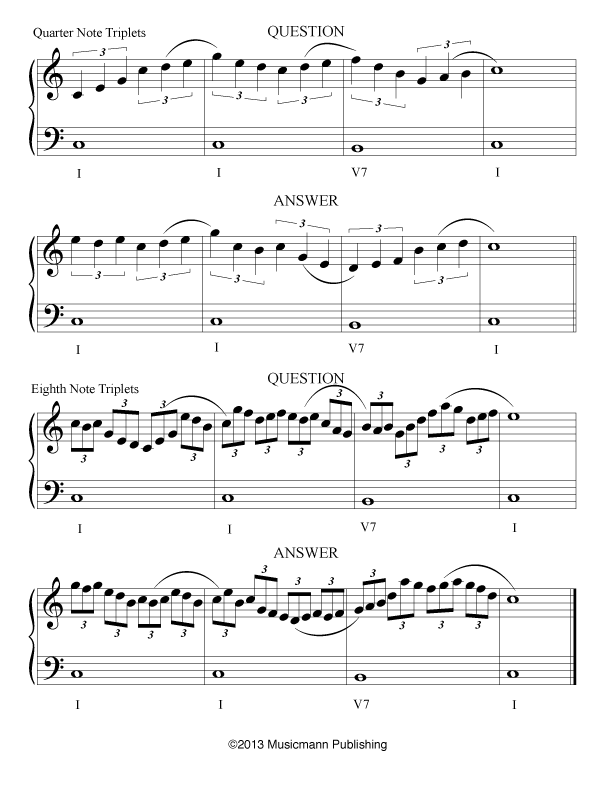
Double or half the time value of the V patterns. Use triplets. Use all manner of rhythm.
Of course, play in all keys, with different time signatures, and vary your accompaniment patterns.
Specifically vary melodic intervals. If you are playing primarily chord tones, then try scale tones. If you are playing without skips, you might specifically try large skips. Try changing registers from middle, to high, to low.
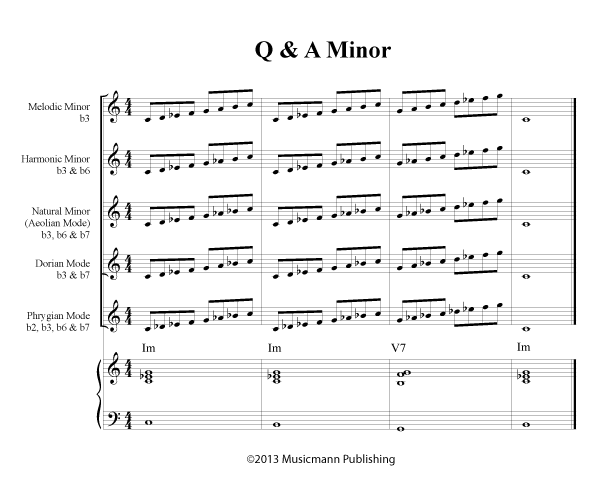
Change the form of the patterns from Question and Answer to, Let’s say, “A B A” form. In short anything goes, except for changing the chord pattern. Once chosen, stick with it. Once the patterns using I and V are mastered, then move on to minor (using the same V7). Then begin experimenting with I IV V I patterns. It is easy to expand into other chord progressions from this beginning exercise. The course of events is that you start with easy I V I progressions using simple accompaniments. Then progress by “opening up” your orchestration of these events. This can be accomplished in steps, perhaps by elaborating on your accompaniment patterns, such as using a Chopin Waltz accompaniment and eventually to not using any set accompaniment pattern at all, but using both hands to provide the motion. This is explained further in the section on modal improvisation.
[membership_download_item_pdf link=”http://jsfp.s3.amazonaws.com/Q-AChPatterns.pdf” + target=”_self”]Question and Answer Chord Patterns[/membership_download_item_pdf]
[membership_download_item_pdf link=”http://jsfp.s3.amazonaws.com/Q-AMelOneRhy.pdf” + target=”_self”]Question and Answer One Melodic Rhythm[/membership_download_item_pdf]
[features_box_blue width=”75%” + border=”2px”]Personal Evaluation
[green_tick_2_list width=”100%”]
- I am familiar with the I I V7 I Question and Answer Chord pattern in all keys.
- I can choose and play one melodic rhythm through the song.
[/green_tick_2_list]
[/features_box_blue]