Practicing Scales 1-2
[features_box_yellow width=”75%” + border=”2px”]Level: Beginning
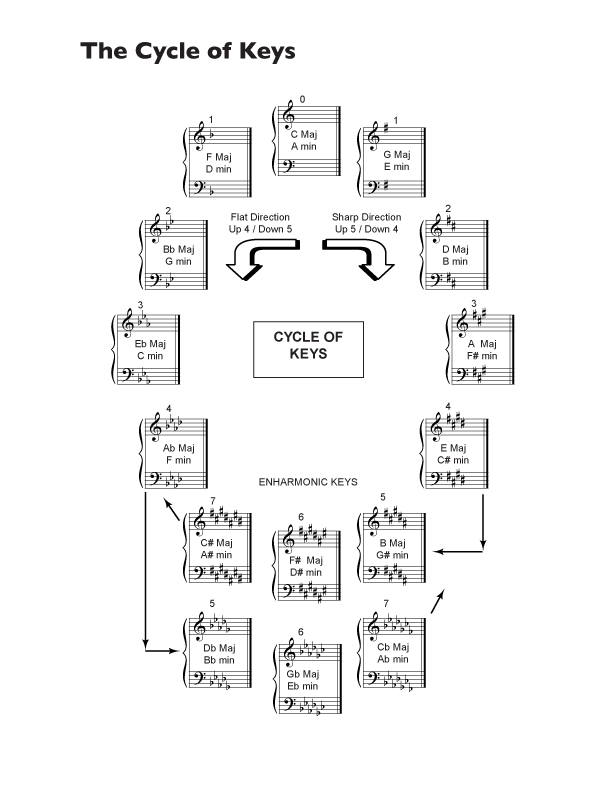
Before studying scales, make sure you have studied the “Five Finger Exercise” (in Beginning Theory). Studying scales is a long-term study. Start now . . . if you don’t already thoroughly know your scales. I suggest that you first learn C G D A & E (they have the same fingering for all). Then, learn Bb Eb Ab & Db (the left hand is a group of 3 & 4). Then Study Cb (B) Gb (F#) & F (the final three scales).
Definitely keep at this until ALL the scales are fluid, effortless and even . . . in all meters. The fingerings should be automatic.
[/features_box_yellow]
It is universally accepted that practicing scales (and arpeggios) is the bedrock of learning an instrument. Strive to develop rhythmic evenness and a beautiful, fluid, legato touch. The fingerings must be totally subconscious. Work on playing scales to a metronome (see video). As you master scales . . . your playing in general will improve.
In studying jazz improvisation, it is also the foundation of music theory. It is essential that you continually assimilate new harmonic sounds in your subconscious to expand your creative improvisation. This is done by mastering new scales.
It is suggested that you start with learning the fingering of a scale in all twelve keys. Once the scale is learned, you can start the process of developing chord structures within that harmony (explained later). Then, begin the process of learning all the modes of the scale (explained later).
Of course, this is a long process. It takes constant practice to develop these “tonalities”. However, as you progress, your “ears” will develop. The language of music will available to you.
The most important scales to master are the Major Scales and the Major Scale Modes. Then work on the Diminished Scales. Once that is accomplished, work on the Melodic Minor Scale and Harmonic Minor Scale and their modes.
Actually, this process can be extended into many many other scales. A wonderful source of scales is the Slonimsky Book of Scales. In addition, there are many jazz books which discuss jazz oriented scales.
I really believe that this is a life-long process. As an improviser, you are always seeking to place new tonalities into your subconscious. Enjoy the process.
[membership_download_item_pdf link=”http://jsfp.s3.amazonaws.com/Scales-Major1-TwoOctaves.pdf” + target=”_blank”]Major Scales – Two Octaves C C# Db D[/membership_download_item_pdf]
[membership_download_item_pdf link=”http://jsfp.s3.amazonaws.com/Scales-MajorB – Two Octaves.pdf” + target=”_blank”]Major Scales – Two Octaves Eb E F F#[/membership_download_item_pdf]
[membership_download_item_pdf link=”http://jsfp.s3.amazonaws.com/Scales-Major3-Two Octaves.pdf” + target=”_blank”]Major Scales – Two Octaves Gb G Ab A[/membership_download_item_pdf]
[membership_download_item_pdf link=”http://jsfp.s3.amazonaws.com/Scales-MajorD Two Octaves.pdf”]Major Scales – Two Octaves Bb B Cb[/membership_download_item_pdf]
[membership_download_item_pdf link=”http://jsfp.s3.amazonaws.com/Scales-MelMinor1-Two Octaves.pdf” + target=”_blank”]Melodic Minor Scales – Two Octaves C C# Db[/membership_download_item_pdf]
[membership_download_item_pdf link=”http://jsfp.s3.amazonaws.com/Scales-MelMinor2-Two Octaves.pdf” + target=”_blank”]Melodic Minor Scales – Two Octaves Eb E F F#[/membership_download_item_pdf]
[membership_download_item_pdf link=”http://jsfp.s3.amazonaws.com/Scales-MelMinor3-Two Octaves.pdf” + target=”_blank”]Melodic Minor Scales – Two Octaves Gb G Ab A[/membership_download_item_pdf]
[membership_download_item_pdf link=”http://jsfp.s3.amazonaws.com/Scales-MelMinor4-Two Octaves.pdf” + target=”_blank”]Melodic Minor Scales – Two Octaves Bb B Cb[/membership_download_item_pdf]
[membership_download_item_pdf link=”http://jsfp.s3.amazonaws.com/Scales-HarMinor1a-Two Octaves.pdf” + target=”_blank”]Harmonic Minor Scales – Two Octaves C C# Db D[/membership_download_item_pdf]
[membership_download_item_pdf link=”http://jsfp.s3.amazonaws.com/Scales-HarMinor2a-Two Octaves.pdf” + target=”_blank”]Harmonic Minor Scales – Two Octaves Eb E F F#[/membership_download_item_pdf]
[membership_download_item_pdf link=”http://jsfp.s3.amazonaws.com/Scales-HarMinor3a-Two Octaves.pdf” + target=”_blank”]Harmonic Minor Scales – Two Octaves Gb G Ab A[/membership_download_item_pdf]
[membership_download_item_pdf link=”http://jsfp.s3.amazonaws.com/Scales-HarMinor4a-Two Octaves.pdf” + target=”_blank”]Harmonic Minor Scales – Two Octaves Bb B Cb[/membership_download_item_pdf]
[features_box_blue width=”75%” + border=”2px”]Personal Evaluation[green_tick_2_list width=”100%”]
- I can play the scales with rhythmic evenness.
- I can play the scales with a beautiful legato touch.
- My fingerings are automatic.
- Practicing scales is part of my daily practice.
[/green_tick_2_list][/features_box_blue]