Diminished Chord Exercise 5-2

Diminished Chord Exercise 5-2

[features_box_yellow width=”75%” + border=”2px”]Level:  Intermediate/Advanced

Learn this lesson after having a basic understanding of diminished scales and chords.[/features_box_yellow]

video
play-sharp-fill

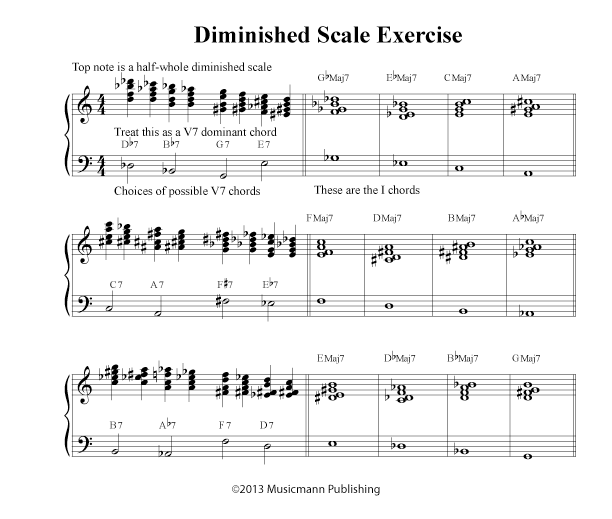
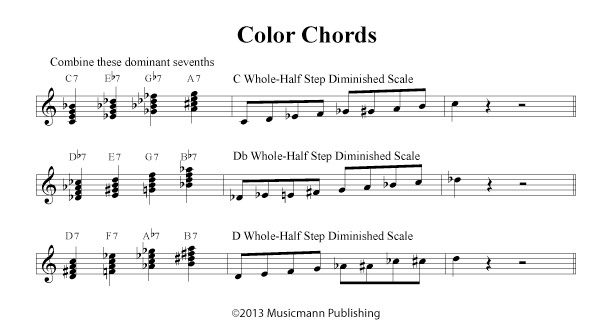
This is an interesting and easy way to learn and use the diminished scale and chords.  If you are playing a diminished seventh . . . move your top two notes up a whole step.  Start from that position, then move down to the original diminished seventh.  See the video and PDF for a demonstration.

DimScEx

ScalesDimColorC

[membership_download_item_pdf link=”http://jsfp.s3.amazonaws.com/DimScEx.pdf” + target=”_self”]Diminished Exercise[/membership_download_item_pdf]

[membership_download_item_pdf link=”http://jsfp.s3.amazonaws.com/ScalesDimColorC.pdf” + target=”_self”]Diminished Color Chord Exercise[/membership_download_item_pdf]

[features_box_blue width=”75%” + border=”2px”]Personal Evaluation

[green_tick_2_list width=”100%”]

  • I understand how Diminished Scales and Color Chords are created.
  • I can easily play the Diminished Scales Exercise in all Keys.
  • I can resolve the Diminished Scales Exercise into four different I chords.
[/green_tick_2_list]

[/features_box_blue]

Sevenths Melodic Chord Exercise 4-6

Sevenths Melodic Chord Exercise 4-6

[features_box_yellow width=”75%” + border=”2px”]Level:  Advanced

Before practicing the Seventh Melodic Chord Exercise . . . make sure that you have thoroughly mastered the Triad Melodic Chord Exercise.[/features_box_yellow]

video
play-sharp-fill

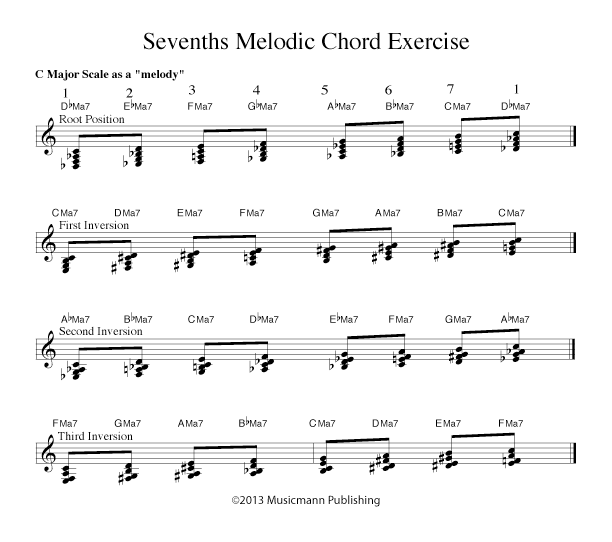
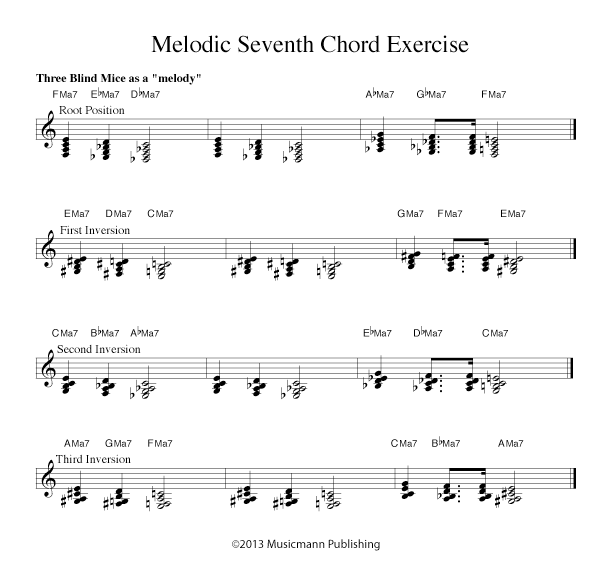
This exercise is the same as the Melodic Triads Exercise – but, this time with Seventh Chords.  You can also use this to harmonize melodies.  This is a way of thinking of “melodies” as “harmonies”.  I always think and hear the top note of a chord as the “melody” of that chord.  Therefore, practice harmonizing a major scale with different types of Seventh Chords.  Remember, each time you change the inversion of the chord, it puts a new melody note on top.

When you finish playing different Major Scales with different Seventh Chords and Inversions, then try to use Seventh Chord harmonies to harmonize simple melodies.

Melodic-ChordsSevMelChordsSevTBM

[membership_download_item_pdf link=”http://jsfp.s3.amazonaws.com/Melodic ChordsSev.pdf” + target=”_self”]Seventh Melodic Chord Exercise[/membership_download_item_pdf]

[membership_download_item_pdf link=”http://jsfp.s3.amazonaws.com/MelChordsSevTBM.pdf” + target=”_self”]Seventh Melodic Chord Exercise w/Three Blind Mice[/membership_download_item_pdf]

[features_box_blue width=”75%” + border=”2px”]Personal Evaluation

[green_tick_2_list width=”100%”]

  • I can quickly play the Melodic Chord Exercise using different Seventh Chords up the Major Scale (in all keys).
  • I can harmonize different simple melodies using Seventh Chords in inversions.
[/green_tick_2_list]

[/features_box_blue]

Seventh Chord Minor Scale Structures 4-5

Seventh Chord Minor Scale Structures 4-5

[features_box_yellow width=”75%” + border=”2px”]Level:  Advanced

Before practicing the Seventh Chords Minor Scale Structures . . . make sure that you have thoroughly mastered the Seventh Chords Major Scale Structures.  Be advised that learning chord structures for the Melodic Minor Scale and Harmonic Minor Scales is a long-term study.  Definitely, keep at it![/features_box_yellow]

video
play-sharp-fill

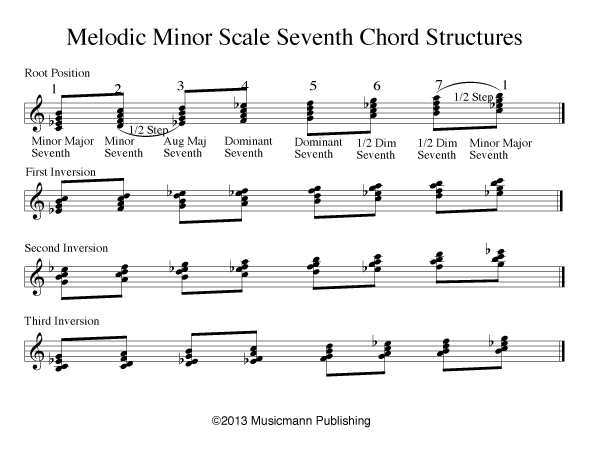
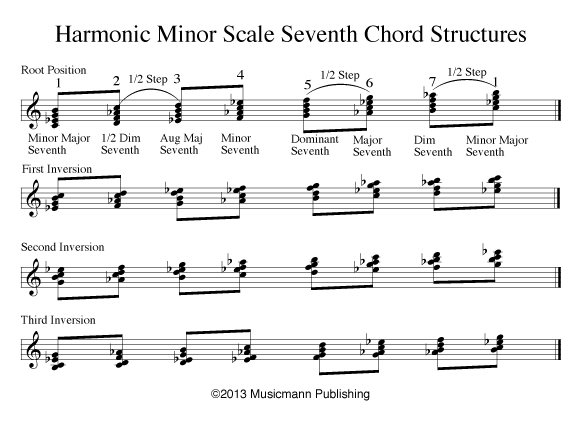
SevMelMinStructSevHarMinStruct

[membership_download_item_pdf link=”http://jsfp.s3.amazonaws.com/SevMelMinStruct.pdf” + target=”_self”]Seventh Chord Melodic Minor Scale Structures[/membership_download_item_pdf]

[membership_download_item_pdf link=”http://jsfp.s3.amazonaws.com/SevHarMinStruct.pdf” + target=”_self”]Seventh Chord Harmonic Minor Scale Structures[/membership_download_item_pdf]

[features_box_blue width=”75%” + border=”2px”]Personal Evaluation

[green_tick_2_list width=”100%”]

  • I have memorized the Seventh Chord types up the Melodic Minor Scale.
  • I can quickly play the Seventh Chords in each inversion up the Melodic Minor Scale in all keys.
  • I have memorized the Seventh Chord types up the Harmonic Minor Scale.
  • I can quickly play the Seventh Chords in each inversion up the Harmonic Minor Scale in all keys.
  • I can play different open voicing Seventh Chord Structures up the Melodic Minor Scale in all keys.
  • I can play different open voicing Seventh Chord Structures up the Harmonic Minor Scale in all keys.
[/green_tick_2_list]

[/features_box_blue]

Seventh Chord Major Scale Structures 4-4

Seventh Chord Major Scale Structures 4-4

[features_box_yellow width=”75%” + border=”2px”]Level:  Intermediate

Before practicing the Seventh Chords Major Scale Structures . . . make sure that you have thoroughly mastered the Triad Major Scale Structures.[/features_box_yellow]

video
play-sharp-fill

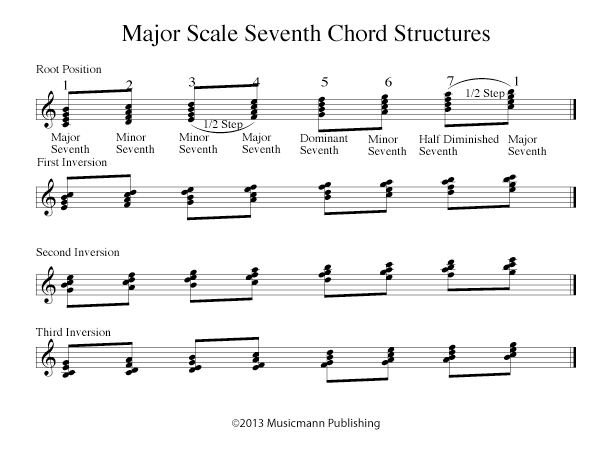
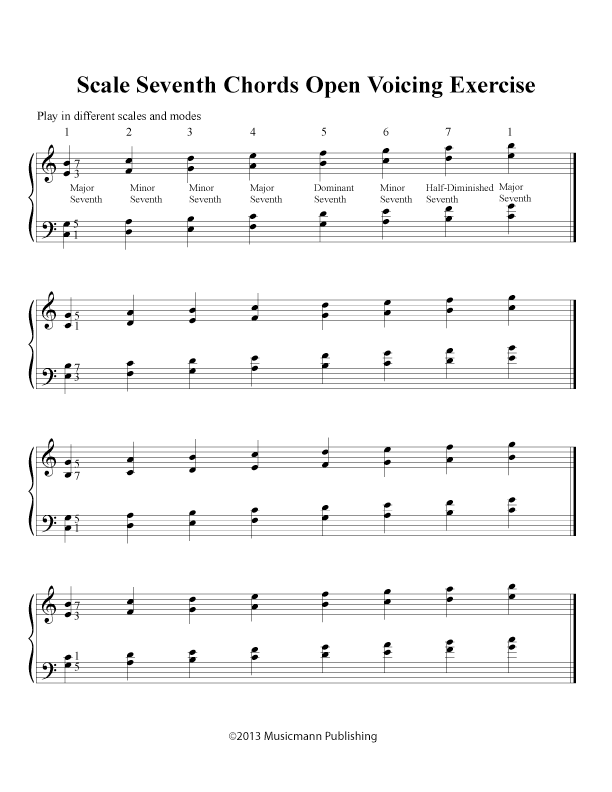
Play seventh chords up the major scale.  You can think of this in two ways.  First you can think of the sharps or flats in the key.  Second, you can think of the type of seventh chord which plays on each step.  In that case the order is always:  major; minor;  minor;  major;  dominant;  minor;  half-diminished.   Once you have played the Seventh Chords in closed positions, then play in all closed position inversions.  After that, practice the Seventh Chords in many Open Voicings.

SevStruct

SevOVStruct

[membership_download_item_pdf link=”http://jsfp.s3.amazonaws.com/SevStruct.pdf” + target=”_self”]Seventh Chord Closed Position Structures[/membership_download_item_pdf]

[membership_download_item_pdf link=”http://jsfp.s3.amazonaws.com/SevOVStruct.pdf” + target=”_self”]Seventh Chord Open Position Structures[/membership_download_item_pdf]

[features_box_blue width=”75%” + border=”2px”]Personal Evaluation

[green_tick_2_list width=”100%”]

  • I have memorized the Seventh Chord types up the Major Scale.
  • I can quickly play the Seventh Chords in each inversion up the Major Scale in all keys.
  • I can play different open voicing Seventh Chord Structures up the Major Scales in all keys.
[/green_tick_2_list]

[/features_box_blue]

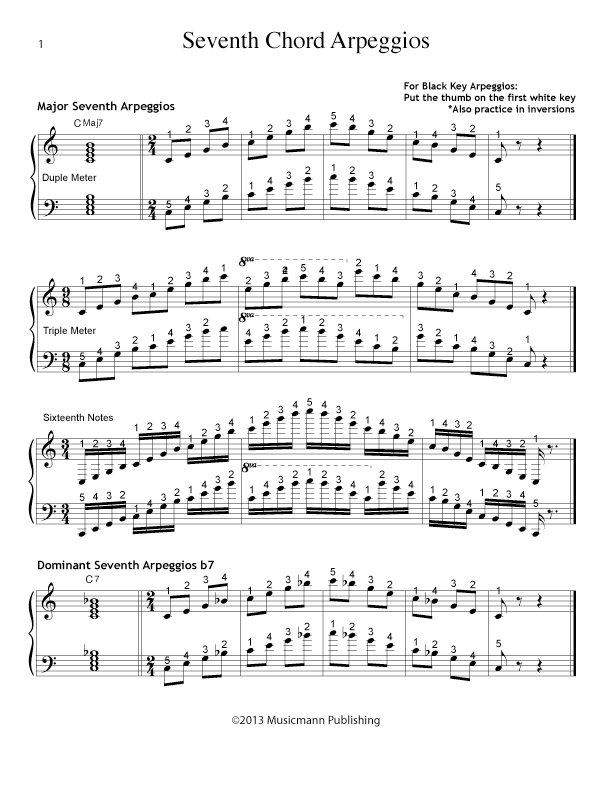
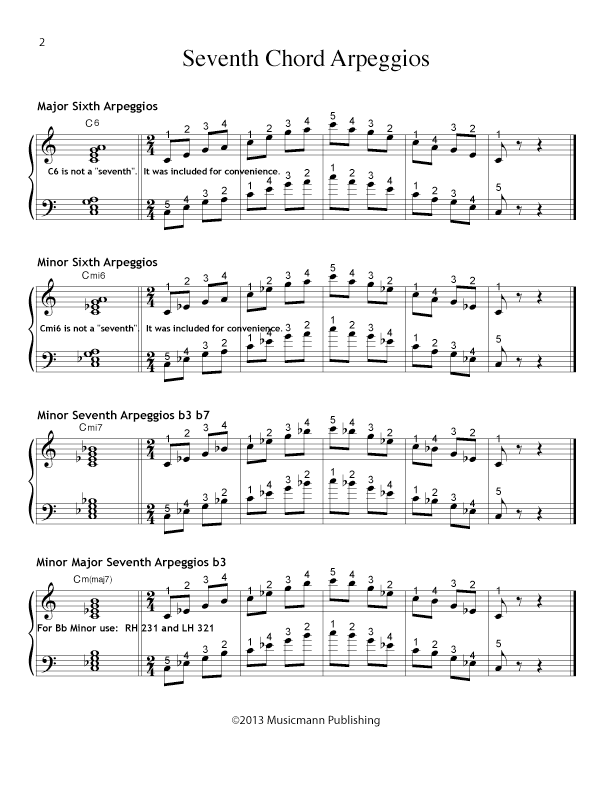
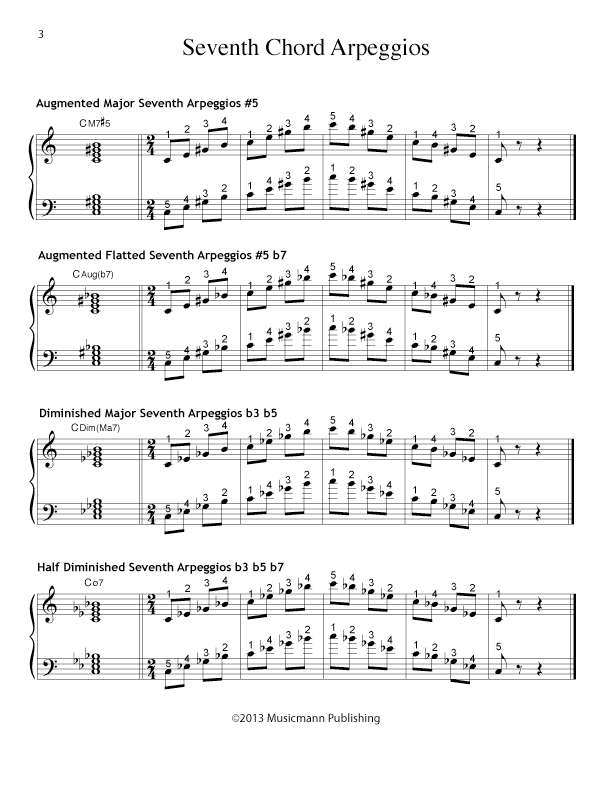
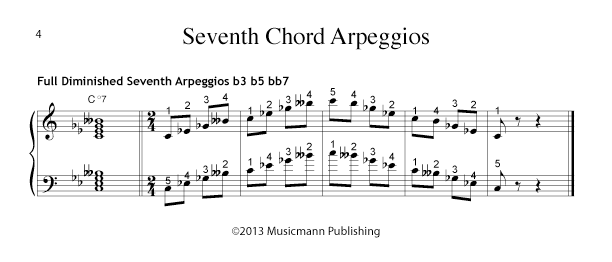
Seventh Chord Arpeggios 4-3

Seventh Chord Arpeggios 4-3

[features_box_yellow width=”75%” + border=”2px”]Level:  Intermediate

Before practicing playing the Seventh Chords Arpeggios . . . make sure that you have thoroughly mastered the Triad Arpeggios.[/features_box_yellow]

video
play-sharp-fill

SevArps1SevArps2SevArps3SevArps4

[membership_download_item_pdf link=”http://jsfp.s3.amazonaws.com/SevArps1.pdf” + target=”_self”]Seventh Chord Arpeggios 1[/membership_download_item_pdf]

[membership_download_item_pdf link=”http://jsfp.s3.amazonaws.com/SevArps2.pdf” + target=”_self”]Seventh Chord Arpeggios 2[/membership_download_item_pdf]

[membership_download_item_pdf link=”http://jsfp.s3.amazonaws.com/SevArps3.pdf”]Seventh Chord Arpeggios 3[/membership_download_item_pdf]

[membership_download_item_pdf link=”http://jsfp.s3.amazonaws.com/SevArps4.pdf”]Seventh Chord Arpeggios 4[/membership_download_item_pdf]

[features_box_blue width=”75%” + border=”2px”]Personal Evaluation

[green_tick_2_list width=”100%”]

  • I practice the all the Sevenths Arpeggios.
[/green_tick_2_list]

[/features_box_blue]

Seventh Chords Around Cycle of Keys 4-1

Seventh Chords Around the Cycle of Keys 4-1

[features_box_yellow width=”75%” + border=”2px”]Level:  Intermediate

Before practicing playing the seventh chords around the cycle . . . make sure that you have thoroughly mastered the Cycle of Keys Exercise.[/features_box_yellow]

video
play-sharp-fill

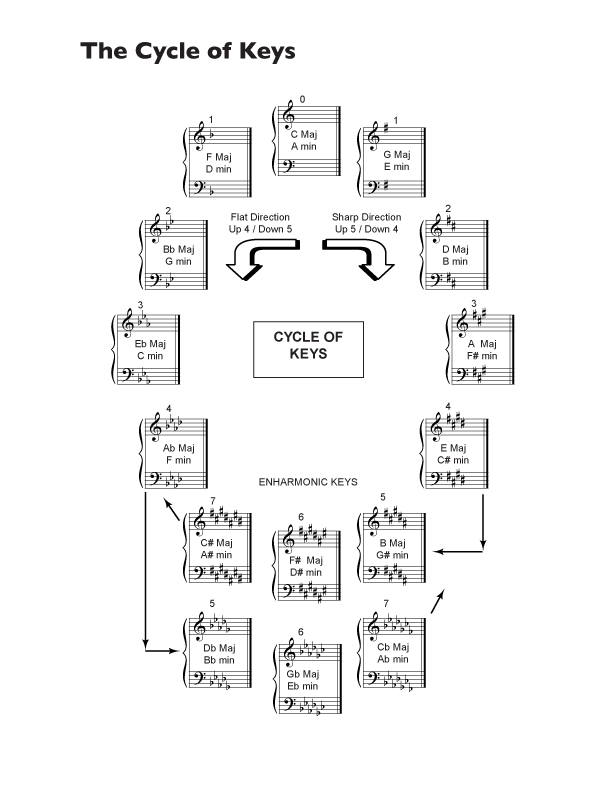
Play each seventh chord around the Cycle of Keys, both in fourths and fifths directions.  Also, play the sevenths up and down chromatically.  Do this also in each inversion of the sevenths.

Sevenths-cycle

CycleChart

[membership_download_item_pdf link=”http://jsfp.s3.amazonaws.com/Sevenths-cycle.pdf” + target=”_self”]Seventh Chords Around Flat Cycle of Keys[/membership_download_item_pdf]

[membership_download_item_pdf link=”http://jsfp.s3.amazonaws.com/CycleChartCnt.pdf” + target=”_self”]Cycle of Keys[/membership_download_item_pdf]

[features_box_blue width=”75%” + border=”2px”]Personal Evaluation

[green_tick_2_list width=”100%”]

  • I can play all the Sevenths (and sixths) around the Cycle of Fourths and Fifths.
  • I can play the Sevenths in all inversions around the Cycle of Fourths and Fifths.
[/green_tick_2_list]

[/features_box_blue]


Closed Triad Progressions 3-6

Closed Triad Progressions 3-6

[features_box_yellow width=”75%” + border=”2px”]Level:  Beginning

Study progressions after you have mastered all the triads and triad inversions.   The progressions are played up 1/2 steps (chromatically) until you can easily and quickly play them in all keys and all inversions.  Then, move on to master the open voicings progressions. [/features_box_yellow]

video
play-sharp-fill
video
play-sharp-fill
video
play-sharp-fill

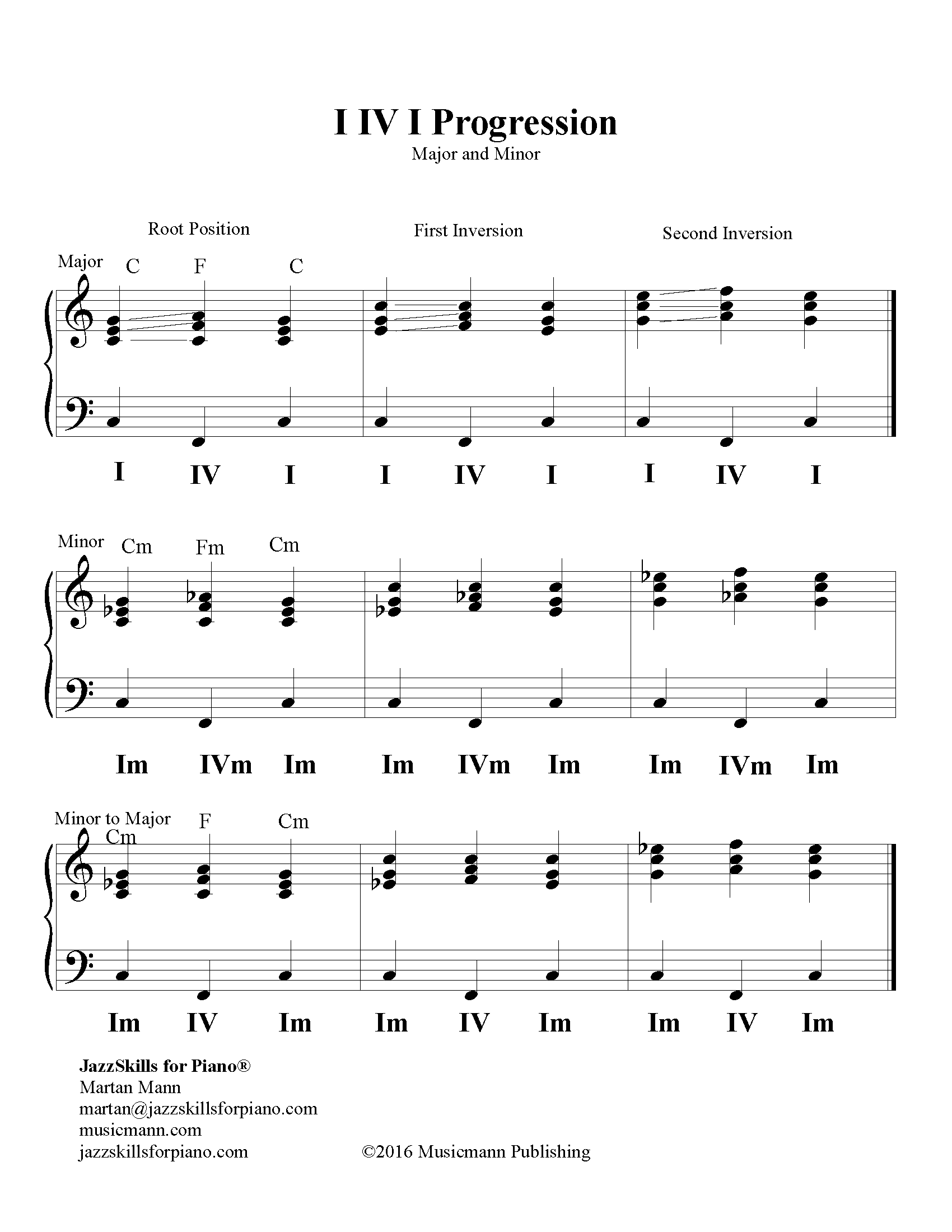
Pianists have a tendency to “bounce around” the keyboard when playing chord to chord.  It is much more musical if you “orchestrate” or use “voice-leading” when moving from chord to chord.  This is more like arranging for strings, voices, horns, etc.

The best way to train yourself to think this way is to practice chord progressions.  In the beginning, start with the most basic progression, I V7 I.  In classical harmony, this progression, or cadence is called the “authentic cadence”, because it is the strongest of all cadences.  In other words, the V7 is a very “restless” chord, which strongly pulls to the “stable” I chord.  This is labeled V to I because it starts with the fifth degree of the major scale.  It is a “five-seventh” (V7) because we count the degrees of the chord, 1-3-5-b7. (See Example )

Scale-w_V7-to-I


In playing the I V7 I progression, we prefer to move from a three-note chord (the I chord) to another three-note chord (the V7).  To accomplish this we leave out the fifth degree of the V7 chord.  Practice the I V7 I progression in all keys, major and minor, usually by moving up and down chromatically.  Also practice all the inversions.  It is also helpful to see the movement of the voice leading.   For instance:  in the root position, the root moves down a half-step, the third moves up a half-step and the fifth stays the same.  Practice the I V7 I progression until you can play it quickly.  (See Example)

ProgIV7I


ProgIIVIV7I

Downloads


[features_box_blue width=”75%” + border=”2px”]Personal Evaluation

[green_tick_2_list width=”100%”]

  • I can quickly and easily play the I V7 I progression in all inversions.
  • I can quickly and easily play the I IV I progression in all inversions.
  • I can quickly and easily play the I IV I V7 I progression in all inversions.
  • I can quickly and easily play the I IV V7 I progression in all inversions.
  • I can quickly and easily play the above in minor.
[/green_tick_2_list]

[/features_box_blue]

Major Triad Open Voicings Part 1 3-7

Major Triad Open Voicings Part 1  3-7

[features_box_yellow width=”75%” + border=”2px”]Level:  Intermediate

Study the Major Triad Open Voicings Exercise after you have mastered playing all the triad inversions.  It would also be a good idea to know how to spell all the major scales.

[/features_box_yellow]

video
play-sharp-fill

Up to this point, we have been playing chords in their “closed” position.  That is when the notes are most compact.  However, to develop an orchestrated sound on the piano, it is necessary to “open up” the notes.  There are many ways to do this.  For instance, we can play the chord inversions in their “open” position.

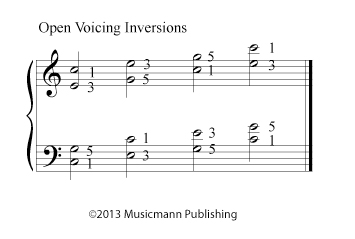
Notice that in the root position, the closed position 1-3-5 is now 1-5-3-1 in the open position.  Move the third up an octave and then double the root.  One way to practice this exercise is to first play the open voicings inversions in each hand separately.  Then put the hands together.  Of course, play in all keys.
OVInvOV-Series-Exercise

Open Voicings Bouncing Exercise

Here is an excellent method to develop your ability to play open voicings.  One of the main issues is to not double the third.  Because of the overtone series, the third sounds “heavy”.  The other voicings sound smooth.

Start by playing two notes in the right hand.  The right hand is used because it allows you to listen to the melody note (the top note).  The right hand will play either a third, sixth, fourth or fifth.  Once you have committed to those intervals in the right hand, you can determine your two notes in the left hand.

For instance, if the right hand plays an interval with a third in it, then do not play a third in the left hand.  Vice versa, if the right hand plays an interval without a third, then you can add in one third in the left hand.

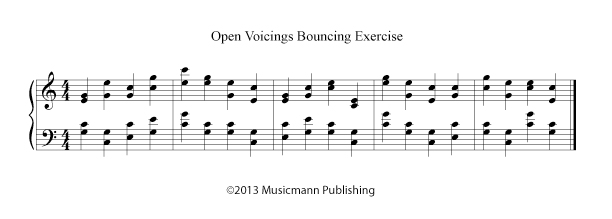
This is called the Open Voicings Bouncing Exercise because you are randomly “bouncing” open voicings triads around the keyboard.  (See Example  )  Eventually, you should be able to do this quickly and effortlessly in all keys, major and minor.
OVexercise[membership_download_item_pdf link=”http://jsfp.s3.amazonaws.com/OVInv.pdf” + target=”_self”]Open Voicings Inversions[/membership_download_item_pdf]

[membership_download_item_pdf link=”http://jsfp.s3.amazonaws.com/OV Series Exercise.pdf” + target=”_self”]Open Voicings Series Exercise[/membership_download_item_pdf]

[membership_download_item_pdf link=”http://jsfp.s3.amazonaws.com/OVexercise.pdf” + target=”_self”]Open Voicings Bouncing Exercise[/membership_download_item_pdf]

[features_box_blue width=”75%” + border=”2px”]Personal Evaluation

[green_tick_2_list width=”100%”]

  • I can quickly and easily play the Open Voicings Inversion Exercise in all keys.
  • I can quickly and easily play the Open Voicings Bouncing Exercise in all keys.
[/green_tick_2_list]

[/features_box_blue]

 

Cycle of Keys w/chords 3-1

Cycle of Keys with chords 3-1

[features_box_yellow width=”75%” + border=”2px”]Level:  Beginning

This is one of the first exercises which utilizes the Cycle.  Play all the triads (and in inversions) around the Cycle.  Do this – until you can play quickly and automatically.  (Don’t forget to learn each inversion around the Cycle.)  Practice “Think before moving” to learn this.  [/features_box_yellow]

video
play-sharp-fill

Once you have mastered playing “up four/down five” and “up five/down four” . . . then play this using major, minor, augmented and diminished triads in all inversions.

[features_box_blue width=”75%” + border=”2px”]Personal Evaluation

[green_tick_2_list width=”100%”]

  • I can quickly and easily play all the Triads around the Cycle in both flat and sharp directions.
  • I can quickly play all the Triads and their inversions “Up four, down five” in both directions.
[/green_tick_2_list]

[/features_box_blue]
Cycle of Keys Introduction 2-4

Cycle of Keys Introduction 2-4

[features_box_yellow width=”75%” + border=”2px”]Level:  Beginning

The Cycle of Keys is really important to master in the beginning of your study.  There will be many exercises to follow which will ask you to play around the Cycle.  Also, this is essential information to know to continue your study of music theory. [/features_box_yellow]

video
play-sharp-fill

The Cycle of Keys (sometimes called the Cycle of Fourths or Cycle of Fifths) is crucial for you to memorize.  It will help you to understand advanced jazz harmony.  I use many exercises which have the student playing around the cycle.  Learn it well.


CycleChart[membership_download_item_pdf link=”http://jsfp.s3.amazonaws.com/Cycle of Keys Sig.pdf” + target=”_self”]Cycle of Keys Chart[/membership_download_item_pdf]

[membership_download_item_pdf link=”http://www.downloadlink.com” + target=”_self”]Your Download Item Name Here[/membership_download_item_pdf]

[features_box_blue width=”75%” + border=”2px”]Personal Evaluation

[green_tick_2_list width=”100%”]

  • I have a good basic understanding of the Cycle of Keys after viewing the video.
[/green_tick_2_list]

[/features_box_blue]