Melodic Chord Exercise Part 1 3-4

Melodic Chord Exercise Part 1  3-4

[features_box_yellow width=”75%” + border=”2px”]Level:  Intermediate

Study the Melodic Chord Exercise after you have mastered playing all the triad inversions.  It would also be a good idea to know how to spell all the major scales.

[/features_box_yellow]

video
play-sharp-fill

This is a “crazy” way to add new harmonies into your ears and to master the major triad.  I warn you, it will sound strange, but the result is that you will start hearing harmonies in fresh ways. This is also a great way to learn the minor triads augmented triads, sevenths or any chord. Also it teaches you to hear a melody in a harmonic way.  In other words, if you play a single note melody, the tendency is to only hear the melody note which you are playing. However, implied in that melody note are hundreds, maybe thousands of ways to harmonize underneath it. This teaches you to hear harmonies from the top down.

Start with any major triad in the root position.  Pick a simple melody of your choice  (i.e. major scale or a nursery rhyme, etc.) and harmonize that melody using only the root position major triads. The melody will entirely be harmonized with major triads. This makes the fifth of the triad the melody note.

Next harmonize the same melody with the major triad in the first inversion. Now the melody note (on top) will be the 3rd of the triad.

Now use the triad in the 2nd inversion. The melody note will now be harmonized by the root of the triad.

Next mix and match any triad in any random order which you choose. This means that any melody note has three possible chord choices depending whether or not you are using the root, third, or fifth of the major triad. (I know, it doesn’t sound very musical.)

[membership_download_item_pdf link=”http://jsfp.s3.amazonaws.com/Melodic Chords New.pdf” + target=”_self”]Melodic Chord Exercise[/membership_download_item_pdf]


[features_box_blue width=”75%” + border=”2px”]Personal Evaluation

[green_tick_2_list width=”100%”]

  • I can quickly and easily play all the the Melodic Chord Exercise Part 1 in all keys.
[/green_tick_2_list]

[/features_box_blue]


Minor Scale Structures 3-3

Minor Scale Structures 3-3

[features_box_yellow width=”75%” + border=”2px”]Level:  Intermediate/Advanced

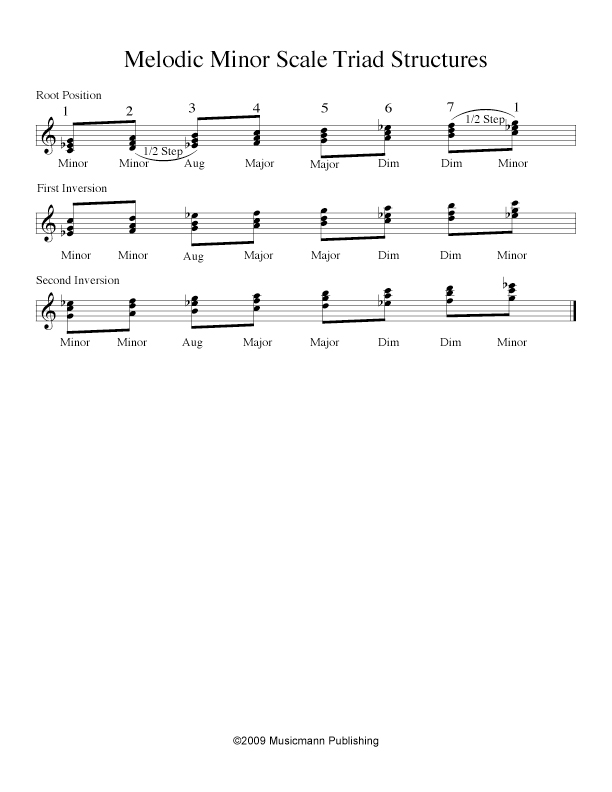
This is an excellent way to deeply learn the melodic and harmonic minor scales, it’s triads and the triad inversions.  A melodic minor scale (major scale with a b3) has seven notes (with half steps at 2&3 and 7&8).   If you number the notes in order, the triad types are as follows:  minor, diminished, augmented, minor, major, major, diminished.  Learn the melodic minor triads in all keys.  Then play the inversions up the melodic minor scale in all keys.

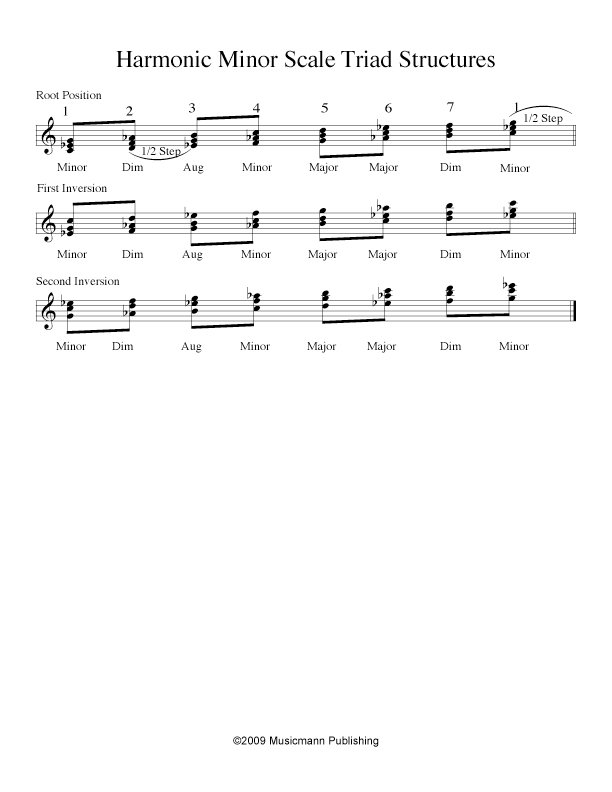
A harmonic minor scale (major scale with a b3 & b6) has seven notes (with half steps at 2&3, 5&6 and 7&8).   If you number the notes in order, the triad types are as follows:  minor, minor, augmented, major, major, diminished, diminished.  Learn the harmonic minor triads in all keys.  Then play the inversions up the melodic minor scale in all keys.

Learn the major chord structures first . . . followed by the melodic minor chord structures . . . and then the harmonic minor structures.  This is a long-term study.  Keep at it.

[/features_box_yellow]

video
play-sharp-fill

Scalew-melminortriads

Scalew-harmminortriads

[membership_download_item_pdf link=”http://jsfp.s3.amazonaws.com/Scalew-melminortriads.pdf” + target=”_self”]Melodic Minor Scale Structures[/membership_download_item_pdf]

[membership_download_item_pdf link=”http://jsfp.s3.amazonaws.com/Scalew-harmminortriads.pdf” + target=”_self”]Harmonic Minor Scale Structures[/membership_download_item_pdf]


[features_box_blue width=”75%” + border=”2px”]Personal Evaluation

[green_tick_2_list width=”100%”]

  • I can quickly and easily play all the Triads up the Melodic Minor Scale.
  • I can quickly and easily play all the Triads up the Harmonic Minor Scale.
[/green_tick_2_list]

[/features_box_blue]

Major Scale Structures 3-2

Major Scale Structures 3-2

[features_box_yellow width=”75%” + border=”2px”]Level:  Beginning/Intermediate

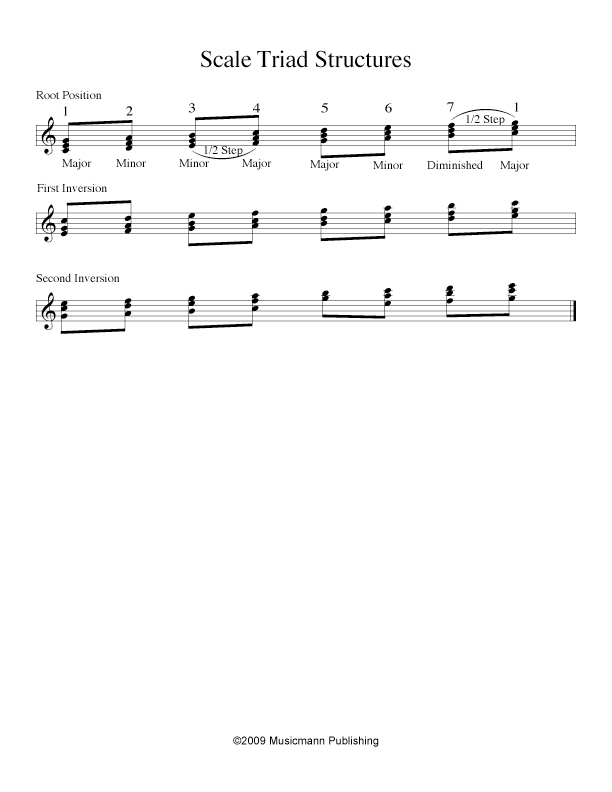
This is an excellent way to deeply learn the major scales, it’s diatonic triads and the triad inversions.  A major scale has seven notes (with half steps at 3&4 and 7&8).   If you number the notes in order, the triad types are as follows:  major, minor, minor, major, major, minor, diminished.  Learn the triads in all major keys.  Then play the inversions up the major scale in all keys.

Take your time.  Learn the major scale chords well before studying the melodic minor and harmonic minor structures.

[/features_box_yellow]

video
play-sharp-fill

Scalew_triads

[membership_download_item_pdf link=”http://jsfp.s3.amazonaws.com/Scalew_triads.pdf” + target=”_self”]Major Scale Structures[/membership_download_item_pdf]

[features_box_blue width=”75%” + border=”2px”]Personal Evaluation

[green_tick_2_list width=”100%”]

  • I can quickly and easily play all the Triads up the Major Scale.
  • I can state the order of triad chord types going up the Major Scale.
[/green_tick_2_list]

[/features_box_blue]

Section 3: Triad Study

Section 3:  Triad Study

It’s time to get intimate with triads.  Why?  Triads are the foundation of all chords.  It’s vitally important to know triads inside and out.  Once that is done, then you can move on to understanding sevenths, ninths, etc.

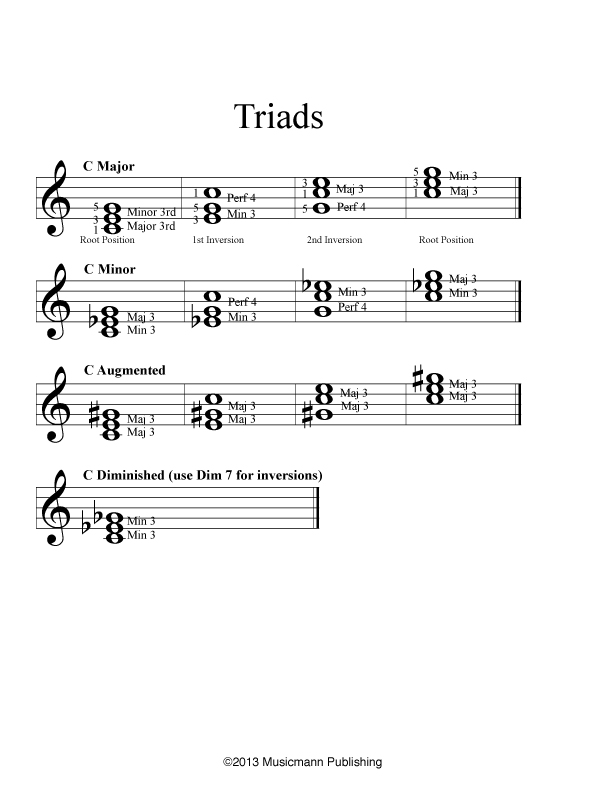
When analyzing triads, look to their structures.  For instance:  a major triad is composed of two thirds:  a major third on the bottom and a minor third on top.  The minor triad is a minor third on the bottom and a major third on top.  Augmented is two major thirds and diminished is two minor thirds.

When you look at the inversions, also analyze their structures.  For instance:  a major third in the first inversion is a minor third on the bottom and a perfect fourth on the top.  You can analyze all chords in this way.

Triads

[membership_download_item_pdf link=”http://jsfp.s3.amazonaws.com/Triads.jpg” + target=”_self”]Triads and Inversions[/membership_download_item_pdf]

Why do we do this?  We want to see structures in all music.  Once we automatically see music in structures, then we can easily play in all keys.  All music is numbers.  It’s important that we automatically see the numbers – and the structures.

This is a long-term study.  Take your time to learn triads  . . . before continuing on to learn the sevenths!

[features_box_blue width=”75%” + border=”2px”]Personal Evaluation

[green_tick_2_list width=”100%”]

  • I can see and play all the Triads and Inversions in their structures.
[/green_tick_2_list]

[/features_box_blue]

Learning Intervals 2-1

Learning Intervals 2-1

[features_box_yellow width=”75%” + border=”2px”]Level:  Beginning

If you a beginning your music study, it is strongly suggested that you quickly become familiar with all of the intervals.  As you improve learning jazz theory, you will need this knowledge in your subconscious.  Keep at it until you can play, sing and hear any interval.  Don’t give up on this study until intervals are totally subconscious.  [/features_box_yellow]

video
play-sharp-fill

Learning to think in intervals is really the core of improvisation. This enables you to hear in all twelve keys (in numbers) and to play on the piano what you are hearing in your head. Classical pianists often have a difficult time with “playing-what-they-are-hearing” simply because they most often think of the written notes that they are playing.  In other words, they don’t think in intervals.  However, jazz players usually have no problem in hearing, singing and thinking in intervals and numbers.  Thinking in numbers actually reduces the complexity of music by one twelfth (all keys are the same) and gives you the ability to play musical ideas in all keys.

The best way that I know to learn to become familiar with intervals is to take them one at a time and learn each interval thoroughly.  It is suggested that you start with the diatonic intervals, which are the intervals within the major scale.  Then move to the chromatic intervals.

One method to start thinking this way is to find a song which starts with a particular interval.  Then use that song to help identify the interval.  Remember, the intervals should be learned both up and down.  Also practice singing the intervals.  Take a simple melody.  Analyze the intervals in the song.  Transpose it in all twelve keys.  This will  quickly teach you to think in intervals.  Every time you play two notes, either simultaneously (as a chord), or one after another (as in a melody), think of the interval between the notes.  This is part of the language of music.

Here are some additional suggestions to help you to become familiar with intervals:

  • Here is an exercise that I call:  “Think before moving” (See the video).  It starts by choosing a specific interval to study.  Then play that interval and hold the keys down.  While holding, look for the same interval starting on another note.  Then, replay the original interval and quickly jump to the second interval.  Once this is easy, add more quick jumps.  The key element is to think ahead and then jump quickly and automatically (see video).
  • Take a particular interval, for example a perfect fourth, and compose (improvise) a simple composition using only that interval.  Composers such as Debussy and Chopin have explored this possibility in their Preludes and Etudes with beautiful and creative results.  Try constructing chords and textures by mixing two intervals (or try three). Try harmonizing a simple melody using only your chosen interval.
  • After you become familiar with each interval, then start testing your abilities at distinguishing between different intervals.  Have a friend test you by playing, for instance, major thirds and minor thirds, or possibly perfect fourths and fifths. This can be done melodically (one note at a time) or harmonically (both notes played together).
  • Take a short melodic idea, three, four or five notes. Analyze the intervals, note to note. Then play this as a sequence, modulating to different keys.  Jazz musicians often do this by playing identical musical ideas (licks) back and forth.  Once you analyze the intervals, you can play those intervals in different keys.
  • Start now to take simple melodic ideas off of recordings. This is called transcription.  Listen to the melody, analyze the intervals and either play the ideas or write them down. (All keys, please!)

This is a long-term study.  Start now . . . and continue throughout your studies.

[membership_download_item_pdf link=”http://jsfp.s3.amazonaws.com/Intervals-Dia copy1.pdf” + target=”_blank”]Diatonic Intervals[/membership_download_item_pdf][membership_download_item_pdf link=”http://jsfp.s3.amazonaws.com/Intervals-ChromT.pdf” + target=”_blank”]Chromatic Intervals[/membership_download_item_pdf]

[features_box_blue width=”75%” + border=”2px”]

[green_tick_2_list width=”100%”]

  • I have mastered hearing, playing and singing all of the intervals.
  • I have tried the “Think Before Moving Exercise” using all the intervals.
  • I can sing intervals that I hear in my head.
  • I can recognize intervals played by another.
[/green_tick_2_list]

[/features_box_blue].